Question: Question - What is your view on positive vs. negative business effects (i.e., on balance, is the result of Citizens United good or bad for
Question -
- What is your view on positive vs. negative business effects (i.e., on balance, is the result of Citizens United good or bad for businesses and why)?
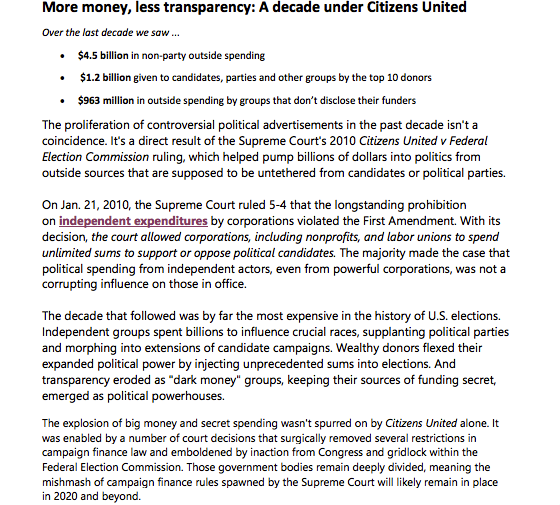
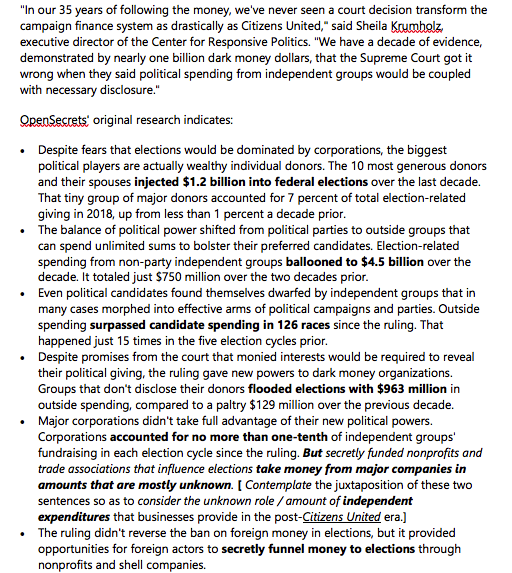
More money, less transparency: A decade under Citizens United Over the last decade we saw... $4.5 billion in non-party outside spending $1.2 billion given to candidates, parties and other groups by the top 10 donors $963 million in outside spending by groups that don't disclose their funders The proliferation of controversial political advertisements in the past decade isn't a coincidence. It's a direct result of the Supreme Court's 2010 Citizens United v Federal Election Commission ruling, which helped pump billions of dollars into politics from outside sources that are supposed to be untethered from candidates or political parties. On Jan. 21, 2010, the Supreme Court ruled 5-4 that the longstanding prohibition on independent expenditures by corporations violated the First Amendment. With its decision, the court allowed corporations, including nonprofits, and labor unions to spend unlimited sums to support or oppose political candidates. The majority made the case that political spending from independent actors, even from powerful corporations, was not a corrupting influence on those in office. The decade that followed was by far the most expensive in the history of U.S. elections. Independent groups spent billions to influence crucial races, supplanting political parties and morphing into extensions of candidate campaigns. Wealthy donors flexed their expanded political power by injecting unprecedented sums into elections. And transparency eroded as "dark money" groups, keeping their sources of funding secret, emerged as political powerhouses. The explosion of big money and secret spending wasn't spurred on by Citizens United alone. It was enabled by a number of court decisions that surgically removed several restrictions in campaign finance law and emboldened by inaction from Congress and gridlock within the Federal Election Commission. Those government bodies remain deeply divided, meaning the mishmash of campaign finance rules spawned by the Supreme Court will likely remain in place in 2020 and beyond. . "In our 35 years of following the money, we've never seen a court decision transform the campaign finance system as drastically as Citizens United," said Sheila Kaumholz, executive director of the Center for Responsive Politics. "We have a decade of evidence, demonstrated by nearly one billion dark money dollars, that the Supreme Court got it wrong when they said political spending from independent groups would be coupled with necessary disclosure." OpenSecrets original research indicates: Despite fears that elections would be dominated by corporations, the biggest political players are actually wealthy individual donors. The 10 most generous donors and their spouses injected $1.2 billion into federal elections over the last decade. That tiny group of major donors accounted for 7 percent of total election-related giving in 2018, up from less than 1 percent a decade prior. The balance of political power shifted from political parties to outside groups that can spend unlimited sums to bolster their preferred candidates. Election-related spending from non-party independent groups ballooned to $4.5 billion over the decade. It totaled just $750 million over the two decades prior. Even political candidates found themselves dwarfed by independent groups that in many cases morphed into effective arms of political campaigns and parties. Outside spending surpassed candidate spending in 126 races since the ruling. That happened just 15 times in the five election cycles prior. Despite promises from the court that monied interests would be required to reveal their political giving, the ruling gave new powers to dark money organizations. Groups that don't disclose their donors flooded elections with $963 million in outside spending, compared to a paltry $129 million over the previous decade. Major corporations didn't take full advantage of their new political powers. Corporations accounted for no more than one-tenth of independent groups' fundraising in each election cycle since the ruling. But secretly funded nonprofits and trade associations that influence elections take money from major companies in amounts that are mostly unknown. [ Contemplate the juxtaposition of these two sentences so as to consider the unknown role / amount of independent expenditures that businesses provide in the post-Citizens United era.) The ruling didn't reverse the ban on foreign money in elections, but it provided opportunities for foreign actors to secretly funnel money to elections through nonprofits and shell companies









 Study Help