



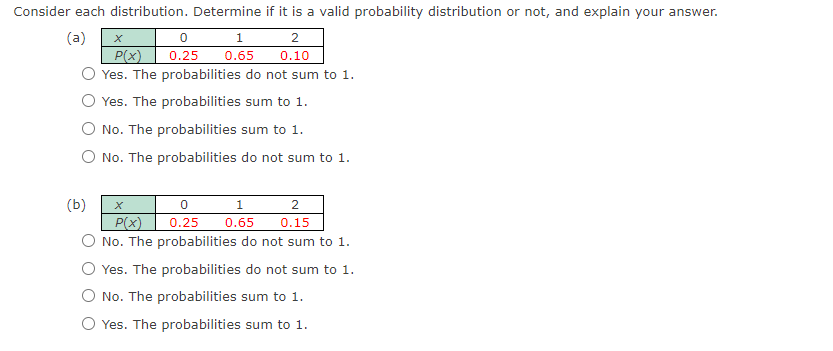
Question: Question1 contains Two Parts: Consider each distribution. Determine if it is a valid probability distribution or not, and explain your answer. (a) X 0 1
Question1 contains Two Parts:
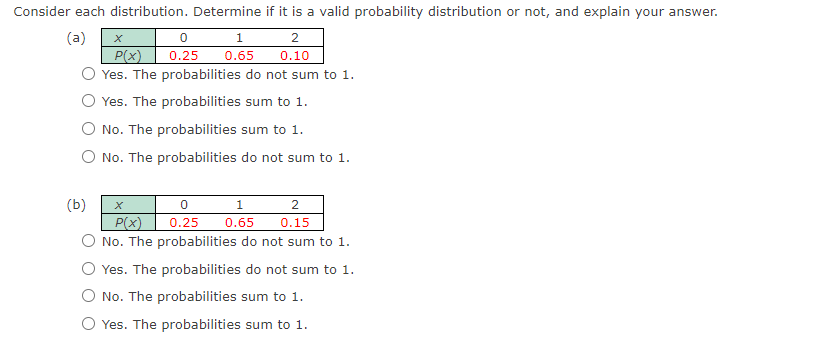
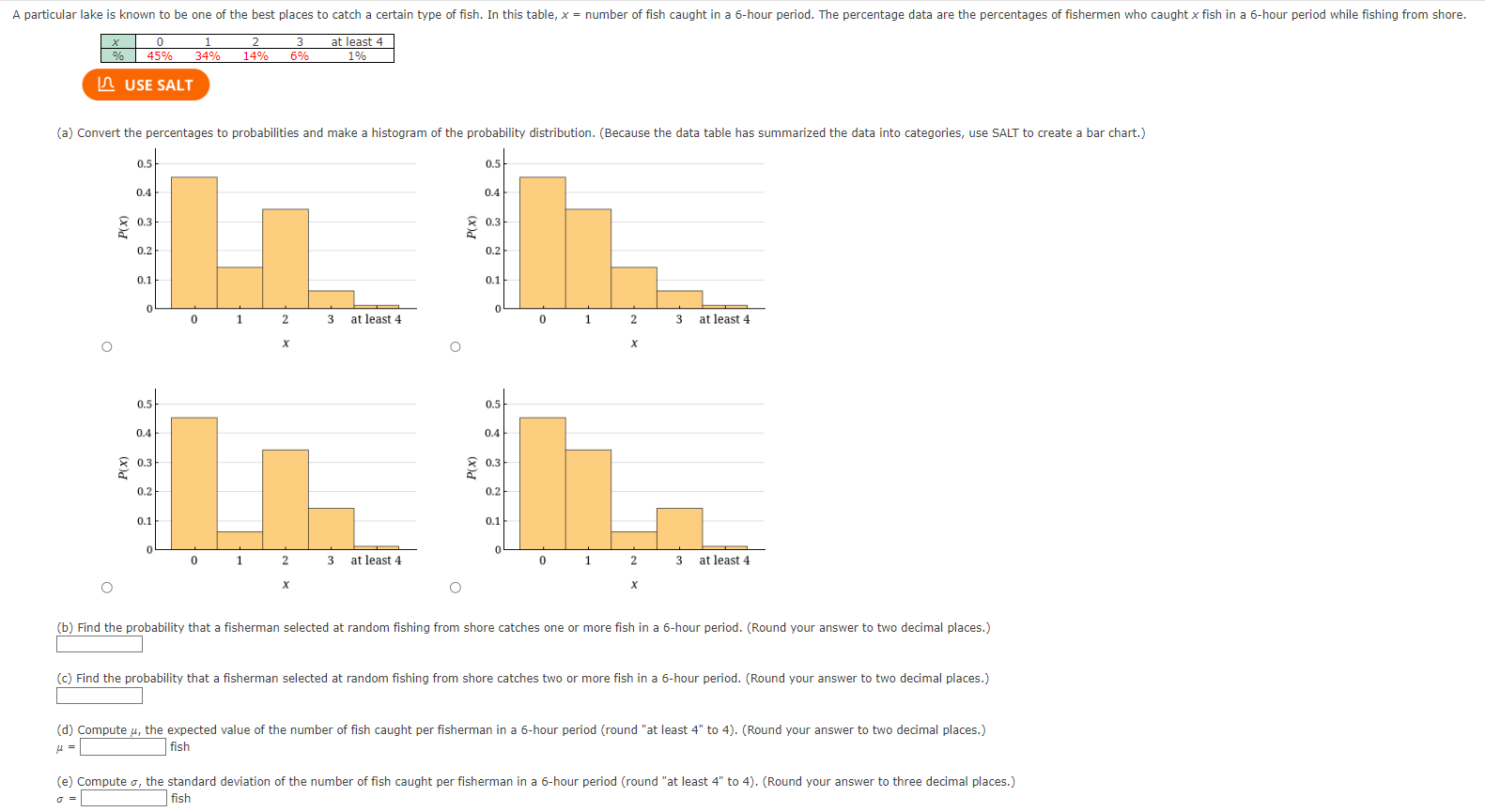
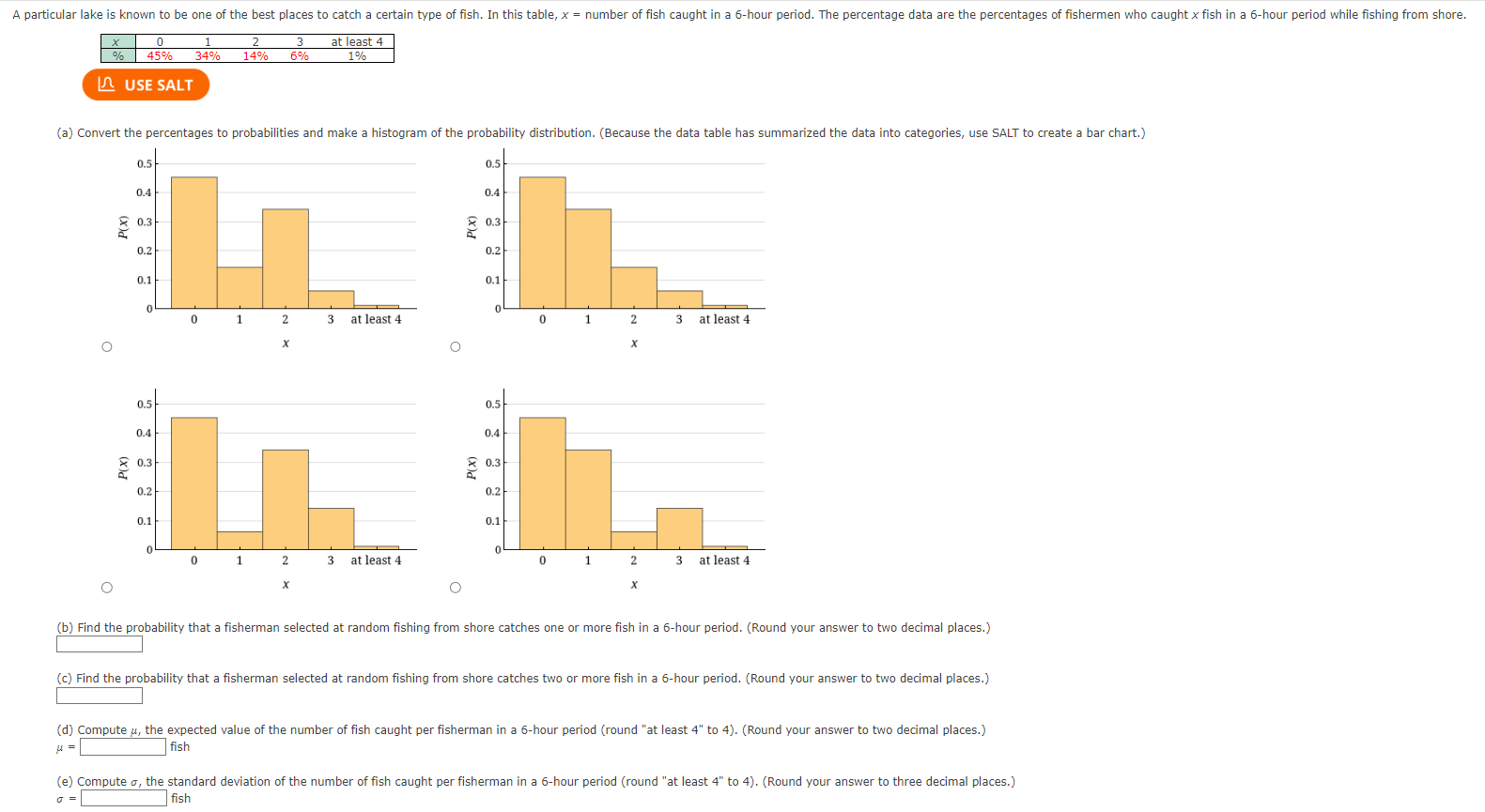
Consider each distribution. Determine if it is a valid probability distribution or not, and explain your answer. (a) X 0 1 2 P(x ) 0.25 0.65 0.10 O Yes. The probabilities do not sum to 1. O Yes. The probabilities sum to 1. O No. The probabilities sum to 1. O No. The probabilities do not sum to 1. (b) X 0 1 2 P(X) 0.25 0.65 0.15 O No. The probabilities do not sum to 1. O Yes. The probabilities do not sum to 1. O No. The probabilities sum to 1. O Yes. The probabilities sum to 1.A particular lake is known to be one of the best places to catch a certain type of fish. In this table, x = number of fish caught in a 6-hour period. The percentage data are the percentages of fishermen who caught x fish in a 6-hour period while fishing from shore. X 0 3 at least 4 % 45% 34% 14% 6% 1% USE SALT (a) Convert the percentages to probabilities and make a histogram of the probability distribution. (Because the data table has summarized the data into categories, use SALT to create a bar chart.) 0.5 0.5 0.4 0.4 0.3 0.3 P(X 0.2 0.2 0.1 0.1 N 3 at least 4 0 2 3 at least 4 x O X 0.5 0.5 0.4 0.4 0.3 P(X) 2 0.3 0.2 0.2 0.1 0.1 N 3 at least 4 2 3 at least 4 O O (b) Find the probability that a fisherman selected at random fishing from shore catches one or more fish in a 6-hour period. (Round your answer to two decimal places.) (c) Find the probability that a fisherman selected at random fishing from shore catches two or more fish in a 6-hour period. (Round your answer to two decimal places.) (d) Compute y, the expected value of the number of fish caught per fisherman in a 6-hour period (round "at least 4" to 4). (Round your answer to two decimal places.) H = fish (e) Compute o, the standard deviation of the number of fish caught per fisherman in a 6-hour period (round "at least 4" to 4). (Round your answer to three decimal places.) fish
Step by Step Solution
There are 3 Steps involved in it

Get step-by-step solutions from verified subject matter experts