Question: Question1: Question2: Question3: Question4: Demand is Normally distributed with mean of 6 per week and a weekly variance of 11 . The ordering cost is

Question1:Question1: Question2: Question3: Question4:

Question2:Question1: Question2: Question3: Question4:Question3:Question1: Question2: Question3: Question4:Question4:

Question1: Question2: Question3: Question4:

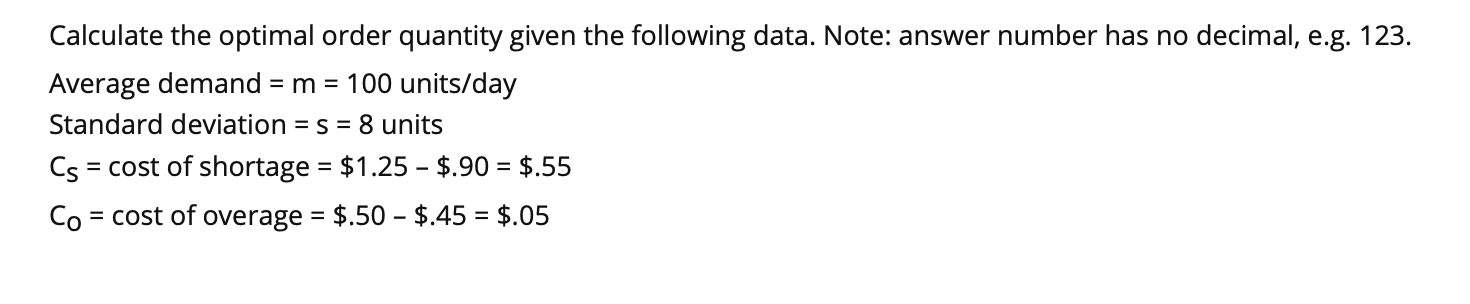
Demand is Normally distributed with mean of 6 per week and a weekly variance of 11 . The ordering cost is $40.29. Lead time is 2 weeks. Shortages cost an estimated $2.35 per unit short to expedite orders to appease customers. The holding cost is $6.55 per week. Estimate the stockout risk if the target service level is 0.11. (Enter a number with two decimal places, e.g. 0.12 ). Demand is Normally distributed with mean of 47 per week and a weekly variance of 6 . The ordering cost is $66.92. Lead time is 8 weeks. Shortages cost an estimated $4.63 per unit short to expedite orders to appease customers. The holding cost is $4.88 per week. What is the average demand during the lead time? (Enter your answer number with no decimal). Demand is Normally distributed with mean of 28 per week and a weekly variance of 9 . The ordering cost is $36.41. Lead time is 4 weeks. Shortages cost an estimated $1.84 per unit short to expedite orders to appease customers. The holding cost is $9.33 per week. What is the critical rato if the target service level is 0.8. (Enter a number with two decimal places, e.g. 0.12). Calculate the optimal order quantity given the following data. Note: answer number has no decimal, e.g. 123. Average demand =m=100 units/day Standard deviation =s=8 units CS=costofshortage=$1.25$.90=$.55C0=costofoverage=$.50$.45=$.05

Step by Step Solution

There are 3 Steps involved in it

1 Expert Approved Answer
Step: 1 Unlock blur-text-image

Question Has Been Solved by an Expert!

Get step-by-step solutions from verified subject matter experts

Step: 2 Unlock
Step: 3 Unlock

Students Have Also Explored These Related General Management Questions!