



Question: question2 2.-5. The remainder of this assignment uses data from the Rand Health Insurance Experiment. Individuals were randomly assigned to one of five different health
question2
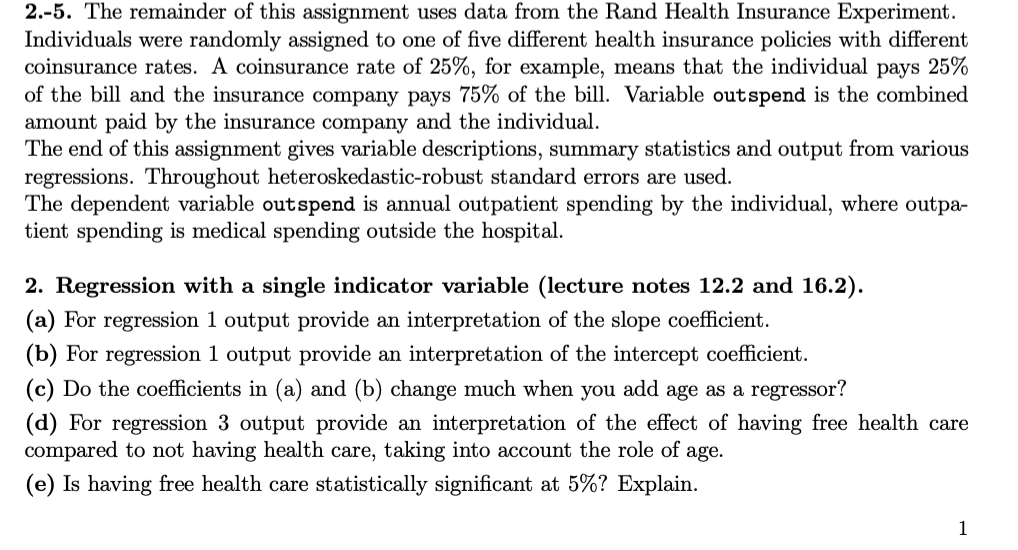
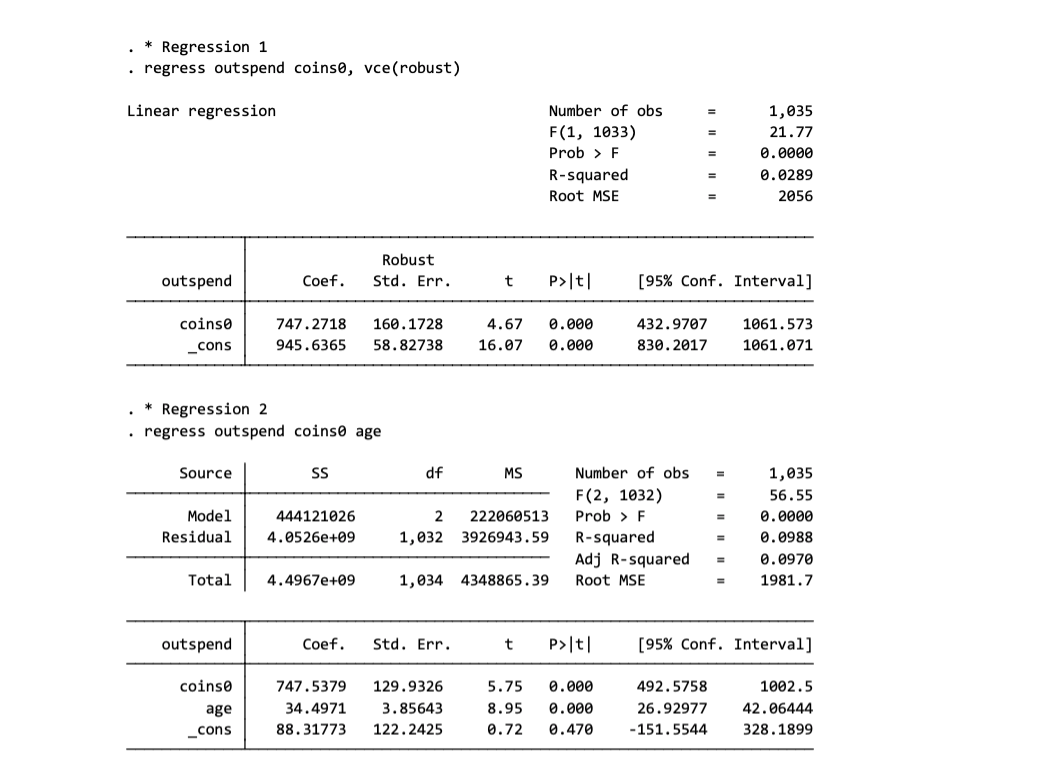
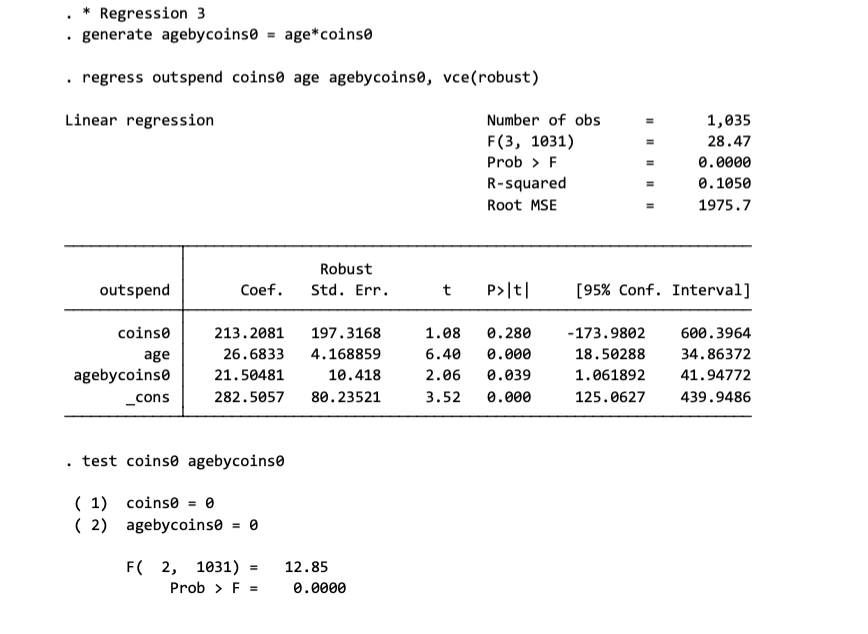
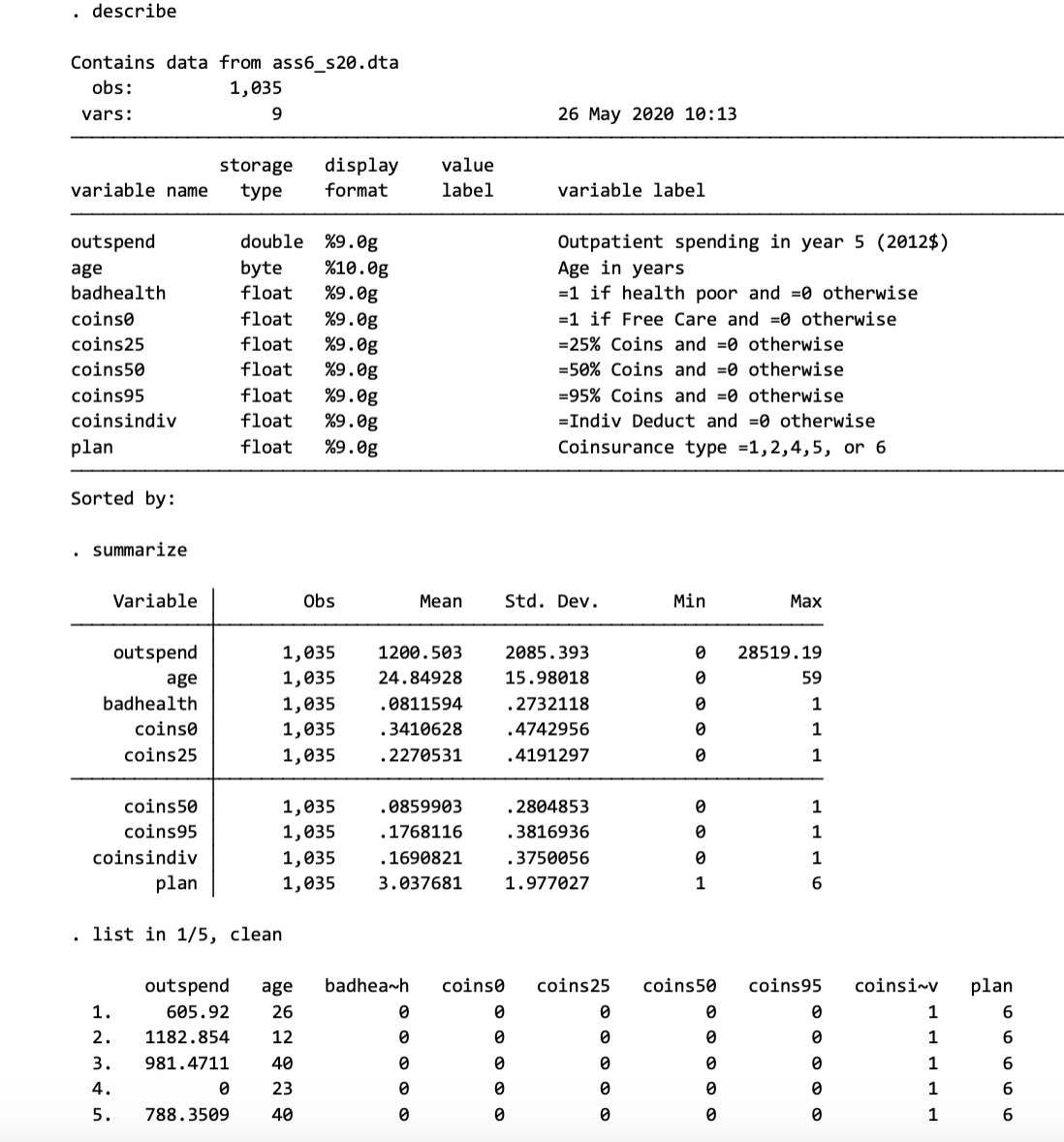
2.-5. The remainder of this assignment uses data from the Rand Health Insurance Experiment. Individuals were randomly assigned to one of five different health insurance policies with different coinsurance rates. A coinsurance rate of 25%, for example, means that the individual pays 25% of the bill and the insurance company pays 75% of the bill. Variable outspend is the combined amount paid by the insurance company and the individual. The end of this assignment gives variable descriptions, summary statistics and output from various regressions. Throughout heteroskedastic-robust standard errors are used. The dependent variable outspend is annual outpatient spending by the individual, where outpa- tient spending is medical spending outside the hospital. 2. Regression with a single indicator variable (lecture notes 12.2 and 16.2). (a) For regression 1 output provide an interpretation of the slope coefficient. (b) For regression 1 output provide an interpretation of the intercept coefficient. (c) Do the coefficients in (a) and (b) change much when you add age as a regressor? (d) For regression 3 output provide an interpretation of the effect of having free health care compared to not having health care, taking into account the role of age. (e) Is having free health care statistically significant at 5%? Explain.* Regression 1 regress outspend coinse, vce (robust) Linear regression Number of obs 1, 035 F(1, 1033) 21.77 Prob > F 0. 0000 R- squared 0. 0289 Root MSE 2056 Robust outspend Coef. Std. Err. t P>| t/ [95% Conf. Interval ] coinse 747 .2718 160.1728 4.67 0.000 432.9707 1061.573 _cons 945. 6365 58. 82738 16.07 0. 000 830. 2017 1061. 071 * Regression 2 regress outspend coins0 age Source SS df MS Number of obs 1, 035 F (2, 1032) 56.55 Model 444121026 2 222060513 Prob > F 0.0000 Residual 4.0526e+09 1, 032 3926943.59 R-squared 0. 0988 Adj R-squared 0. 0970 Total 4.4967e+09 1, 034 4348865.39 Root MSE 1981.7 outspend Coef. Std. Err. t P>It| [95% Conf. Interval ] coinse 747.5379 129.9326 5.75 0.090 492. 5758 1002.5 age 34. 4971 3.85643 8.95 0.000 26.92977 42. 06444 cons 88. 31773 122.2425 0.72 0.470 -151. 5544 328. 1899* Regression 3 . generate agebycoins0 = age*coinse . regress outspend coins0 age agebycoins@, vce(robust) Linear regression Number of obs 1, 035 F (3, 1031) 28.47 Prob > F 0.0000 R-squared 0. 1050 Root MSE 1975.7 Robust outspend Coef. Std. Err. t [95% Conf. Interval ] coinse 213. 2081 197 . 3168 1.08 0. 280 -173.9802 600. 3964 age 26.6833 4. 168859 6.40 0.000 18. 50288 34. 86372 agebycoinso 21. 50481 10.418 2.06 0.039 1. 061892 41.94772 cons 282.5057 80.23521 3.52 0. 090 125. 0627 439.9486 . test coins0 agebycoinse ( 1) coins0 = 0 ( 2) agebycoins0 = 0 F( 2, 1031) = 12.85 Prob > F = 0. 0000describe Contains data from ass6_s20. dta obs : 1, 035 vars: 26 May 2020 10:13 storage display value variable name type format label variable label outspend double %9.0g Outpatient spending in year 5 (2012$) age byte %10.0g Age in years badhealth float %9.0g =1 if health poor and =0 otherwise coinse float %9.0g =1 if Free Care and =0 otherwise coins25 float 19.0g =25% Coins and =0 otherwise coins50 float %9.0g =50% Coins and =0 otherwise coins95 float %9.0g =95% Coins and =0 otherwise coinsindiv float %9.0g =Indiv Deduct and =0 otherwise plan float %9.0g Coinsurance type =1, 2,4,5, or 6 Sorted by: Summarize Variable Obs Mean Std. Dev. Min Max outspend 1, 035 1200.503 2085. 393 28519. 19 age 1, 035 24.84928 15.98018 badhealth 1, 035 0811594 2732118 coinse 1, 035 3410628 4742956 coins25 1, 035 2270531 . 4191297 coins50 1, 035 0859903 2804853 coins95 1, 035 1768116 . 3816936 coinsindiv 1, 035 1690821 3750056 plan 1, 035 3. 037681 1.977027 HOOD . list in 1/5, clean outspend age badhea~h coinse coins25 coins50 coins95 coinsi~v plan 1. WN 605.92 26 1182.854 12 981. 4711 40 4 . 23 5 . 788. 3509 40
Step by Step Solution
There are 3 Steps involved in it

Get step-by-step solutions from verified subject matter experts