







Question: Question#3 29 CASE 24 OUTSOURCING AND VERTICAL INTEGRATION AT APPLE This case was prepared by Melissa A. Schilling of the School of Business, New York
Question#3 
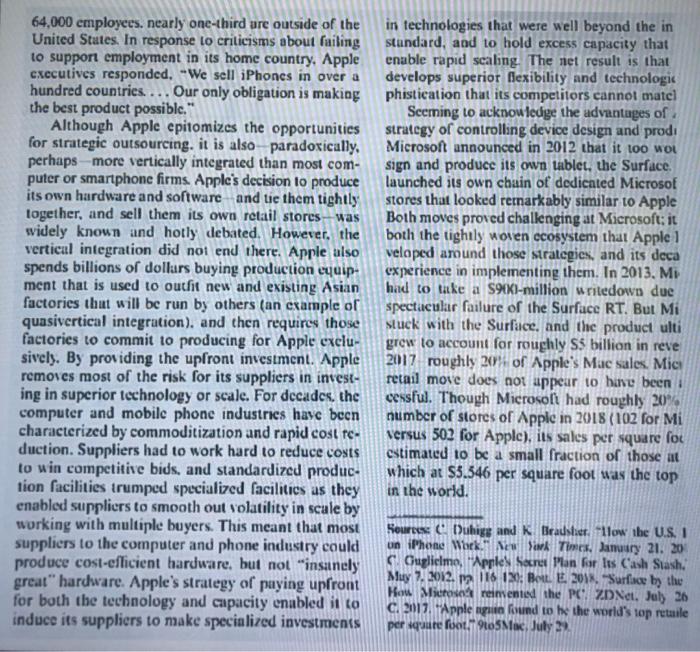

29 CASE 24 OUTSOURCING AND VERTICAL INTEGRATION AT APPLE This case was prepared by Melissa A. Schilling of the School of Business, New York University Al a dinner for Silicon Valley luminaries in February 2011. U.S. President Barack Obanu asked Steve Jobs of Apple. "What would it take to make iPhones in the United States Jobs replied, "These jobs aren't coming back." Apple's management had concluded that overseas factories provided superior scale. Nexibility, diligence and access to industrial skills "Made in the USA" just did not make sense for Apple anymore As an example of the superior responsiveness of Chinese fuctories to Apple's needs an executive described a recent event when Apple wanted to re- vamp its iPhone manufacturing just weeks before it was scheduled for delivery to stores. At the last minute. Apple had redesigned the screen, and now screens arrived at the Chinese factory at midnight. Fortunately, the 8.000 workers slept in dormitories at the factory--they were woken, given a cookie and a cup of tea and were at work fitting glass screens into their beveled frames within 30 minutes Soon the plant was producing 10.000 iPhones per day. The Executive commented. "The speed and flexibility is breathtaking ... There's no American plant that can match that." "Foxconn City" a complex where the iPhone is as sembled. las 230,000 employees, many of whom work 6 days a week and up to 12 hours a day. It is owned by Forcon Technology, which has dores of lacto- ries in Asia, Eastern Europe, Mexico, and Brazil. It is estimated that Fosconn assembles 40 of the world's Consumer electronics Il boasts a customer list that includes Amazon. Dell. Hewlett-Packard, Motorola, Nintendo Nokia Samsung, and Sony, in addition to Apple. Foxconn can hire thousands of engineers overnight and house them in dorm something no American firm could do. Nearly 8.700 industrial en- gineers were needed to oversee the 200.000 assembly line workers required to manufacture iPhones. Apple's analysts estimated that it could take 9 months to find that many qualified engineers in the United States. It only took 15 days in China. Moreover. China's advan- tage was not only in assembly: it also allered advan. tages across the entire supply chain. As noted by an Apple executive. The entire supply chain is in China now You need a thousand rubber gaskets? That's the fuctory next door. You need a million screws! That factory is a block away. You need that screw made a little bit different? It will take three hours or Apple's 64,000 employees. nearly one-third ure outside of the United States. In response to criticisms about failing to support employment in its home country, Apple executives responded, "We sell iPhones in over a hundred countries. ... Our only obligation is making the best product possible." Although Apple epitomizes the opportunities for strategic outsourcing. it is also paradoxically, perhaps more vertically integrated than most com- puter or smartphone firms Apple's decision to produce its own hardware and software and tie them tightly together, and sell them its own retail stores was widely known and hotly debated. However, the vertical integration did not end there. Apple also spends billions of dollars buying production equip- ment that is used to outfit new and existing Asian factories that will be run by others (an example of quasivertical integration), and then requires those factories to commit to producing for Apple exelu- sively. By providing the upfront investment. Apple removes most of the risk for its suppliers in invest- ing in superior technology or scale. For decades, the computer and mobile phone industries have been characterized by commoditization and rapid cost re- duction. Suppliers had to work hard to reduce costs to win competitive bids, and standardized produc- tion facilities trumped specialized facilities as they enabled suppliers to smooth out volatility in scule by working with multiple buyers. This meant that most suppliers to the computer and phone industry could produce cost-efficient hardware, but not "insanely great" hardware. Apple's strategy of paying upfront for both the technology and capacity enabled it to induce its suppliers to make specialized investments in technologies that were well beyond the in stundard, and to hold excess capacity that enable rapid scaling. The net result is that develops superior flexibility and technologi phistication that its competitors cannot matel Seeming to acknowledge the advantages of strategy of controlling device design and prodi Microsoft announced in 2012 that it too wou sign and produce its own tablet, the Surface launched its own chain of dedicated Microsof stores that looked remarkably similar to Apple Both moves proved challenging at Microsoft: it both the tightly woven ecosystem that Apple 1 veloped around those strategies, and its deca experience in implementing them. In 2013. Mi had to take a S9K-million writedown due spectacular failure of the Surface RT. But Mi stuck with the Surface, and the product ulti grew to account for roughly S5 billion in reve 2017 roughly 2015 of Apple's Muc sales. Mick retail move does not appear to have been cessful. Though Microsoft had roughly 20% number of stores of Apple in 2018 (102 for Mi Nersus 502 for Applc), its sales per square fou estimated to be a small fraction of those at which at $5.546 per square foot was the top in the world. Sources: Dubigg and K Braustier, fllow the U.S. un iPhone Woek. New York Times. January 21, 20 Ouglielmo, Apple Sacret Plan for its Cash Stash. Muy 7. 2012.17 118 13: BIL E. 2018, Surface by the How Microse reinvented the PC: ZDNet, July 26 C 2017. Apple ng i found to be the world's top returile per square foot Mac, July 22 3. Why is Apple more vertically integrated than its competitors Step by Step Solution
There are 3 Steps involved in it
1 Expert Approved Answer
Step: 1 Unlock

Question Has Been Solved by an Expert!
Get step-by-step solutions from verified subject matter experts
Step: 2 Unlock
Step: 3 Unlock
 Study Help