



Question: Question-3: The following table shows how average share prices jump (in percentage) after the announcement that the stocks will be cross-listed (see Miller, 1999). The
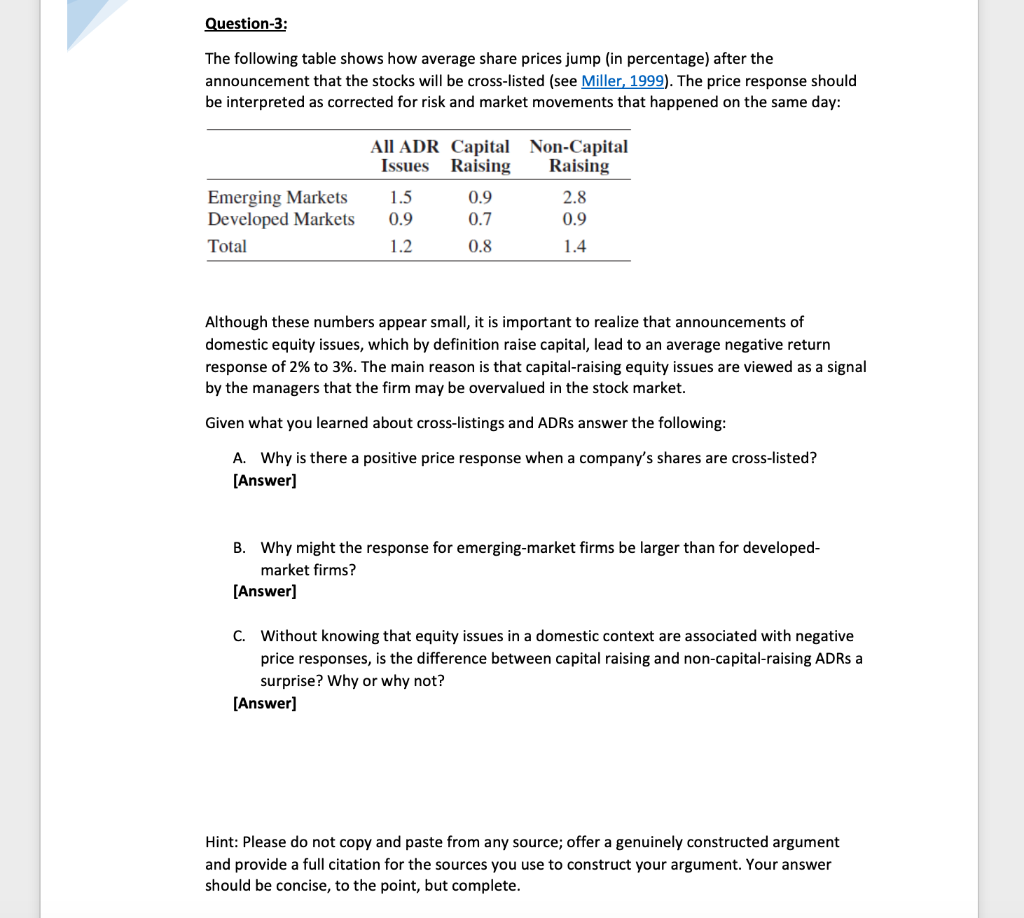
Question-3: The following table shows how average share prices jump (in percentage) after the announcement that the stocks will be cross-listed (see Miller, 1999). The price response should be interpreted as corrected for risk and market movements that happened on the same day: All ADR Capital Non-Capital Issues Raising Raising Emerging Markets Developed Markets Total 1.5 0.9 1.2 0.9 0.7 0.8 2.8 0.9 1.4 Although these numbers appear small, it is important to realize that announcements of domestic equity issues, which by definition raise capital, lead to an average negative return response of 2% to 3%. The main reason is that capital-raising equity issues are viewed as a signal by the managers that the firm may be overvalued in the stock market. Given what you learned about cross-listings and ADRs answer the following: A. Why is there a positive price response when a company's shares are cross-listed? [Answer] B. Why might the response for emerging market firms be larger than for developed- market firms? [Answer] C. Without knowing that equity issues in a domestic context are associated with negative price responses, is the difference between capital raising and non-capital-raising ADRs a surprise? Why or why not? [Answer] Hint: Please do not copy and paste from any source; offer a genuinely constructed argument and provide a full citation for the sources you use to construct your argument. Your answer should be concise, to the point, but complete. Question-3: The following table shows how average share prices jump (in percentage) after the announcement that the stocks will be cross-listed (see Miller, 1999). The price response should be interpreted as corrected for risk and market movements that happened on the same day: All ADR Capital Non-Capital Issues Raising Raising Emerging Markets Developed Markets Total 1.5 0.9 1.2 0.9 0.7 0.8 2.8 0.9 1.4 Although these numbers appear small, it is important to realize that announcements of domestic equity issues, which by definition raise capital, lead to an average negative return response of 2% to 3%. The main reason is that capital-raising equity issues are viewed as a signal by the managers that the firm may be overvalued in the stock market. Given what you learned about cross-listings and ADRs answer the following: A. Why is there a positive price response when a company's shares are cross-listed? [Answer] B. Why might the response for emerging market firms be larger than for developed- market firms? [Answer] C. Without knowing that equity issues in a domestic context are associated with negative price responses, is the difference between capital raising and non-capital-raising ADRs a surprise? Why or why not? [Answer] Hint: Please do not copy and paste from any source; offer a genuinely constructed argument and provide a full citation for the sources you use to construct your argument. Your answer should be concise, to the point, but complete
Step by Step Solution
There are 3 Steps involved in it

Get step-by-step solutions from verified subject matter experts