



Question: questions 1, 2 & 3 please !!!!!! Joint cost allocation Rosie's Roses produces three colors of roses: red, white, and peach. The roses are produced
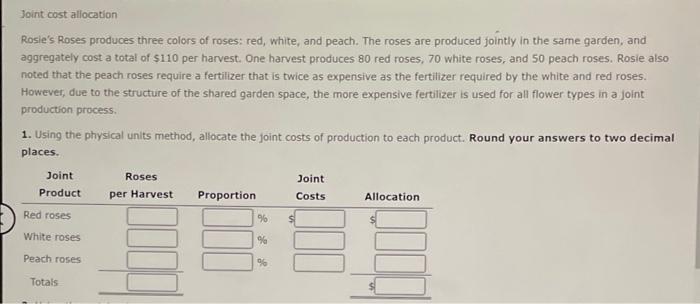
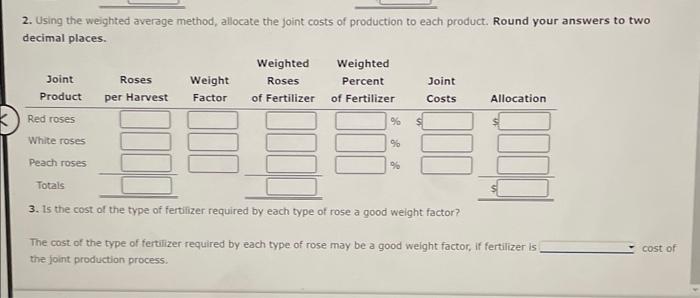
Joint cost allocation Rosie's Roses produces three colors of roses: red, white, and peach. The roses are produced jointly in the same garden, and aggregately cost a total of $110 per harvest. One harvest produces 80 red roses, 70 white roses, and 50 peach roses. Rosie also noted that the peach roses require a fertilizer that is twice as expensive as the fertilizer required by the white and red roses. However, due to the structure of the shared garden space, the more expensive fertilizer is used for all flower types in a joint production process. 1. Using the physical units method, allocate the joint costs of production to each product. Round your answers to two decimal places. 2. Using the weighted average method, allocate the joint costs of production to each product. Round your answers to two decimal places. 3. 15 the cost of the type of fertilizer required by each type of rose a good welght factor? The cost of the type of fertilizer required by each type of rose may be a good weight factor, if fertilizer is the joint production process
Step by Step Solution
There are 3 Steps involved in it

Get step-by-step solutions from verified subject matter experts