





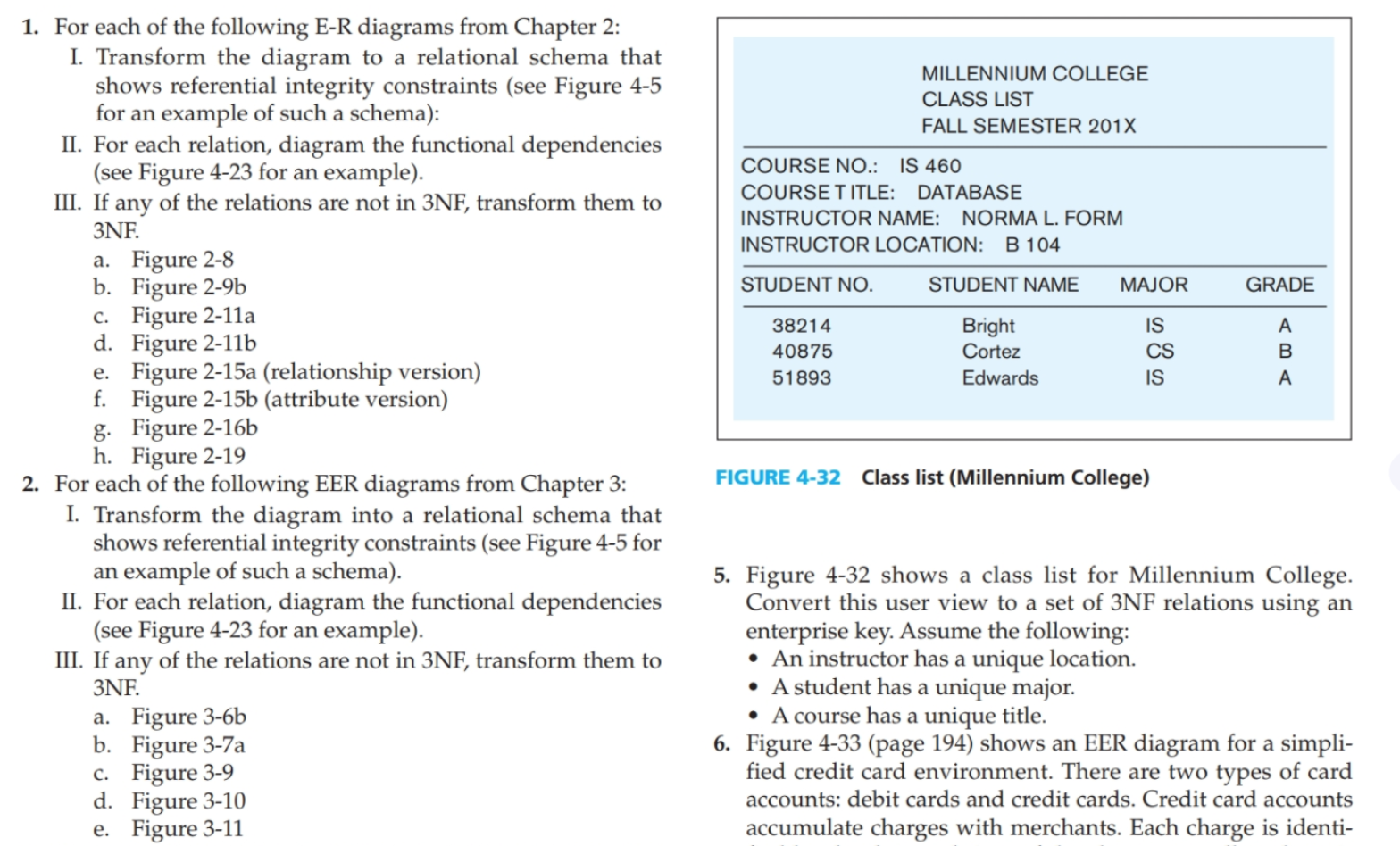
Question: Questions 1 & 2 please! MILLENNIUM COLLEGE CLASS LIST FALL SEMESTER 201X COURSE NO.: IS 460 COURSE TITLE: DATABASE INSTRUCTOR NAME: NORMA L. FORM INSTRUCTOR
Questions 1 & 2 please! MILLENNIUM COLLEGE CLASSQuestions 1 & 2 please!

MILLENNIUM COLLEGE CLASS LIST FALL SEMESTER 201X COURSE NO.: IS 460 COURSE TITLE: DATABASE INSTRUCTOR NAME: NORMA L. FORM INSTRUCTOR LOCATION: B 104 STUDENT NO. STUDENT NAME MAJOR GRADE 38214 40875 51893 Bright Cortez Edwards IS CS IS B 1. For each of the following E-R diagrams from Chapter 2: 1. Transform the diagram to a relational schema that shows referential integrity constraints (see Figure 4-5 for an example of such a schema): II. For each relation, diagram the functional dependencies (see Figure 4-23 for an example). III. If any of the relations are not in 3NF, transform them to 3NF. a. Figure 2-8 b. Figure 2-9b c. Figure 2-11a d. Figure 2-11b e. Figure 2-15a (relationship version) f. Figure 2-15b (attribute version) g. Figure 2-16b h. Figure 2-19 2. For each of the following EER diagrams from Chapter 3: I. Transform the diagram into a relational schema that shows referential integrity constraints (see Figure 4-5 for an example of such a schema). II. For each relation, diagram the functional dependencies (see Figure 4-23 for an example). III. If any of the relations are not in 3NF, transform them to 3NF. a. Figure 3-6b b. Figure 3-7a c. Figure 3-9 d. Figure 3-10 e. Figure 3-11 FIGURE 4-32 Class list (Millennium College) 5. Figure 4-32 shows a class list for Millennium College. Convert this user view to a set of 3NF relations using an enterprise key. Assume the following: An instructor has a unique location. A student has a unique major. A course has a unique title. 6. Figure 4-33 (page 194) shows an EER diagram for a simpli- fied credit card environment. There are two types of card accounts: debit cards and credit cards. Credit card accounts accumulate charges with merchants. Each charge is identi- MILLENNIUM COLLEGE CLASS LIST FALL SEMESTER 201X COURSE NO.: IS 460 COURSE TITLE: DATABASE INSTRUCTOR NAME: NORMA L. FORM INSTRUCTOR LOCATION: B 104 STUDENT NO. STUDENT NAME MAJOR GRADE 38214 40875 51893 Bright Cortez Edwards IS CS IS B 1. For each of the following E-R diagrams from Chapter 2: 1. Transform the diagram to a relational schema that shows referential integrity constraints (see Figure 4-5 for an example of such a schema): II. For each relation, diagram the functional dependencies (see Figure 4-23 for an example). III. If any of the relations are not in 3NF, transform them to 3NF. a. Figure 2-8 b. Figure 2-9b c. Figure 2-11a d. Figure 2-11b e. Figure 2-15a (relationship version) f. Figure 2-15b (attribute version) g. Figure 2-16b h. Figure 2-19 2. For each of the following EER diagrams from Chapter 3: I. Transform the diagram into a relational schema that shows referential integrity constraints (see Figure 4-5 for an example of such a schema). II. For each relation, diagram the functional dependencies (see Figure 4-23 for an example). III. If any of the relations are not in 3NF, transform them to 3NF. a. Figure 3-6b b. Figure 3-7a c. Figure 3-9 d. Figure 3-10 e. Figure 3-11 FIGURE 4-32 Class list (Millennium College) 5. Figure 4-32 shows a class list for Millennium College. Convert this user view to a set of 3NF relations using an enterprise key. Assume the following: An instructor has a unique location. A student has a unique major. A course has a unique title. 6. Figure 4-33 (page 194) shows an EER diagram for a simpli- fied credit card environment. There are two types of card accounts: debit cards and credit cards. Credit card accounts accumulate charges with merchants. Each charge is identi

Step by Step Solution

There are 3 Steps involved in it

1 Expert Approved Answer
Step: 1 Unlock blur-text-image

Question Has Been Solved by an Expert!

Get step-by-step solutions from verified subject matter experts

Step: 2 Unlock
Step: 3 Unlock

Students Have Also Explored These Related General Management Questions!