







Question: Questions :- 1. Based on the information provided about the trait approach in Tables 2.1 and 2.2, if you were Sandra, whom would you select?
Questions :-
1. Based on the information provided about the trait approach in Tables 2.1 and 2.2, if you were Sandra, whom would you select?
2. In what ways is the trait approach helpful in this type of selection?
3. In what ways are the weaknesses of the trait approach highlighted in this case?
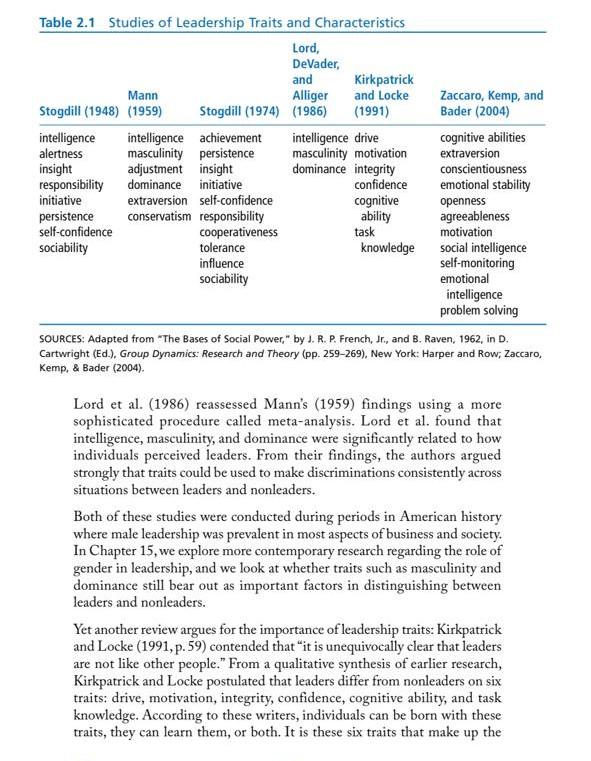
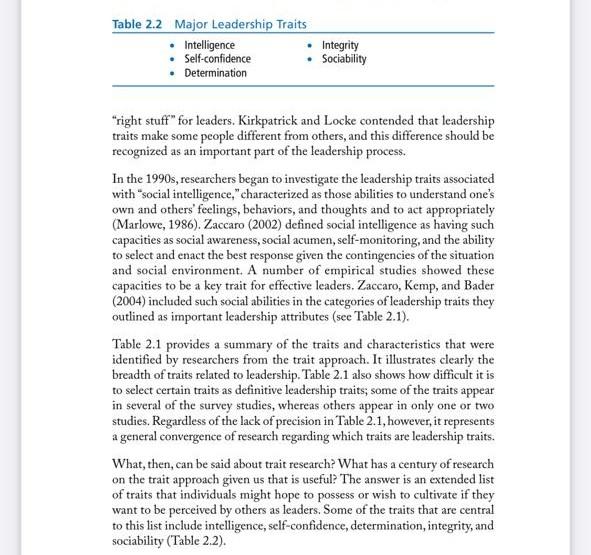
Table 2.1 Studies of Leadership Traits and Characteristics Lord, DeVader, and Kirkpatrick Mann Alliger and Locke Zaccaro, Kemp, and Stogdill (1948) (1959) Stogdill (1974) (1986) (1991) Bader (2004) intelligence intelligence achievement intelligence drive cognitive abilities alertness masculinity persistence masculinity motivation extraversion insight adjustment insight dominance integrity conscientiousness responsibility dominance initiative confidence emotional stability initiative extraversion self-confidence cognitive openness persistence conservatism responsibility ability agreeableness self-confiden cooperativeness task motivation sociability tolerance knowledge social intelligence influence self-monitoring sociability emotional intelligence problem solving SOURCES: Adapted from "The Bases of Social Power," by J. R. P. French, Jr., and B. Raven, 1962, in D. Cartwright (Ed.), Group Dynamics: Research and Theory (pp. 259-269), New York: Harper and Row, Zaccaro, Kemp, & Bader (2004) Lord et al. (1986) reassessed Mann's (1959) findings using a more sophisticated procedure called meta-analysis. Lord et al. found that intelligence, masculinity, and dominance were significantly related to how individuals perceived leaders. From their findings, the authors argued strongly that traits could be used to make discriminations consistently across situations between leaders and nonleaders. Both of these studies were conducted during periods in American history where male leadership was prevalent in most aspects of business and society. In Chapter 15, we explore more contemporary research regarding the role of gender in leadership, and we look at whether traits such as masculinity and dominance still bear out as important factors in distinguishing between leaders and nonleaders. Yet another review argues for the importance of leadership traits: Kirkpatrick and Locke (1991, p.59) contended that it is unequivocally clear that leaders are not like other people." From a qualitative synthesis of earlier research, Kirkpatrick and Locke postulated that leaders differ from nonleaders on six traits: drive, motivation, integrity, confidence, cognitive ability, and task knowledge. According to these writers, individuals can be born with these traits, they can learn them, or both. It is these six traits that make up the Table 2.2 Major Leadership Traits Intelligence Integrity Self-confidence Sociability Determination "right stuff" for leaders. Kirkpatrick and Locke contended that leadership traits make some people different from others, and this difference should be recognized as an important part of the leadership process. In the 1990s, researchers began to investigate the leadership traits associated with "social intelligence, "characterized as those abilities to understand one's own and others' feelings, behaviors, and thoughts and to act appropriately (Marlowe, 1986). Zaccaro (2002) defined social intelligence as having such capacities as social awareness, social acumen, self-monitoring, and the ability to select and enact the best response given the contingencies of the situation and social environment. A number of empirical studies showed these capacities to be a key trait for effective leaders. Zaccaro, Kemp, and Bader (2004) included such social abilities in the categories of leadership traits they outlined as important leadership attributes (see Table 2.1). Table 2.1 provides a summary of the traits and characteristics that were identified by researchers from the trait approach. It illustrates clearly the breadth of traits related to leadership. Table 2.1 also shows how difficult it is to select certain traits as definitive leadership traits; some of the traits appear in several of the survey studies, whereas others appear in only one or two studies. Regardless of the lack of precision in Table 2.1, however, it represents a general convergence of research regarding which traits are leadership traits. What, then, can be said about trait research? What has a century of research on the trait approach given us that is useful? The answer is an extended list of traits that individuals might hope to possess or wish to cultivate if they want to be perceived by others as leaders. Some of the traits that are central to this list include intelligence, self-confidence, determination, integrity, and sociability (Table 2.2)Step by Step Solution
There are 3 Steps involved in it
1 Expert Approved Answer
Step: 1 Unlock

Question Has Been Solved by an Expert!
Get step-by-step solutions from verified subject matter experts
Step: 2 Unlock
Step: 3 Unlock
 Study Help