







Question: Questions: 1. Potential consequences: identify the potential consequences to the stakeholders of accepting the aggressive bid and risks involved in the project. Identify the potential
Questions: 1. Potential consequences: identify the potential consequences to the stakeholders of accepting the aggressive bid and risks involved in the project. Identify the potential consequences to the stakeholders of accepting this aggressive bid without a risk management plan. 2. Potential breaches: identify the potential breaches of the Project Management Institute (PMI) ethical standards by the Project team. Examine the PMI code and identify requirements that are relevant to this case study. 3. Potential Risks: identify the potential risks. Identify the potential consequences of implementing the project without a risk management plan. 4. Recommendations: present your recommendations to the project manager on how to proceed to solve the ethical dilemma he/she is facing. The project manager is attempting to resolve the ethical dilemma. Having completed your ethical analysis, provide advice as to how he/she should proceed.
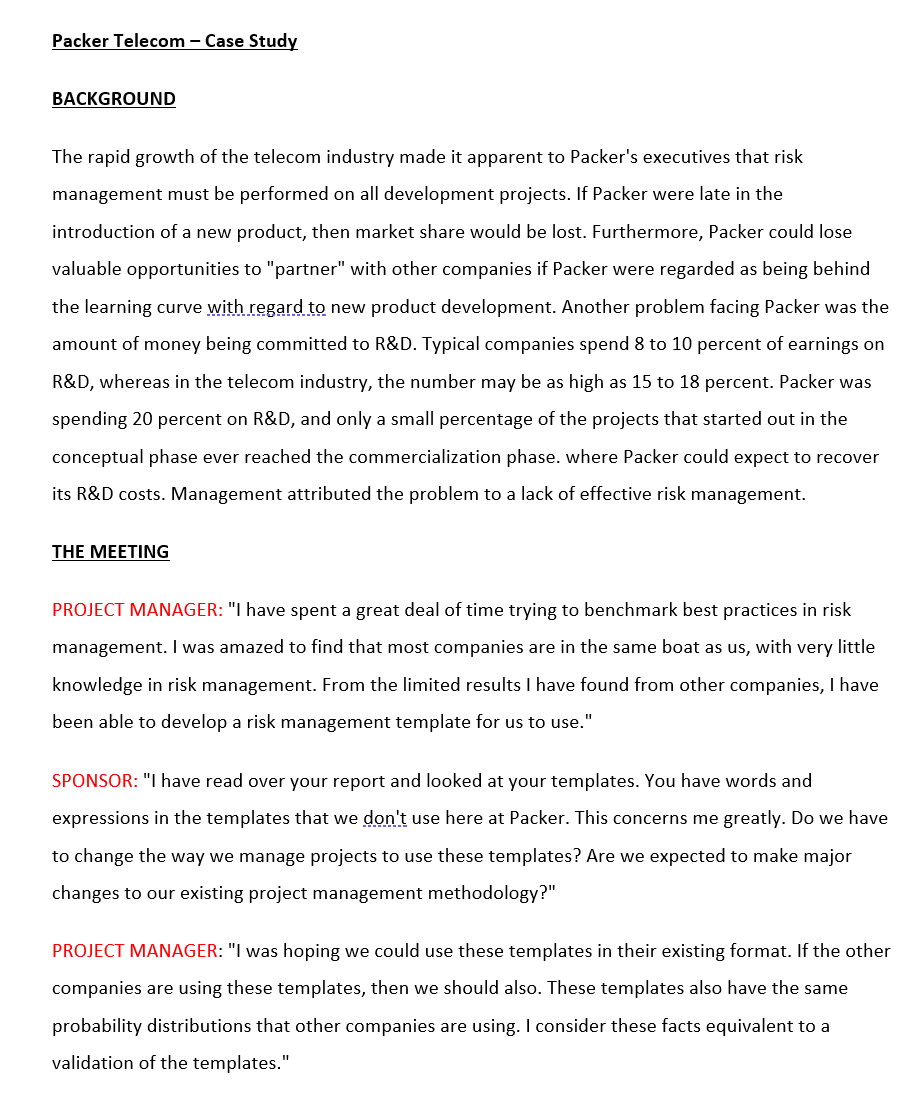
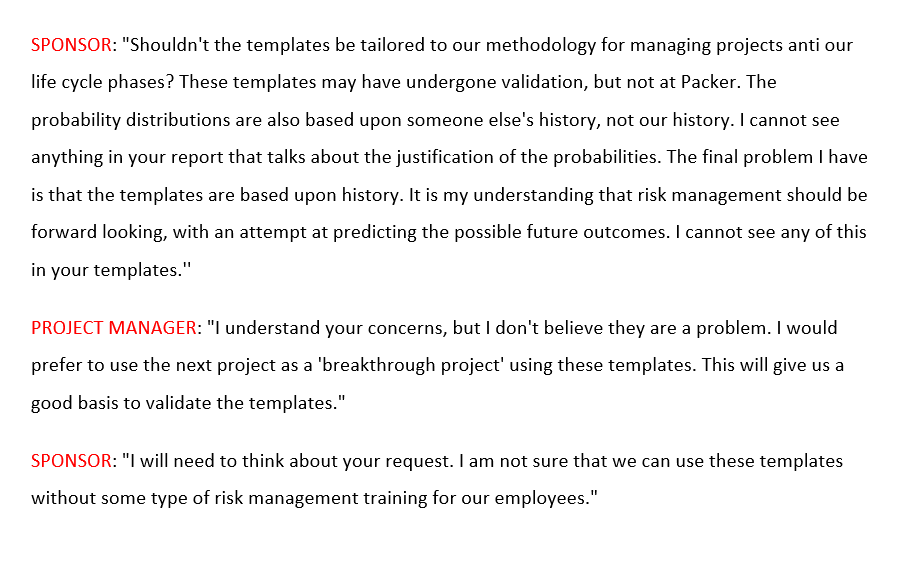
Packer Telecom - Case Study BACKGROUND The rapid growth of the telecom industry made it apparent to Packer's executives that risk management must be performed on all development projects. If Packer were late in the introduction of a new product, then market share would be lost. Furthermore, Packer could lose valuable opportunities to "partner" with other companies if Packer were regarded as being behind the learning curve with regard to new product development. Another problem facing Packer was the amount of money being committed to R&D. Typical companies spend 8 to 10 percent of earnings on R&D, whereas in the telecom industry, the number may be as high as 15 to 18 percent. Packer was spending 20 percent on R&D, and only a small percentage of the projects that started out in the conceptual phase ever reached the commercialization phase. where Packer could expect to recover its R&D costs. Management attributed the problem to a lack of effective risk management. THE MEETING PROJECT MANAGER: "I have spent a great deal of time trying to benchmark best practices in risk management. I was amazed to find that most companies are in the same boat as us, with very little knowledge in risk management. From the limited results I have found from other companies, I have been able to develop a risk management template for us to use." SPONSOR: "I have read over your report and looked at your templates. You have words and expressions in the templates that we don't use here at Packer. This concerns me greatly. Do we have to change the way we manage projects to use these templates? Are we expected to make major changes to our existing project management methodology?" PROJECT MANAGER: "I was hoping we could use these templates in their existing format. If the other companies are using these templates, then we should also. These templates also have the same probability distributions that other companies are using. I consider these facts equivalent to a validation of the templates." SPONSOR: "Shouldn't the templates be tailored to our methodology for managing projects anti our life cycle phases? These templates may have undergone validation, but not at Packer. The probability distributions are also based upon someone else's history, not our history. I cannot see anything in your report that talks about the justification of the probabilities. The final problem I have is that the templates are based upon history. It is my understanding that risk management should be forward looking, with an attempt at predicting the possible future outcomes. I cannot see any of this in your templates." PROJECT MANAGER: "I understand your concerns, but I don't believe they are a problem. I would prefer to use the next project as a 'breakthrough project' using these templates. This will give us a good basis to validate the templates." SPONSOR: "I will need to think about your request. I am not sure that we can use these templates without some type of risk management training for our employeesStep by Step Solution
There are 3 Steps involved in it

Get step-by-step solutions from verified subject matter experts
 Study Help