







Question: QUESTIONS: (12) Total Points: (10.0) 1. Given the following code, answer the questions: 0000 mov eax, (ebp + Oxc] ; assume eax = Oxff after
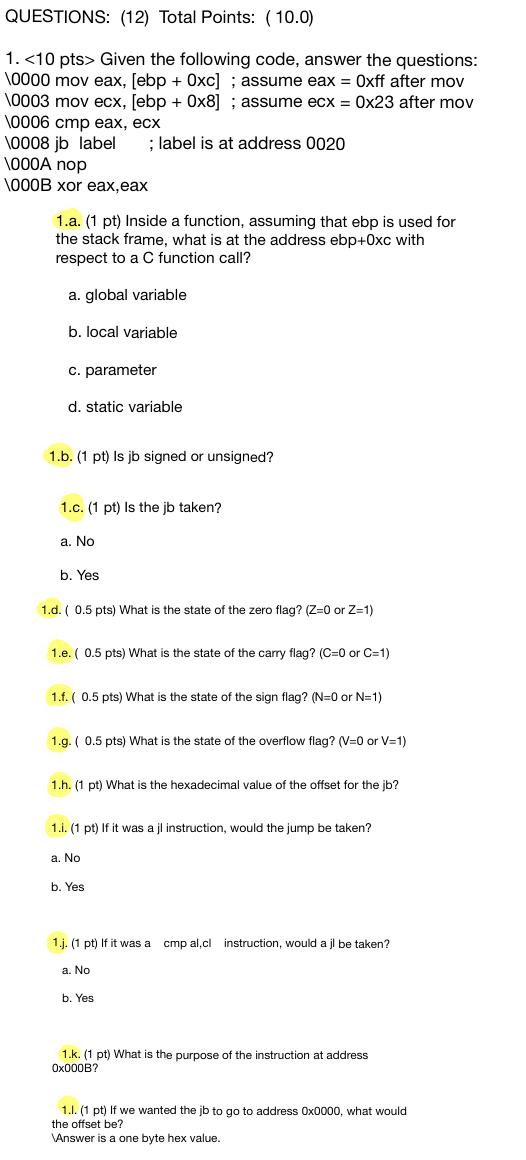
QUESTIONS: (12) Total Points: (10.0) 1. Given the following code, answer the questions: \0000 mov eax, (ebp + Oxc] ; assume eax = Oxff after mov \0003 mov ecx, [ebp + 0x8] ; assume ecx = 0x23 after mov \0006 cmp eax, ecx \0008 jb label ; label is at address 0020 \000A nop \000B xor eax,eax 1.a. (1 pt) Inside a function, assuming that ebp is used for the stack frame, what is at the address ebp+Oxc with respect to a C function call? a. global variable b. local variable c. parameter d. static variable 1.b. (1 pt) Is jb signed or unsigned? 1.c. (1 pt) is the jb taken? a. No b. Yes 1.d. ( 0.5 pts) What is the state of the zero flag? (Z=0 or Z=1) 1.e. ( 0.5 pts) What is the state of the carry flag? (C=0 or C=1) 1.f. ( 0.5 pts) What is the state of the sign flag? (N=0 or N=1) 1.g. ( 0.5 pts) What is the state of the overflow flag? (V=O or V=1) 1.h. (1 pt) What is the hexadecimal value of the offset for the jb? 1.1. (1 pt) If it was a jl instruction, would the jump be taken? a. No b. Yes 1.j. (1 pt) If it was a cmp al,cl instruction, would a jl be taken? a. No b. Yes 1.k. (1 pt) What is the purpose of the instruction at address OxO00B? 1.1. (1 pt) If we wanted the jb to go to address Ox0000, what would the offset be? Answer is a one byte hex value
Step by Step Solution
There are 3 Steps involved in it

Get step-by-step solutions from verified subject matter experts
 Study Help