







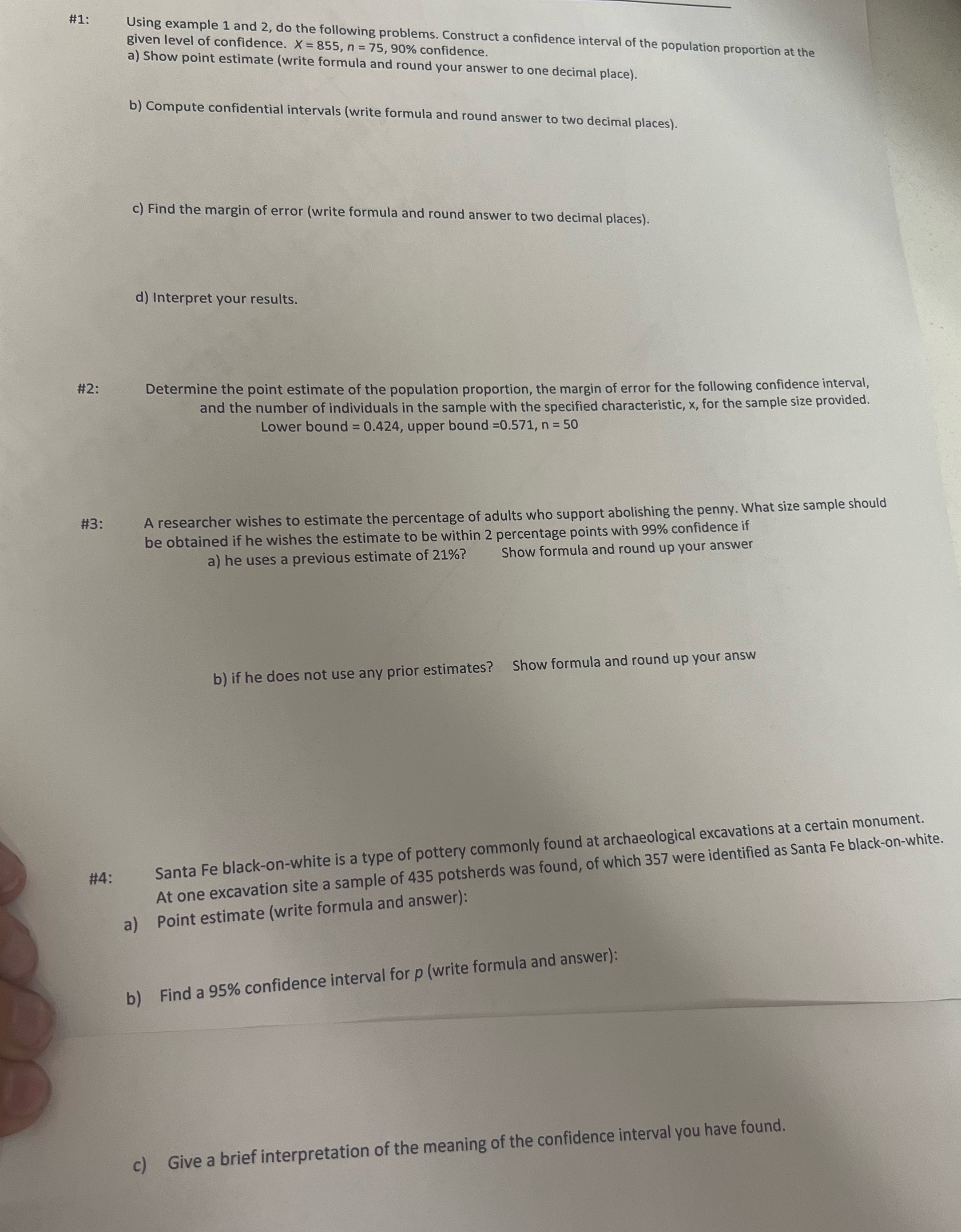
Question: Questions 1,2,3,4 #1: Using example 1 and 2, do the following problems. Construct a confidence interval of the population proportion at the given level of
Questions 1,2,3,4
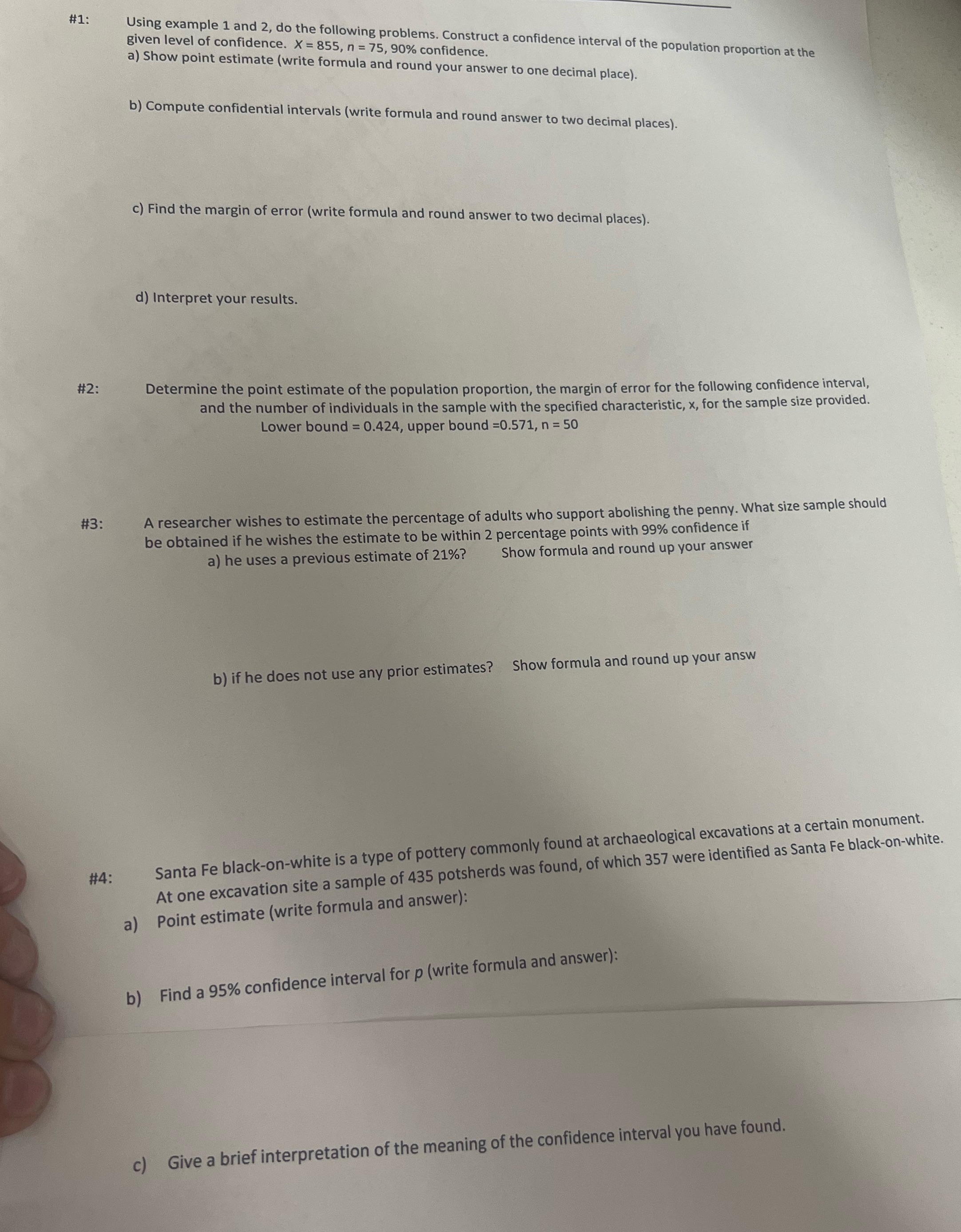
#1: Using example 1 and 2, do the following problems. Construct a confidence interval of the population proportion at the given level of confidence. X = 855, n = 75, 90% confidence. a) Show point estimate (write formula and round your answer to one decimal place). b) Compute confidential intervals (write formula and round answer to two decimal places). c) Find the margin of error (write formula and round answer to two decimal places). d) Interpret your results. #2: Determine the point estimate of the population proportion, the margin of error for the following confidence interval, and the number of individuals in the sample with the specified characteristic, x, for the sample size provided. Lower bound = 0.424, upper bound =0.571, n = 50 #3: A researcher wishes to estimate the percentage of adults who support abolishing the penny. What size sample should be obtained if he wishes the estimate to be within 2 percentage points with 99% confidence if a) he uses a previous estimate of 21%? Show formula and round up your answer b) if he does not use any prior estimates? Show formula and round up your answ Santa Fe black-on-white is a type of pottery commonly found at archaeological excavations at a certain monument. #4: At one excavation site a sample of 435 potsherds was found, of which 357 were identified as Santa Fe black-on-white. a) Point estimate (write formula and answer): b) Find a 95% confidence interval for p (write formula and answer): c) Give a brief interpretation of the meaning of the confidence interval you have found
Step by Step Solution
There are 3 Steps involved in it

Get step-by-step solutions from verified subject matter experts
 Study Help