







Question: Questions 2 and 3 focus around two key formulae we had in class, namely that if Q is the (random) proportion of trials (out of
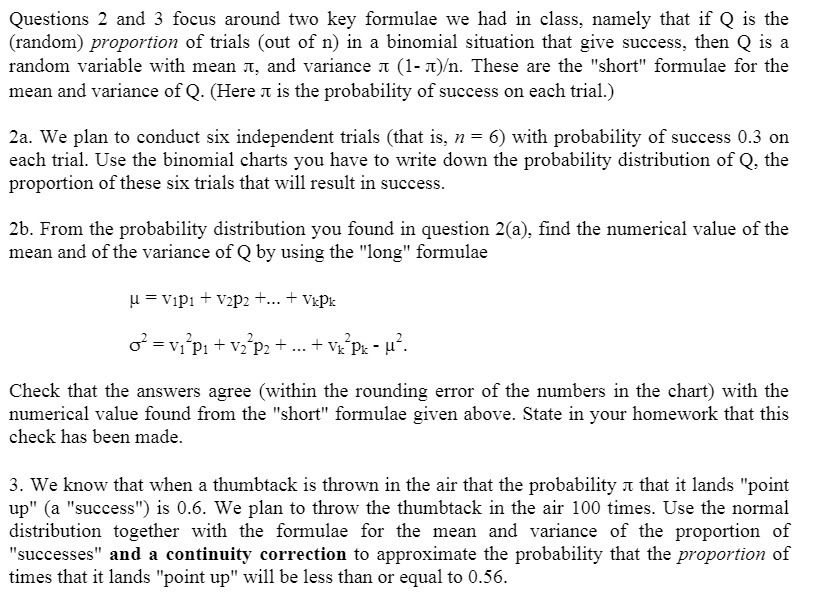
Questions 2 and 3 focus around two key formulae we had in class, namely that if Q is the (random) proportion of trials (out of n) in a binomial situation that give success, then Q is a random variable with mean rt, and variance rt (1- Min. These are the "short" formulae for the mean and variance of Q. (Here It is the probability of success on each trial.) 2a. We plan to conduct six independent trials (that is, n = 6) with probability of success 0.3 on each trial. Use the binomial charts you have to write down the probability distribution of Q, the proportion of these six trials that will result in success. 2b. From the probability distribution you found in question 2(a)= find the numerical value of the mean and of the variance of Q by using the "long\" formulae u=v1p1+v2p2+___+vkpk _ '2 2 _2 2 021-1p1+v3 p2+...+y1E pic-p. Check that the answers agree (within the rounding error of the numbers in the chart) with the numerical value found from the \"short'T formulae given above. State in your homework that this check has been made. 3. We know that when a thumbtack is thrown in the air that the probability .11 that it lands "point up" [a "success") is {1.6. We plan to throw the thumbtack in the air IUD times. Use the normal distribution together with the formulae for the mean and variance of the proportion of "successes" and a continuity correction to approximate the probability that the proportion of times that it lands "point up" will be less than or equal to ELSE
Step by Step Solution
There are 3 Steps involved in it

Get step-by-step solutions from verified subject matter experts
 Study Help