







Question: Questions# 2 : Consider the following situation, which involves four separate servers connecting to four different clients over four three - hop paths between servers
Questions#:
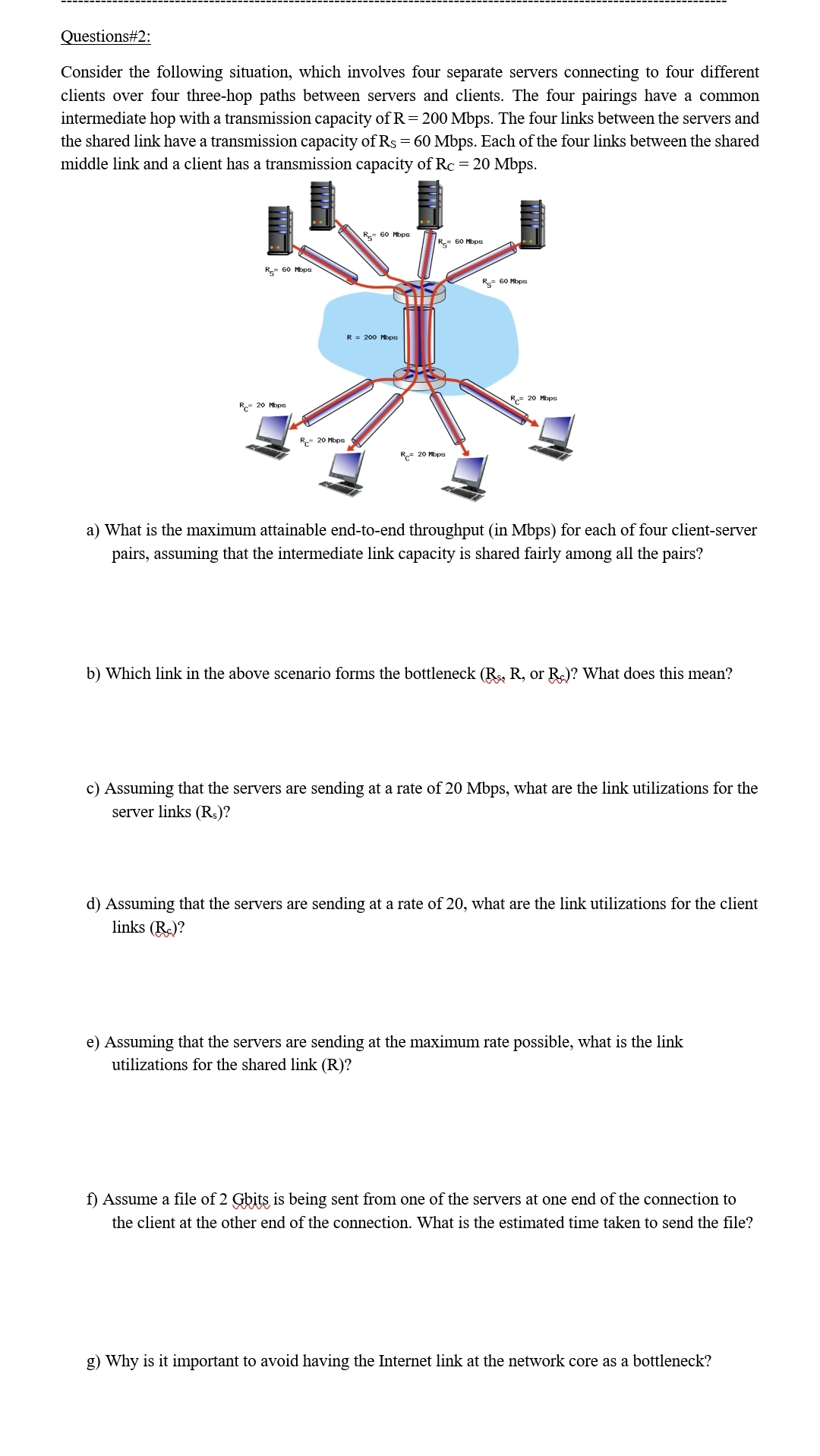
Consider the following situation, which involves four separate servers connecting to four different
clients over four threehop paths between servers and clients. The four pairings have a common
intermediate hop with a transmission capacity of The four links between the servers and
the shared link have a transmission capacity of Each of the four links between the shared
middle link and a client has a transmission capacity of
a What is the maximum attainable endtoend throughput in Mbps for each of four clientserver
pairs, assuming that the intermediate link capacity is shared fairly among all the pairs?
b Which link in the above scenario forms the bottleneck or What does this mean?
c Assuming that the servers are sending at a rate of Mbps what are the link utilizations for the
server links
d Assuming that the servers are sending at a rate of what are the link utilizations for the client
links
e Assuming that the servers are sending at the maximum rate possible, what is the link
utilizations for the shared link
f Assume a file of Gbits is being sent from one of the servers at one end of the connection to
the client at the other end of the connection. What is the estimated time taken to send the file?
g Why is it important to avoid having the Internet link at the network core as a bottleneck?
Step by Step Solution
There are 3 Steps involved in it
1 Expert Approved Answer
Step: 1 Unlock

Question Has Been Solved by an Expert!
Get step-by-step solutions from verified subject matter experts
Step: 2 Unlock
Step: 3 Unlock
 Study Help