







Question: Questions 2-4 are a modification to the cake-eating problem so that there is a return to storage. Let p > 0 be the return to
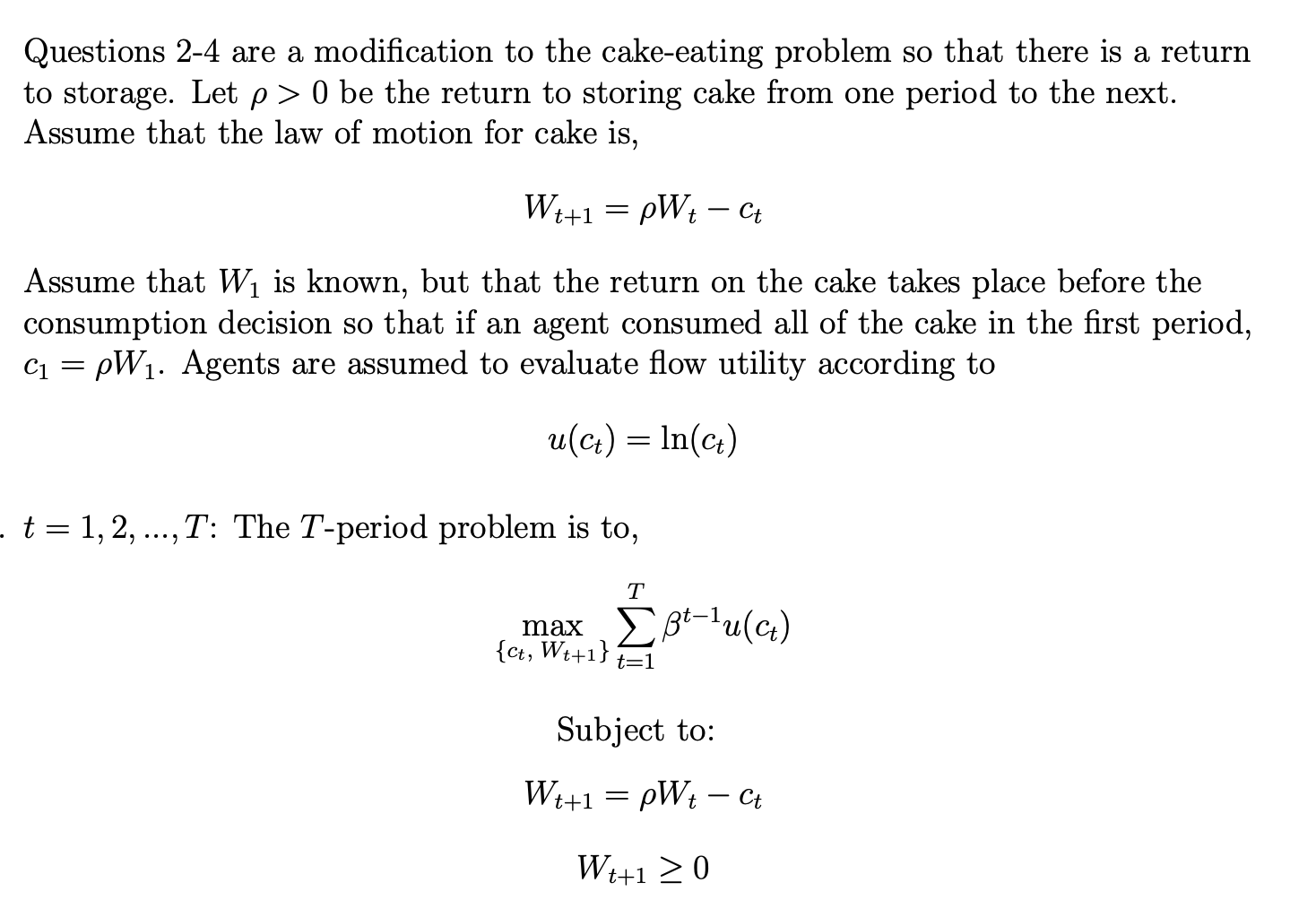

Questions 2-4 are a modification to the cake-eating problem so that there is a return to storage. Let p > 0 be the return to storing cake from one period to the next. Assume that the law of motion for cake is, W++1 = PW+ Ct Assume that W1 is known, but that the return on the cake takes place before the consumption decision so that if an agent consumed all of the cake in the first period, C1 = PW1. Agents are assumed to evaluate flow utility according to = u(ct) = In(c) t=1,2,...,T: The T-period problem is to, T 1 max Bt-u(c) {Ct, Wt+1} t=1 Subject to: W++1 = pWt - Ct t= W4+1 > 0 4. There are two distinct economic interpretations of p depending on whether p 1. What are these interpretations? Questions 2-4 are a modification to the cake-eating problem so that there is a return to storage. Let p > 0 be the return to storing cake from one period to the next. Assume that the law of motion for cake is, W++1 = PW+ Ct Assume that W1 is known, but that the return on the cake takes place before the consumption decision so that if an agent consumed all of the cake in the first period, C1 = PW1. Agents are assumed to evaluate flow utility according to = u(ct) = In(c) t=1,2,...,T: The T-period problem is to, T 1 max Bt-u(c) {Ct, Wt+1} t=1 Subject to: W++1 = pWt - Ct t= W4+1 > 0 4. There are two distinct economic interpretations of p depending on whether p 1. What are these interpretations
Step by Step Solution
There are 3 Steps involved in it

Get step-by-step solutions from verified subject matter experts
 Study Help