



Question: Questions and 8. Short Answer 1. A is where a function's local variables are stored. 2. define the process of low-level procedure implementation. 3. Using
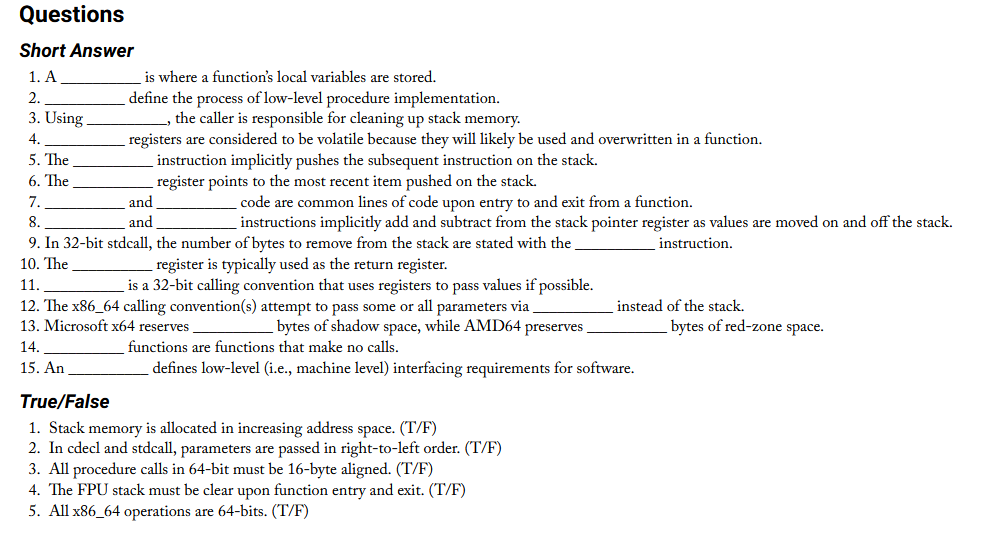
Questions and 8. Short Answer 1. A is where a function's local variables are stored. 2. define the process of low-level procedure implementation. 3. Using _, the caller is responsible for cleaning up stack memory. 4. registers are considered to be volatile because they will likely be used and overwritten in a function. 5. The instruction implicitly pushes the subsequent instruction on the stack. 6. The register points to the most recent item pushed on the stack. 7. code are common lines of code upon entry to and exit from a function. and instructions implicitly add and subtract from the stack pointer register as values are moved on and off the stack. 9. In 32-bit stdcall, the number of bytes to remove from the stack are stated with the instruction. 10. The register is typically used as the return register. 11. is a 32-bit calling convention that uses registers to pass values if possible. 12. The x86_64 calling convention(s) attempt to pass some or all parameters via instead of the stack. 13. Microsoft x64 reserves bytes of shadow space, while AMD64 preserves bytes of red-zone space. 14. functions are functions that make no calls. 15. An defines low-level (i.e., machine level) interfacing requirements for software. True/False 1. Stack memory is allocated in increasing address space. (T/F) 2. In cdecl and stdcall, parameters are passed in right-to-left order. (T/F) 3. All procedure calls in 64-bit must be 16-byte aligned. (T/F) 4. The FPU stack must be clear upon function entry and exit. (T/F) 5. All x86_64 operations are 64-bits. (T/F)
Step by Step Solution
There are 3 Steps involved in it

Get step-by-step solutions from verified subject matter experts