







Question: Questions: (Answer from the following case) 1. Describe the benefits & limitations of TQM, Six Sigma, and Lean separately? (minimum 1000 words) The current and
Questions: (Answer from the following case) 1. Describe the benefits & limitations of TQM, Six Sigma, and Lean separately? (minimum 1000 words)
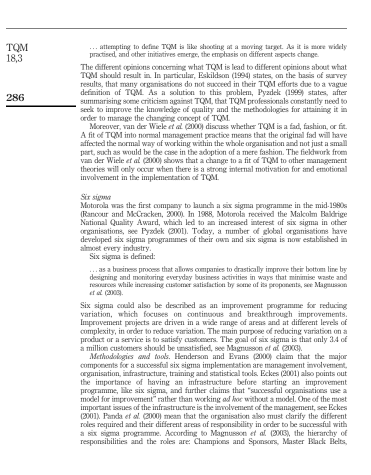
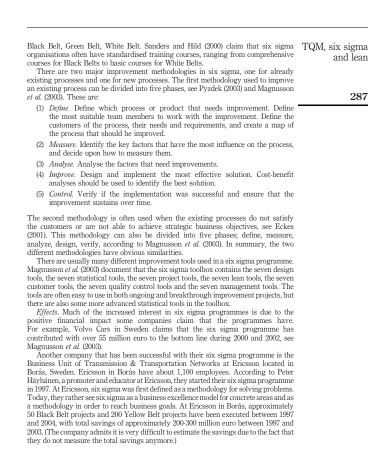
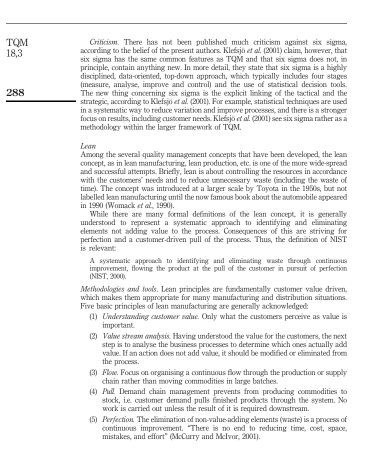
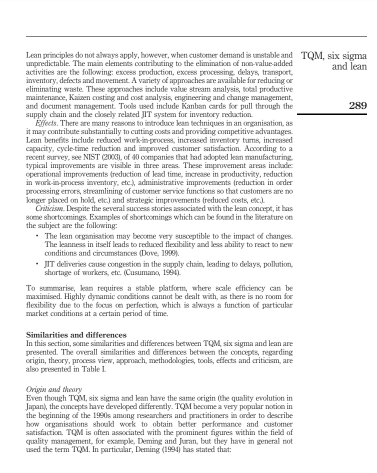
The current and full testade of this peralis viib www.radingle-47.im 18,3 282 Similarities and differences between TQM, six sigma and lean Roy Andersson, Henrik Eriksson and Hkan Torstensson School of Engineering, University College of Boris, Boris, Sweden Abstract Purpose - During the last decades, diferent quality management concepts, including total nility martTOS, sigurado, haweblad by many difcant. Although questions incroceming the applicability of these receptes in various parties and contests Hence, the purpose of this paper is to describe the smlarities and differences between the concepts, including an evaluate and criticism of ache Design/methodology approach - Wahis way anal face-to-face interview in typical TM si sa and an ematea berceried out Finding - Wale TOM, we wymi, pially coming in, methods to and effect the differ in an in particular the main they approach and the main criticism. The en concept is slightly different from Tost and six sigma. However, there is a lot to gaina ganisations are able to combine the three mob, they are platbury. Siste dans les dep, which could lead ce by to combined her with the values in TOM. Originality/value- Tarpauper provide guidance to creates regarding the applicability and properties of accepts Organised to work continly with customer orientated activities in cater to servisimptive of an activities are bed. The paper will be serve sa band for further in this ans, on eactical exprimare of these Keywarch Quality amt, Six eget, Total quality management, La prochactice Quality improvement Paper type Reche Introduction While management is considered as relatively immature compared to other social sciences, the field has been bombarded with "ad" ser, for example, Carson dal 1999. In summary, the different management theories presented over the years of which some could be argued to be management fads, have been criticised for having four major defects. These major defects of the management theory are the following (1) it is constitutionally incapable of self-criticism (2) its terminology and industry-specific jargon rather confuse than ingem; Emerald 3) it marely rises above common sense, and 10 it is replete with fads and plagued with contradictions that would be intolerable in other scientific disciplines (Carson et al, 1999 The TOMM 20 The authors would like to thank Peter Hayhanen, Peter Manfredsson and Anders Nadid at the Cum se hit of Transion and Transportation Networks at Ericson for their contribution *** of valuable information During the last decades, quality management has been put forward by a number of its TQM, six sigma promoters as a new management theory, see, for example, Foley (2004). However, and lean the description of what quality management is differs Quality management can be described as a management revolution, a revolutionary philosophy of management, a new way of thinking about the management of organisations, a paradigm shift, a compechensive way to improve total organisational performance, an alternative to management by control or as a framework for competitive management (Foley, 2000, 283 Despite the high aims of promoters of quality management, the failures of organisaties trying to implement a successful quality management programme have been well documented, see Brown et al (1991), Eskildson (1991), Harari (1997) Chocol (2000) or Nwabue (2001). These failures have led some authors to question whether some concepts in the area of quality management are fads, see.fe example. van der Wieleef (2001 John Godfrey Saxe's famous fable The Blind Men and the Elephant" in which six blind men attempt, and ultimately fail, to describe an elephant could actually be a good description of quality management. In this well written story, each blind man touches only a part of the elephant. They go on to describe what the elephant feels like For example: one blind man says the elephant feels like a wall another blind man describes it as "the elephant feels like a snake". In much the same way as each blind forms a vision of the whole by examining a part promoters of quality manngement have written books and articles and presented seminars about different Crecepts, which either me about the parts or are visions of the whole down from the knowledge of one or a few parts, see Foley (2001). Concepts that have been presented and promoted are, for instance, total quality management (TOM, six sigma, lan manufacturing, business peocess re-engineering, just-in-time (IT), Kaizen and Business Excellence However, the description and definition of these chifferent quality management concepts differ. For example, TOM is sometimes defined ... a continuously evolving memente consisting of values, methodologies and took the aim of which is to increase external and internal customer satisfaction with a reduced amount of resources, see Hellsten and Klefsjo2000 Six Sigma, on the other hand, is defined: as a business process that allows cuatrpanies to drastically improve their bottom line by designing and moting everyday las activities in ways that minimise waste and sons while increasing customer satisfaction by some data proposta, see Magu.com dal (2) NIST (20) defines lean ... as a systematic speech to identifying and diminating waste through costs improvement, flowing the prochact at the pulled the customer in pursuit of perfection While the definitions of TOM, six sigma and lean differ, the aim of the different concepts seems to be similar, through improvements minimising waste and resources while improving customer satisfaction and financial results. These concepts also have the same origin, the quality evolution in Japan after the World War II, see Dahlgaard and Dahlgaard (2001) TQM 18,3 284 With parallel to the fable described above, ce could argue that different promoters in the field of quality management the six blind mel, who each describes different quality management concepts the wall, smake, etc.) are trying to describe a part or a vision about the whole the ans of quality management the elephant. However, the parts or the visions about the whole differ, according to the definitions contributed of TQM six signs and lean (which also was the case for the six blind men. Furthermore, the way to achieve these objectives seems to differ between the different concepts. On the other hand, and as shown above, there are also many similarities, for example, with respect to the overall aim and origin. Therefore, ce could also argue that the different promotes the six blind men in some areas are able to describe a similar vision of the whole a similar picture of the dephant. Hence, and in summary, this paper sets out to describe if the vision of the different promoters of quality management concepts (TQM six sigma and lean) is the same or if it differs. Although considerable progress has been made in the field of quality management in general and in TOM six sigma and lesn in particular, many important issues remain unexplored concerning the similarities and differences between these concepts. Hence, the purpose of this paper is to describe similarities and differences between TQM six sigma and lean. In specific, similarities and differences concerning areas such as the methodologies, tools, effects and criticism are illuminated in this paper. Purthermore, an overall description of each concept is contributed in this paper. Moreover, different management theories have been criticised for having four major defects, see above Hence, the intention with this paper is also to present criticism of each concept (point 1) and informi, rather than confuse the reader about the similarities and differences of each concept point 2, see Carson dal (1999) Quality management concepts Total quality engage www (TOMO Quality has been an important issue organisations for many years. The early focus quality evolved from inspection to quality control and later to quality assurance according to Dale (1998). During the 1990, TQM evolved as a common term amoeg Eganisations. Different definitions of TOM have been presented over the years. Dahlgaard et al. (1998) view TOMS ...a corporate culture caracterised by increand customer satisfaction through contos improvement, in which all employees in the firm actively participate Shiba et al (1993), on the other hand, argue that: TOM is an evolving systemet, and training methods fe managing companies to provide customer satisfaction in a rapidly changing world Hellsten and Klefs (2000) support the view that TOM is an evolving system. Hellsten and Klessjo (2000) define TOME ... as a continuously evolving margement system consisting of values, methodologies and took the sim of which is to increase external and internal customer satisfaction with a reduced amount of resources Metakogues and looks Hellsten and Klefsjo (2000) argue that methodologies are *ways to work within the corganisation to reach the values. A methodology, according to Hellsten and Klefsjo (2000), consists of a number of activities performed in a certain TQM, six sigma way". Helsten and Klefsjid (2000) define took as: and lean ... rather concrete and well-defined tools, which sometimes have a statistical basis to support decision-making or facilitate aralysis of data Tools that are frequently mentioned in the TOM literature include the seven quality control tools, see Shewhart (1990) and Ishikawa (1985), and the seven management 285 tools, see Mizuno (1988). The improvement cycle is also a common methodology in ceder to improve the business, according to Evans and Lindsay (1999). The improvement cycle is composed of four stages: plan, ds, study and act (PDSAL Efects. Vokurka et al. (2000) argue that with customers demanding quality and competitors respoeding to such demands, business turned to TQM as the key to enhance overall performance. There are many different approaches to evaluating the possible benefits of TQM. Historically, one of the most common ways to quantify the benefits of quality has been to estimate the cost of poor quality, se, for example, Juran (1989) and Surqvist (1996). In recent years, research has also shown that one of the goal of TQM customer satisfaction, has a significant positive impact on market value as well as accounting returns, see, for example, Andersson and Fornell (1991) and Elder (19) The General Accounting Office GAO) study was one of the first studies trying to establish a link between TOM practices and the performance of companies, see GAO (1991). In this study, alcolm Baldrige recipients and companies that had received a site-visit fie companies that in a sense were close to receiving an award were evaluated. The main coeclasice from the GA study was that the companies investigated and improved their operating results. Moreover, better employee relations and improved operating procedures had been achieved greater customer satisfaction had been accomplished, and an increased market share and profitability had been ained Hendricks and Singhal (1997) and Eriksson and Hansson (2006) compare recipients of quality awards with different control companies. The main conclusions from their research are that companies that have received a quality award outperform the control companies concerning operating income based measures and other indicators during a period that follows the announcement. For instance, the growth in operating income for recipients averaged 91 per cent during a period that followed the award announcement, in contrast to a 13 per cent average growth for the control groups, see Hendricks and Singhal (1997). Lemak and Reed (1997) also daim that TOM leads to an improved profit margin, after studying 80 companies that had demonstrated a commitment to TOM for a period of at least five years, Criticism. The failures of TQM implementation have been well documented, see for example, Brown ef al (1990). Eskilson (1991), Harari (1997). Cao et al 20001 Nwabuese (2001) and Foley (2004). In more detail Harari (1997) states that after studying all the independent research conducted by consulting firms, the conclusion is that only about coefifth, or at best one-third of the TQM programmes in the US and Europe have achieved significant even tangible improvements in quality, productivity, competitiveness or financial results As shown above described in Baden (1997) and Hellsten and Klefsjo (20001 opinions differ about what TOM really is. Boaden (1997) claims in particular that: 18,3 286 ... attempting to define TOM is like sbecting at a serving target. As it is mee widely practised, and other initiatives emerge, the emphasis on different aspects change The different opinions concerning what TOM is lead to different opinions about what TOM should result in In particular, Eskildsen (1999states on the basis of survey results, that many organisaties do not succeed in their TOM efforts clue to a vague definition of TOM As a solution to this problem, Pyzdek (1999) states, after summarising some criticism against TOM, the TQM professionals constantly need to seek to improve the knowledge of quality and the methodologies for attaining it in rder to manage the changing concept of TOM. Moreover, van der Wiele et d (2000) discuss whether TQM is a fad, fashion, or fit A fit of TOM into normal management practice means that the original fad will have affected the normal way of working within the whole organisation and not just a small part, such as would be the one in the adoption of a mere fashion. The flekhwork from van der Wiele et al (2000) shows that a change to a fit o TOM to other management theories will only couur when there is a strong internal motivation for and emotional involvement in the implementation of TOM. Sir Motorola was the first company to launch a six sigma pengramme in the mid-1980s Fancour and McCracken, 2000. In 1988. Motorola received the Malcolm Bakrige National Quality Award, which led to an increased interest of six sigma in other ganisations, see Pyadek (2001). Today, a number of global organisations lave developed six sigma programmes of their own and six sigma is now established in almost every industry Six sigma is defined: was a business process that allows companies to drastically improve their bottom line by designing and monitoring everyday business activities in ways that minimise waste and or while increasing customer satisfaction by some of its peopotants, see Magisson Six Sigma could also be described as an improvement programme for reducing variation, which focuses on continuous and breakthrough improvements Improvement projects are driven in a wide range of areas and at different levels of complexity, in order to rechace variation. The main purpose of reducing variation on a product or a service is to satisfy customers. The goal of six sigma is that only 3.4 of a millice customers should be unsatisfied, see Magnusson el of 2000). Methodologies and tool. Henderson and Evans (2000) claim that the major components for a successful six sigma implementation are management involvement cerganisation, infrastructure, training and statistical tools. Eckes (2001) also points out the importance of having an infrastructure before starting an improvement programme, le six sigma, and further daims that successful organisaties use a model for improvement" rather than working for without a model. One of the most important issues of the infrastructure is the involvement of the management, see Eckes (2001) Panda, et al. 2000) mean that the organisation also must clarify the different roles required and their different arests of responsibility in ceder to be successful with a six sigma programme. According to Magnusson et al (2003), the hierarchy of responsibilities and the roles are: Champices and Sponses Master Black Belts Black Belt, Green Belt, White Belt. Somders and Hild (2000) daim that six sigm TQM, six sigma Organisaties often have standardised training courses, ranging from comprehensive and lean courses for Black Belts to basic courses ke White Belts There are two major improvement methodologies in six sigma, one for already existing processes and one for new processes. The first methodology used to improve an existing process can be divided into five phases, see Pyzdek (2008) and Magnusson ef (2000). These are 287 (1) Define Define which process or prochact that needs improvement. Define the most suitable team members to work with the improvement. Define the customers of the process, their needs and requirements, and create a map of the process that should be improved. ( Masure. Identify the key factors that have the most influence on the process, and decide upon how to measure them. 5) Analyst Analyse the factors that need improvements 4) Improve Design and implement the most effective solution. Cost benefit analyses should be used to identify the best solution Cuinal Verify if the implementation was successful and ensure that the improvement sustains over time The second methodology is often used when the existing processes do not satisfy the customers or are not able to achieve strategic business objectives, see Eckes (2001). This methodoge can also be divided into five paises define, mestre analyze, design, verify, according to Magnusson el (2003). In summary, the two different methodologies have obvious similarities. There are usually many different improvement tools used in a six sigma programme Magnusson et d (2003) document that the six sigma toolbox contains the seven design tools, the seven statistical tools, the seven project tools, the seven kan tools, the seven customer tools, the seven quality control tools and the seven management took. The tools are oftenessy to use in both going and breakthrough improvement projects, but there are also some more advanced statistical tools in the toolbox Eyfects. Much of the increased interest in six sim programmes is due to the positive financial impact some companies claim that the programmes have For example, Volvo Cars in Sweden daims that the six sigma programme des Sretributed with over 55 milion euro to the bottom line during 2000 and 2002, see Magnusson et al (2003) Another company that has been successful with their six sigma programme is the Business Unit of Transmission & Transportation Networks at Ericsson located in Bors, Sweden. Ericsson in Beras have about 1,100 employees. According to Peter Hastanen, a promoter and educate at Ericssce, they started their six sigma progomme in 1997. At Ericsson, six sigma was first defined as a methodology Resolving problems Today, they rather see six sigma as a business excellence model for concrete areas and as a methodology in order to reach business goals. At Ericsson in Boris, approximately 50 Black Belt projects and 200 Yellow Belt projects have been executed between 1997 and 2001, with total savings of approximately 200-300 million euro between 1997 and 2005. (The company admits it is very difficult to estimate the savings due to the fact that they do not measure the total savings anymore.) TOM 18,3 Criticism. There has not been published much criticism against six sigma, according to the belief of the present authors. Klessjo et al. (2001) claim, however, that six sigma as the same common features a TOM and that six sigma does not, in principle, contain anything new. In more detail, they state that six sigma is a highly disciplined data-ciented, top-down approach, which typically includes four stages messure, analyse, improve and control and the use of statistical decision took. The new thing concerning six sigma is the explicit linking of the tactical and the strategic, according to Klefs et al (2001). For example, statistical techniques are used in a systematic way to reduce variation and improve processes, and there is a stronger focus on results, including customer needs. Klebjot a. (2001) see six sigma rather as a methodology within the larger framework of TQM. 288 Among the several quality management concepts that have been developed the lean concept, as in lean manufacturing, lean production, etc is one of the more widespread and successful attempts. Briefly, lean is about controlling the resources in accordance with the customers' needs and to reduce necessary waste (including the waste of time. The recept was introduced at a larger scale by Toyota in the 1990s, but not labelled lean manufacturing until the now famous book about the mobile appeared in 1990 (Womack et al. 1990). While there are many formal definitions of the lean concept it is generally understood to represent a systematic approach to identifying and eliminating elements not ackling value to the process. Consequences of this are striving for perfection and a customer-driven pull of the process. Thus, the definition of NIST is relevant A systematic approach to identifying and diminating waste through times INIST, 2X00 improvement , towing the product at the pull of the customer in pursuit of perfection Methodologies and fails. Lean principles are fundamentally customer value driven. which makes them appropriate for many manufacturing and distribution situations Five basic principles of lean manufacturing are generally acknowledged (1) Understanding customer salue. Only what the customers perceive as value is important 12 Value stream wiss Having understood the value for the customers, the next step is to analyse the business processes to determine which cecs actually add value. If an action does not add value, it should be modified ce eliminated from the procese 3 Pow. Focus on organising a continuous flow through the production de supply chain rather than moving commodities in large batches 14 P Demand chain management prevents from producing commodities to stock, ie customer demand pulls finished products through the system. No work is carried out unless the result of it is required downstream. Perfection. The elimination of non-value-addling elements (waste) is a process of continuous improvement. There is no end to reducing time, cost, space mistakes, and effort" McCurry and McIvor, 2001). Lean principles do not always apply, however, when customer demand is unstable and TQM, six sigma unpredictable. The main elements contributing to the elimination of ne-value added activities are the following excess production, excess processing delays, transport and lean inventory, defects and movement. A variety of approaches are available for reducing ce eliminating waste. These approaches include value stream analysis, total productive maintenance, Kaien casting and cost analysis, engineering and change management and document management. Tools used include Kanban cards for pull through the 289 supply chain and the closely related JIT system for inventory reaction Effects. There are many reasons to introduce la techniques in an organisation, as it may contribute substantially to cutting costs and providing competitive advantages. Lean benefits include reduced work in process, increased inventory tums, increased capacity, cycle time reduction and improved customer satisfaction. According to a recent survey, see NIST (2003). of 40 companies that had adopted lean manufacturing typical improvements are visible in three areas. These improvement arests include operational improvements (reduction of lead time, increase in productivity, reduction in work in process inventory, etc), administrative improvements reduction in ceder processing errors, streamlining of customer service functions so that customers are no longer placed on hold, etc.) and strategic improvements reduced costs, etc.) Criticism. Despite the several success stories associated with the leam concept, it has scene shortcomings Examples of shortcomings which can be found in the literature on the subject are the following: The lean organisation may become very susceptible to the impact of changes The leanness in itself leads to reduced flexibility and less ability to react to new conditions and circumstances (Dove, 1990). JIT deliveries cause congestice in the supply chain, leading to delays, pollution shortage of workers, etc. (Cusumana, 1994 To summarise, lean requires a stable platform, where scale efficiency can be maximised. Highly dynamic conditions cannot be dealt with, as there is no room for flexibility due to the focus ce perfection, which is always a functice of particular market conditions at a certain period of time. Similarities and differences In this section, some similarities and differences between TOM, six sigma and lean are presented. The overall similarities and differences between the concepts regarding origin, theory, process view, approach, methodologies, tools, effects and criticism, are also presented in Table 1 Origin and theory Even though TOM, six sigma and lean have the same origin (the quality evolution in Japan, the concepts have developed differently. TOM become a very popular notice in the beginning of the 1990s among researchers and practitioners in order to describe how organisations should work to obtain better performance and customer satisfaction. TOM is often associated with the prominent figures within the field of quality management, for example, Deming and Juman, but they have in general mot used the term TQM. In particular, Deming (1994, has stated that: lae tecuble with TOM, the failure of TUA yw can call, is that there is no such thing. It TQM, six sigma is a buzzword. I have never used the term as it carries no meaningsommo (1994) and lean The success with six sigma at Motoroka and with lean at Toyota is a main reason these concepts to spread to other organisations. In contrast to six sigma and lesin, no organisatie was the origin to the term TQM (there is ongoing discussion on who really labelled TOM A notable difference between six sigma and lean is that Motorola labeled six sigma, se Rancour and McCracken (20001.while authors in the field 291 Womack et al (1990), labelled the len concept. George et al 200) caim that the main difference between six sigma and lean is that the previous focuses more on accomplishing no defects, while the latter is a better choice whence wants to improve process flow and eliminate waste. TQM also has elements of accomplishing no defects and eliminate waste, but with the main objectives to increase external and internal customer satisfaction with a reduced amount of resources, see Hellsten and Klefsj (2000) Princess and approach The improvement projects in a six sigma programme are conducted in a wide range of areas and at different levels of complexity in order to reduce variation, see Magnusson et al (2003). When the project members have reduced the variation in a percess, and hence achieved the business goals, increased the profit or lowered the cost, this improvement is visualised to the top managers at the company. Often some of the top managers are also involved in the performed improvement projects. As a result, the six sigma programme receives necessary support from the top managers at the company, as the managers recognise the conceical impact of it. This could be cae explanation for the documented successes of six sima compared with TOM, ie six siem programmes all the top manager language the comical gains of the improvement). Lean on the other hand, is a discipline that focuses ce process speed and efficiency, or the flow, in order to increase the customer value, see George et al 2001). In lean manufacturing project groups are usually the approach to perform the necessary improvements. While six sigma and lean focus on performing improvements mainly through prujects, TOM has sometimes a different approach. TOM emphasis the commitment and involvement of all employees, see, for example Bergman and Klefsj 20. In TOM, there is also like six sigma and lean, a strong focus on processes. It is the authors' opinion that the main objectives of the process work within TOM are to alternatively improve and mifcem the processes Metodologies Hellsten and Kiefejo (2000) argue that TOM contains a number of methodologies However, the improvement cycle is one of the most widespread methodologies in TQM. according to Evans and Lindsay (1996). The improvement cycle is composed offer stages PDSA. In six sigma there are two major improvement methodologies, one se already existing processes and one for new processes, see above. The lean principles could in this context be regarded as a methodology. The principles of lean are understanding customer vakre, value stream, analysis, flow.pull and perfection. There are many similarities between the improvement cyde in TOM and the methodologies of six sige. the methodologies are cyclical and consist of similar phases. One could argue that the methodologies in six sigma are a further development of the TQM 18,3 improvement cyck, which first was developed by Shewhart and Deming. The bean principles are different compared to the methodologies in TQM and six sigma, as they are not cyclical in nature and are not focused on how to perform improvements 292 Tools Deming stated that about 96 per cent of the problems are built into the system and that individual employees cam cely control about percent. The purpose of most improvement efforts is to use data in a proper way in order to find out what is wroeg with the system and hence improve the system in six sigma, lean and TOM, there are many different tools that could be used in order to find out what is wrong with the system. TQM normally consists of tools that have either a statistical or an analytical hase. Among others the seven quality control tools and the seven management tools are frequently applied in TOM. In general, six sigma programmes have been successful at integrating advanced improvement tools with the methodologies. The tools range from design tools to management tools and from very simple tools to more advanced statistical tools. During the training programmes in six sigma, one learns how to chocce the most appropriate tool and how it should be applied. In addition, cee must verify the selection in order to assure that the appropriate tool was chosen. In general six sigma programmes have successfully emphasised the statistical part in quality management. In lean, a variety of tools are available for reducing or eliminating waste. see above. In summary, the tools in the lean concept are more analytical in nature compared to the more statistical tools used in TQM and six sigma. The main objective with TQM is to increase the customer satisfactice, see Hellsten and Klefsjo (2000. Ele al (1909) have also shown that there is a positive correlation between customer satisfaction and the financial results of companies. Furthermore, there is strong cuerelation between customer satisfaction and customer loyalty, see Sderlund (2001). Moreover, it has been shown that canisations that have successfully implemented TQM outperform similar organisations regarding a number of financial indicators, see Hendricks and Singhal (1997) and Eriksson and Hanse (2003). On the other hand, Ingle and Roe (2001) argue that in a six sigma programme the projects are selected in such a way that they are cleely tied to the business goals or objectives. The company's business goals are normally set in such a way that customers' needs will be satisfied. Before starting a six sigma project, one must prove that the improvement will result in economical savings for the company. This results in the fact that all improvements in a six sigma programme are economically justified. However, it is the authors' opinion that six sigma does not necessarily improve customer satisfaction to the same extent as a successful TQM programme. The reasca is that a six sigma programme primarily emphasises the economical savings and secondly the customer satisfaction. This view was supported by Ericson in Boris. When starting a lean project with the objectives to recoce the lead time of a process cee first analyses the customer's demands of the process. Hence, the objectives of the improvement, besides redacing the lead time is also to increase customer satisfaction In addition, increased productivity and an inventory reduction are common effects of successful les projects TOM, six sigma and lean 293 Critic The main criticism against TOM is that there is a widespread confusion concerning what TOM really means, see Baden (1997) and Hellsten and Klefsio (2000). In addition, a number of failures of organisations trying to implement TOM have been documented. In mee detail a number of ceganisations have put a large amount of resources on implementing TOM, but with no tangible improvements achieved, see, among others, Harari (1997). According to Magnusson et al. (2003), there is a difficulty in six sigma programmes to exceed the customer's needs and hence increase the customer satisfaction. To avoid this problem some companies use voice of the customer tools in their define phase. Klefsjef ol (2001) claim that six sigma programmes fail to create coeditions in order to involve everyone, which is more emphasised in the TOM literature. Furthermore, in six sigma training programmes one can only start a project which gives a certain amount of savings. This project is often executed in the department of the project members. The project normally lead to an improvement in the department of the project members, but due to the performed change another department can experience deterioration. As a result, six sigma is sometimes accused not having a system view. The main criticism against lean is the lack of flexibility the concept offers, see Dove (1999), and that the concept actually can lead to delays se the customers, see Cusumano (1991). There is also a discussion going on whether lean. which was developed for manufacturing and distribution situations, is applicable in all industries. Mast (20041.ca the other hand, argues that six sigma can be applied in a wide range of areas, including both manufacturing and service industries Discussions The presented concepts show many similarities, especially six sigma and TOM However, the package of quality took the attention to financial result, the sustaining of the gains, and the focus of the problem solving methods of projects are new approaches in six sigma compared to other concepts in quality management. Klefsjef al (201) argue that six siema should be regarded as a methodology within the larger framework of TOM. One reason for this is due to the fact that Six Sigma Supports all the six values in TOM, see Klefsio et al (2001). Dahlgaard and Dahlgaard (201) also state that there is not any contradiction between the objectives in lean and TOM. They suppet the view persented by Klessjo et al (2001) above, and argue that six sigma and lean should rather been seen as a collection of concepts and tools, which support the overall principles and aims of TQM. Dahlgaard and Dahlgaard (2001) mean that six sigma and lean have clear road-maps in order to achieve business excellence, but it is important in order to be successful to stress the corporate culture and human factor in these concepts. TQM is often accused for being blur and unclear, and it is therefore, the authors in that six sigma and lean can be appropriate approaches for organisaties in order to make important progress in the field of quality management. Recently, the term lean Six Sigma has been put forward by, for example, George et al (2004) and Martichenko (2004). In specific, George et al. (2004) claim that: Lean Six Sigma helps companies fourish in a new world where customer expect to defects and fast delivery at the minimal cost. Magnusson et al. (2004) also state that many companies have merged six sigma and Lean manufacturing practices. The merger can be traced back to early developments at General Electrics where they realised that the two concepts complemented each other TQM 18,3 294 very well, ie. kan manufacturing addresses process flow and waste whereas six sig addresses variation and design This paper has focused ca a theoretical description and comparison of the quality management concepts. Further research in this area will need to focus on the practical experience of these crecepts, and contribute to a better understanding concerning which concept is most appropriate in different situations. Furthermore, a more detailed descriptice of how these concepts can be combined needs to be presented in order to facilitate for organisaties to meet and exceed the demands of future customers and survive in an even more competitive environment. Conclusions The purpose of this paper is to describe similarities and differences between TOMsix sigma and lean. With parallels to the table described above, one could argue that the blind men's visions about the whole are very similar the three presented concepts have many similarities, especially crecerning on methodologies tools and effects However, the blind men's vision about the whole also differs slightly in some areas especially concerning the main theory, approach and the main criticism.Comparing the different quality management concepts, TOM and six sigma show many similarities while the les concept is slightly different compared to the previous two. However, it is the authors' recommendation that there is a lot to gain if organisations are able to combine these three concepts. Indeed, the concepts are complementary, especially six sigma and lean are excellent road-maps, which could be used one by one or combined in order to strengthen the values of TOM within an organisatice. Even if some of the presented concepts have been accused for being management fads, see above it is the authors' opinion that organisations continuously need to work with customer-orientated activities in order to survive, irespective of how these activities are labelled today and in the futureStep by Step Solution
There are 3 Steps involved in it
1 Expert Approved Answer
Step: 1 Unlock

Question Has Been Solved by an Expert!
Get step-by-step solutions from verified subject matter experts
Step: 2 Unlock
Step: 3 Unlock
 Study Help