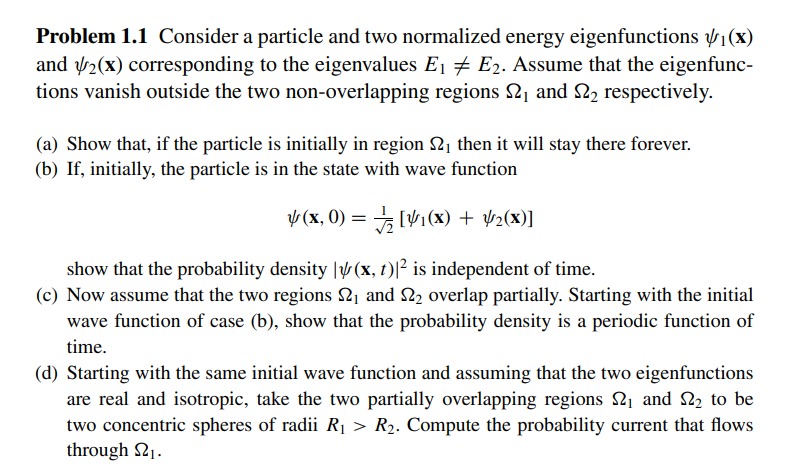
Question: Questions are attached below; Problem Ll Consider a particle and two normalized energy eigenfunctions y'rl (x) and wx) corresponding to the eigenvalues E] 51: E3.
Questions are attached below;
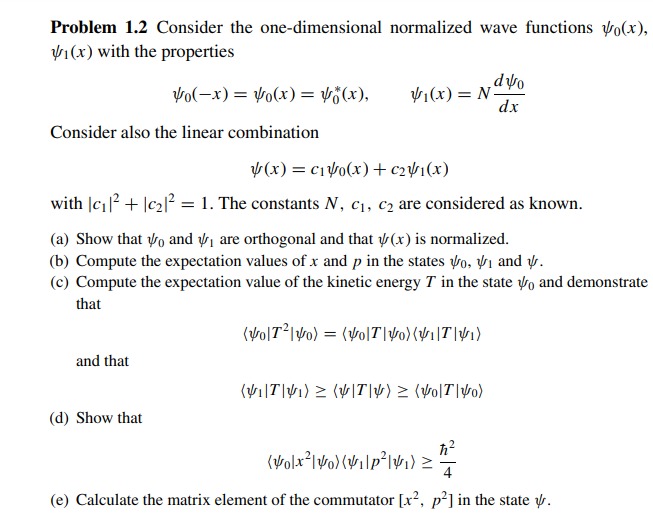
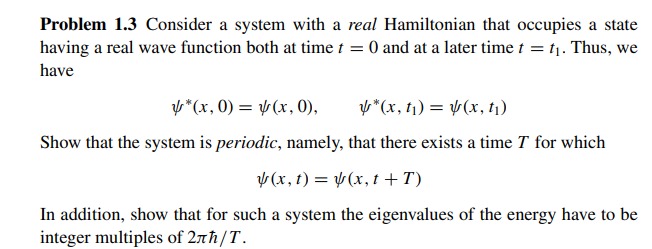
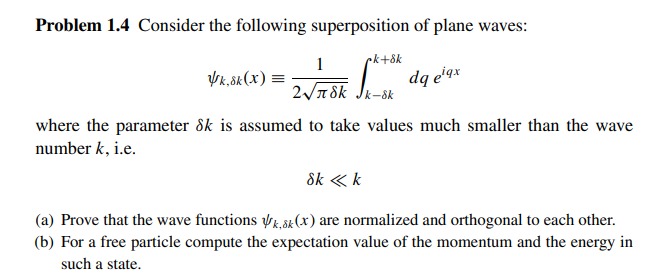
Problem Ll Consider a particle and two normalized energy eigenfunctions y'rl (x) and wx) corresponding to the eigenvalues E] 51: E3. Assume that the eigenfunc- tions vanish outside the two non-overlapping regions (21 and 523 respectively. (a) Show that, if the particle is initially in region Ql then it will stay there forever. (b) If, initially, the particle is in the state with wave function we, 0} = g was + 1am] show that the probability density \"MK, ll is independent of time. (c) Now assume that the two regions 5'21 and E22 overlap partially. Starting with the initial wave function of case (b), show that the probability density is a periodic function of time. (d) Starting with the same initial wave function and assuming that the two eigenftmctions are real and isotropic, take the two partially overlapping regions 5'21 and 22 to be two concentric spheres of radii R] :3 R2. Compute the probability current that ows through 3'2]. Problem 1.2 Consider the one-dimensional normalized wave functions vo(x), y (x) with the properties yo( -x) = vo(x) = vo (x), VI (x) = N dx Consider also the linear combination V (x) = cio(x) + czyI(x) with |cil + |c212 = 1. The constants N, c1, c2 are considered as known. (a) Show that vo and v are orthogonal and that vr(x) is normalized. (b) Compute the expectation values of x and p in the states vo, y and v. (c) Compute the expectation value of the kinetic energy 7 in the state wo and demonstrate that (VolT |vo) = (volT|yo)(wilTly1) and that ( Wil TIVI) = (VITly) = (volT/vo) (d) Show that (wolx ] [yo) (wilp IV1) = (e) Calculate the matrix element of the commutator [x-, p'] in the state v.Problem 1.3 Consider a system with a real Hamiltonian that occupies a state having a real wave function both at time * = 0 and at a later time f = 1. Thus, we have y*(x, 0) = y (x, 0). * ( x , 1 1 ) = y (x, t1 ) Show that the system is periodic, namely, that there exists a time T for which y ( x , t ) = v(x, t+ T) In addition, show that for such a system the eigenvalues of the energy have to be integer multiples of 2xh/T.Problem 1.4 Consider the following superposition of plane waves: k +8k YA, SK (x ) = dq eqx 2vnSK JK-8k where the parameter 8k is assumed to take values much smaller than the wave number k, i.e. Sk









 Study Help