







Question: Questions attached below 2. Consider the following IS-LM model: C = 200 + 025(Y -T) I = 150 + 0.25Y - 1000i 7 = 200
Questions attached below
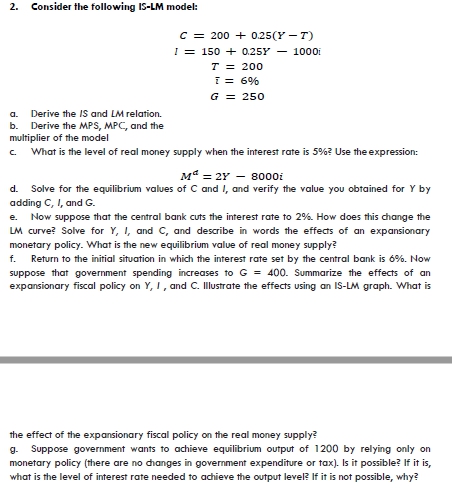
2. Consider the following IS-LM model: C = 200 + 025(Y -T) I = 150 + 0.25Y - 1000i 7 = 200 7 = 6% G = 250 a. Derive the IS and LM relation. b. Derive the MPS, MPC, and the multiplier of the model C. What is the level of real money supply when the interest rate is 5%? Use the expression: M" = 2Y - 8000i d. Solve for the equilibrium values of C and I, and verify the value you obtained for Y by adding C, I, and G. e. Now suppose that the central bank cuts the interest rate to 2% How does this change the LM curve? Solve for Y, I, and C, and describe in words the effects of an expansionary monetary policy. What is the new equilibrium value of real money supply? f. Return to the initial situation in which the interest rate set by the central bank is 6%. Now suppose that government spending increases to G = 400. Summarize the effects of an expansionary fiscal policy on Y, I , and C. Illustrate the effects using an IS-LM graph. What is the effect of the expansionary fiscal policy on the real money supply? g- Suppose government wants to achieve equilibrium output of 1200 by relying only on monetary policy (there are no changes in government expenditure or tax). Is it possible? If it is, what is the level of interest rate needed to achieve the output level? If it is not possible, why
Step by Step Solution
There are 3 Steps involved in it

Get step-by-step solutions from verified subject matter experts
 Study Help