Question: Questions: Authors Message. Highlight two or three of the authors major ideas from the chapter that resonate with you. Applying the information: How do these
Questions:
- Authors Message. Highlight two or three of the authors major ideas from the chapter that resonate with you.
- Applying the information: How do these ideas affect you personally? What are the possible implications for your educational and career planning?
- What is the one important learning that you can take away from this chapter, and why?
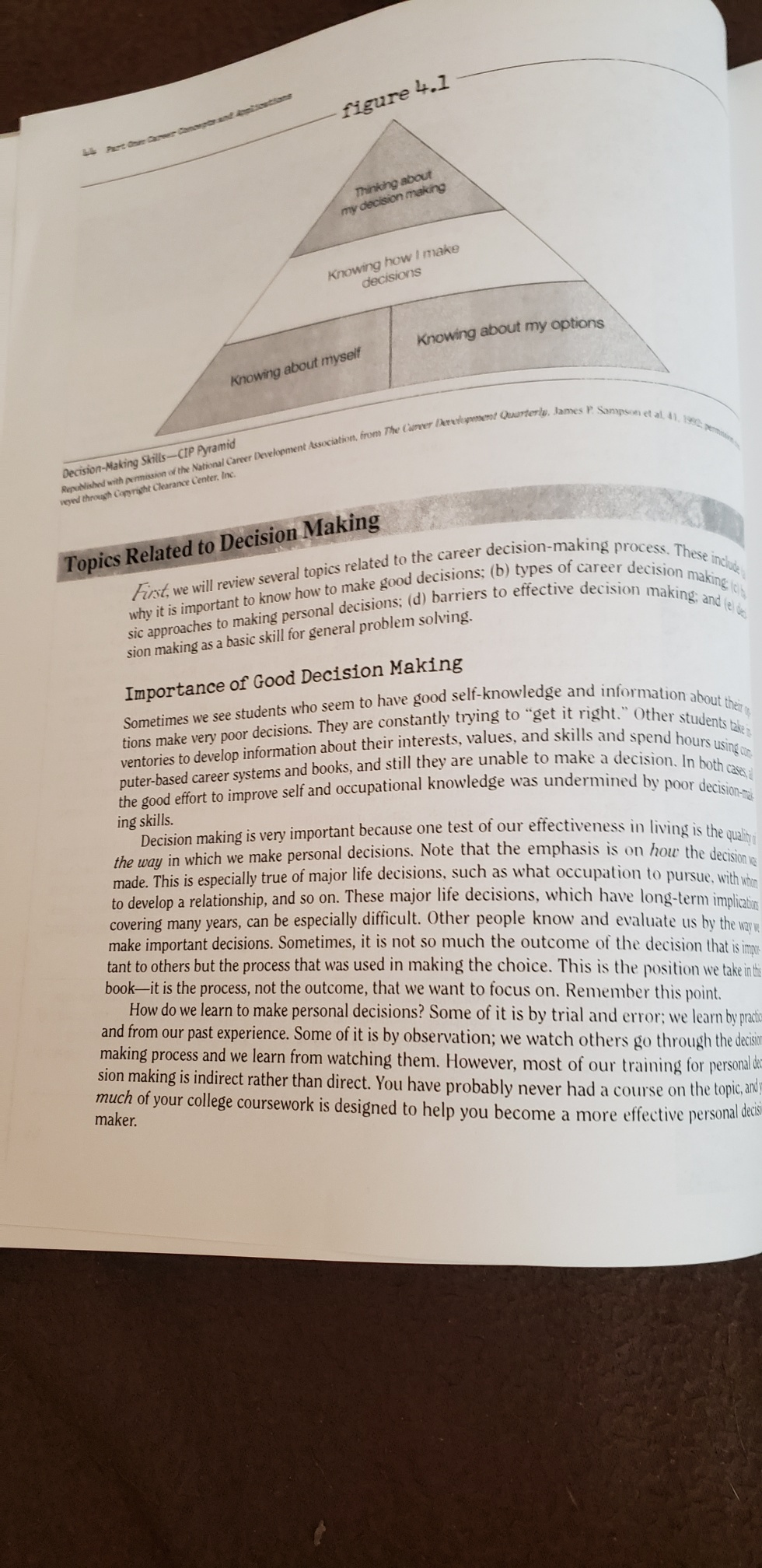
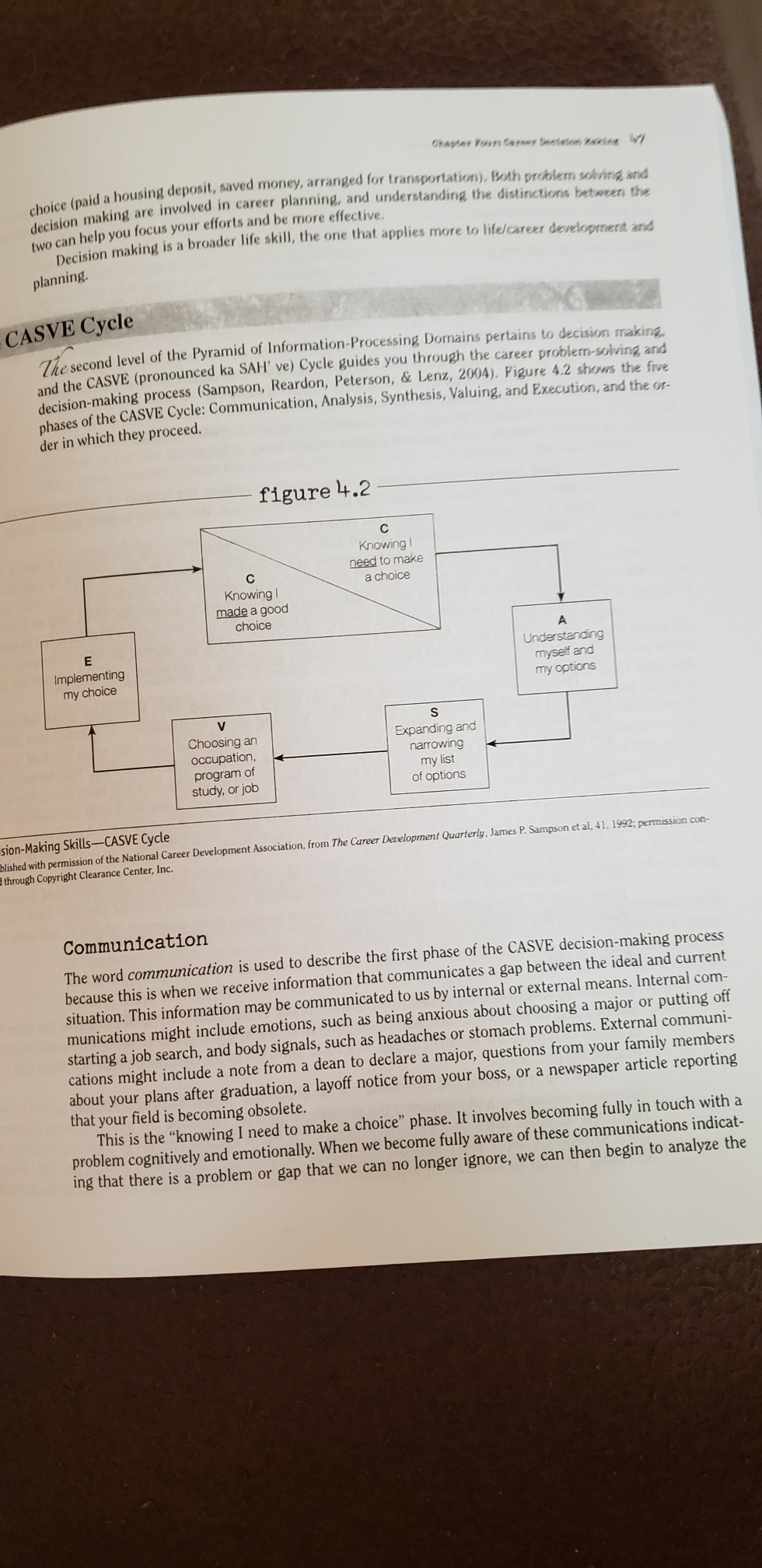
Repuished with permission of the National Career Development Association from the car and Quarterle. James P Sonypetal decision-making process. These include why it is important to know how to make good decisions; (b) types of career decision making, tions make very poor decisions. They are constantly trying to get it right." Other students taken ventories to develop information about their interests, values, and skills and spend hours using our puter-based career systems and books, and still they are unable to make a decision. In both caso, the good effort to improve self and occupational knowledge was undermined by poor decision-made sic approaches to making personal decisions; (d) barriers to effective decision making and le Sometimes we see students who seem to have good self-knowledge and information about the figure 4.2 Thinking about my decision making Knowing how I make decisions Knowing about my options Knowing about myself Decision-Making Skills -CIP Aramid vond through Copyright Clearance Center, Inc Topics Related to Decision Making First, we will review several topics related to the career sion making as a basic skill for general problem solving. Importance of Good Decision Making ing skills. Decision making is very important because one test of our effectiveness in living is the que la the way in which we make personal decisions. Note that the emphasis is on how the decisione made. This is especially true of major life decisions, such as what occupation to pursue, with whin to develop a relationship, and so on. These major life decisions, which have long-term implication covering many years, can be especially difficult. Other people know and evaluate us by the way we make important decisions. Sometimes, it is not so much the outcome of the decision that is imp tant to others but the process that was used in making the choice. This is the position we take in this bookit is the process, not the outcome, that we want to focus on. Remember this point How do we learn to make personal decisions? Some of it is by trial and error; we learn by pract- and from our past experience. Some of it is by observation; we watch others go through the decision making process and we learn from watching them. However, most of our training for personal de sion making is indirect rather than direct. You have probably never had a course on the topic , and much of your college coursework is designed to help you become a more effective personal decisi maker. Kinds of Career Decision Makers The general education courses you take in college, such as those in history, literature, humani- course and to help you learn to apply that knowledge in personal decision making. For example, ties, biology, and psychology, are designed to both inform you about the discipline undergirding the coursework in biology, history, geography, or economics can help you develop a personal understand- decisions in this regard. The CASVE Cycle, which we will explore in more detail in this chapter, is Sometimes it is hard to distinguish who is decided, undecided, or indecisive with respect to career Chapter Four: Career Decision Making 45 based on the common problem-solving ideas behind those general education courses. decision making. Even if we are decided on our career goals and have a career plan, we may still expe- rience periods of uncertainty and indecision over particular aspects of our situation. Peterson, Samp- son, and Reardon (1991) reviewed theory and research literature in this area and identified three States, or conditions, of career decision makers. These three kinds of individual decision makers are (a) decided, (b) undecided, and (c) indecisive. Decided individuals are people who independently integrate knowledge about self and knowledge about options that enables them to develop a career plan that is satisfying and beneficial to them- selves and to society as a whole. They need to confirm a decision or to implement one. A key point is that the person has reviewed all of the relevant facts and data about self and about options in order to make a decision. In other words, a person is decided" because of internal decision-making processes rather than from the external judgments by others. However, a "false" decided person is one who has chosen an option in order to reduce immediate stress. For example, a student might list a psychology major on a college application form to avoid being identified as undecided" by out- siders (college admissions officials), even though the student is uncertain about which major to pursue. Undecided individuals are people who have not made a commitment to an occupational or edu- cational choice. Some undecided people may be considering options, but for very appropriate reasons are comfortable not declaring a first choice. Other undecided people want occupational certainty and are uncomfortable not being able to declare a first choice. This lack of comfort may lead them to seek career counseling or to get more information about their occupational and educational options. Still other undecided people may have many interests and skills and are unable to make a commitment to an occupational choice due to the numerous options that fit their interests and skills. Indecisive individuals are people who are often unable to make career decisions and continually experience considerable stress in their lives. They often find it difficult to make plans in many areas of life, and generally they focus on outside events or people in making decisions. In some cases, inde- cisive people find it difficult to explore options because of their anxiety; they put off or procrastinate making decisions; they shift responsibility for the decisions to someone else; or they exaggerate the advantages and disadvantages of various options. These three kinds of decision states are sometimes difficult to identify with respect to specific in- dividuals, but in general they help us understand what kind of career assistance may be needed. Peo- ple who are indecisive may need special assistance in their career decision making. Problems in Effective Decision Making What kinds of things can interfere with effective decision making? The following are some of the more general problems. Being aware of these problems can help you take the necessary steps to set yourself up to succeed in the decision-making process. PERSONAL. We need to be in good physical, emotional, and mental condition to engage in effectiva decision making. If we were competing in an athletic event, we would want to be in top form and we prepared so we could succeed and have the best chance of winning the event. Being tired or stress and unable to focus on the decision-making activity will not ensure a good performance. This may are often not in good decision-making condition. Their general lack of life-management skills pro- FAMILY. Family members and relationships with significant others can interfere with effective de cision making. (They can help too, of course, but we're looking at problem areas for now.) For younger people, the problems may be with parents; for older individuals, problems may be with spouses, partners, or children. Scholars who study family systems and career decision making have separating themselves emotionally and psychologically in decision making. For example, when there observed that people who are too interconnected with another family member can have difficulty is a lack of distinction between what a significant other thinks you should major in and what you think you should major in, and you can't keep it all separate, then you can have a problem. A lack of sound obvious, but career counselors find that people who have difficulty in career decision making agreement among family members about things like duty, money, responsibility, achievement, and Part Onet Career Concepts and Applications vides little foundation for effective decision making. values can present problems in personal decision making. (As an aside, it is important to note that in some cultures , it is considered proper and appropriate for older family members to actively partici. pate in the career decisions of younger members. We will explore these ideas more in Part Two of this book.) SOCIETY. Social , economic, historical, and cultural forces can interfere with effective career deci. sion making. A national economic recession, gender , ethnic prejudice shared among residents in a community, or age discrimination can complicate one's career options and decisions. In the case of a recession, none of the options may be very good, unless you work for a company that tries to find jobs for workers that have been "dehired." Altogether, these three factors can make decision making even more difficult than usual, but they are all likely to be a part of many career decisions. Effective career decision makers learn to de velop strategies for overcoming personal and social factors that interfere with their decision making. Decision Making Contrasted with Problem Solving You have probably noticed that in the first four chapters of this book, the phrases problem solving and decision making" have been used repeatedly. What are the similarities and differences between these terms? Understanding the distinction is important if this book is to be helpful. Cognitive psychologists view a problem as a gap between a current state and a more desired state of affairs. The desire to remove the gap is the source of motivation to engage in the career prob- lem-solving and decision-making process. Problem solving, then, involves thinking or processing information that will lead to a course of action to remove the gap. This thinking process involves (a) recognizing the gap, (b) analyzing its causes, (c) coming up with different ways to remove the gap, and (d) choosing one of these ways to remove the gap. Thus, problem solving involves a choice among plausible alternative courses of action. In contrast to problem solving, cognitive psychologists view decision making in a broader way. It includes the four steps of problem solving, but it adds (e) the development of a plan or strategy for implementing the chosen solution and the adoption of a risk-taking attitude and commitment to carry the plan to completion. Decision making, then, adds our feelings and behaviors to the problem- solving process. Decision making includes the implementation of a choice. For example, when you were selecting a college to attend, you used problem-solving processes to select a course of action (choosing to come to your current college) and to remove a gap between a real and ideal state (being able to tell anybody who asks where I'm going to college). Decision making occurred when you adopted a risk-taking attitude (your application could have been rejected; your friends could have laughed at you and you committed energy and resources to attend your first Chayan Ostos tres choice (paid a housing deposit, saved money, arranged for transportation), an pricklern swing, and decision making are involved in career planning, and understanding the distinction between the two can help you focus your efforts and be more effective, Decision making is a broader life skill, the one that applies more to lifelcareer development and planning. CASVE Cycle The second level of the Pyramid of Information Processing Domains pertains to decision making and the CASVE (pronounced ka SAH' ve) Cycle guides you through the career problem-solving and decision-making process (Sampson, Reardon, Peterson, & Lenz, 2004). Pigure 4.2 shows the five phases of the CASVE Cycle: Communication, Analysis, Synthesis, Valuing, and Execution, and the or der in which they proceed. figure 4.2 Knowing! need to make a choice Knowing made a good choice A Understanding myself and my options E mplementing my choice V Choosing an occupation, program of study, or job S Expanding and narrowing my list of options sion-Making Skills-CASVE Cycle blished with permission of the National Career Development Association, from The Career Development Quarterly, James P. Sampson et al, 41, 1992: permission con- through Copyright Clearance Center, Inc. tting off Communication The word communication is used to describe the first phase of the CASVE decision-making process because this is when we receive information that communicates a gap between the ideal and current situation. This information may be communicated to us by internal or external means. Internal com- munications might include emotions, such as being anxious about choosing a major or starting a job search, and body signals, such as headaches or stomach problems. External communi- cations might include a note from a dean to declare a major, questions from your family members about your plans after graduation, a layoff notice from your boss, or a newspaper article reporting that your field is becoming obsolete. This is the knowing I need to make a choice" phase. It involves becoming fully in touch with a problem cognitively and emotionally. When we become fully aware of these communications indicat- ing that there is a problem or gap that we can no longer ignore, we can then begin to analyze the sources of the problem and explore its causes. The Guide to Good Decision Making shown in Appen cause this is when good problem solvers take a moment to think, observe, research, and more fully - Portes Oro Concepts and tools to dix F provides some ways for you to think more specifically about your own "communications" reer decisions. Analysis understand the gap and their ability to respond effectively. Some of the questions they might ask in "What do I need to know about myself and my situation to solve this problem?" "What exactly do I need to do to solve this problem?" "Why am I feeling this way?" "What do my significant others think about my choice process?" "Where is the pressure coming from to make a choice?" . Good decision makers do not act impulsively to remove the tension or pain experienced in the Communication phase, because they know that impulsive, thoughtless actions may be either ineffi- cient or ineffective, or they make the problem worse. This is the understanding myself and my options phase. During the Analysis phase, a career problem solver often takes steps to improve self-knowledge, especially in the areas of interests, val. ues, and skills, as well as to improve knowledge about options with regards to occupations, fields of study, leisure areas, kinds of work organizations and industries, geographic areas, and so forth. In a nutshell, Analysis involves learning everything possible about all the factors that have led to creating the gap communicated in the first phase. In Chapters 2 and 3, we learned about instruments, activi- ties, and resources that can help us improve our knowledge of ourselves and our options for career problem solving. The Analysis phase may include more than simply increasing one's knowledge about self and op- tions. For example, "analysis might involve learning about relationships or connections between self-knowledge and occupational (option) knowledge. We can draw upon the prior work of scholars and other thoughtful people for information about the connections between these two domains. Hol- land's hexagon and the World-of-Work Map are two examples of how this has been done. For exam- ple, we know that particular occupational options are more closely associated with the Realistic type, and similar knowledge exists for the other five Holland types. This might be a good time to review the information in Chapters 2 and 3 to make sure you understand the schemes that have been developed to link self and occupational knowledge. Finally, Analysis may involve learning more about how you usually make important decisions. What is your attitude about this career problem-solving and decision-making process? How do you think about it? The Guide to Good Decision Making provides some examples related to self-talk, self- awareness, and awareness and control of self-talk. Synthesis The term synthesis is used to describe the third phase in the CASVE Cycle because it is the time for synthesizing or processing information uncovered in the Analysis phase in order to identify courses of action to remove the problem or gap. The basic question in the Synthesis phase is, What can I do to solve the problem?" This is the expanding and narrowing my list of options" phase. Synthesis actually occurs in two subphases: expanding and narrowing the possible options for removing the gap. Synthesis Elabora- tion is the subphase when problem solvers expand the list of possible options to solve the problem, to think divergently about every possible solution to the problem. Sometimes groups use the brain storming" process to elaborate or expand the list of possible problem solutions. This can be difficult Chapter Four: Career Decision Making 49 to accomplish, especially if you are tense, threatened, or pressured. One mental image that some- times helps is to think of yourself fishing in a pond and using a big net to scoop up everything that you might want to keep. Obviously, not everything in the net will satisfy your needs or remove the gap (get fish for dinner), but the process is useful as one part of the problem-solving process. In ca- reer problem solving, this is the time to list all the possible occupational, major, or job options that loosely fit at least some of your values, interests, and skills. Synthesis Crystallization is the second subphase of Synthesis. This is the time when problem solvers reduce the list of alternatives to a smaller number , usually three to five options. Cognitive re- search suggests that we can most effectively remember and work with this number of options in our minds. That is one reason why phone numbers are broken down into three or four-digit groups. To narrow down the list of possible options, problem solvers return to the results of the Analysis phase and pick the best three to five options that remove the gap identified in the Communication phase. At this point, you have probably noticed that the Analysis and Synthesis phases involve repeat- edly checking out the quality of the information and of the decision-making processes in terms of whether or not the gap is being removed. Review the Guide to Good Decision Making to help you think more concretely about this phase of the CASVE Cycle and to prepare for the next phase. Valuing The term valuing is used to describe the fourth phase of the CASVE Cycle. This is the "choosing an occupation, job, or field of study" phase. The first part of Valuing involves evaluating each option in terms of how it affects you and impor- tant people in your life. For example, if you select Occupation A, then how will that choice affect your friends, parents, spouse, family, neighborhood, community, gender, or ethnic group? The impact of selecting each option is examined in terms of both costs and benefits to oneself and others. However,"valuing" also involves judging each option in terms of the problem solver's moral ide- als, his or her sense of right and wrong. As you can see, "valuing" in career decision making at this phase involves making moral judgments of right and wrong. Each of us is ultimately faced with mak- ing choices about (a) "What is best for me personally?" or (b) "What is best for significant others in my life?" and (c) What is best for my community at large? Sometimes, the Valuing process might reveal options that are good for both the individual and society. Some social groups have strong be- liefs about what options are most valuable. These social groups might include racial and ethnic groups, recent immigrants to the United States, religious groups, patriotic groups, and so forth. The second phase of the Valuing process involves ranking or prioritizing the options carried for ward from the Synthesis phase. The option, perhaps an occupation or college major, that best re moves the gap between the existing and the ideal state of affairs identified in the Communicatic phase is given the first priority or ranking, the next best option is ranked second, and so forth. R view the Guide to Good Decision Making and identify some specific things to consider in the Valui phase. At this point, a good problem solver selects a best option and makes an emotional commitme to implement it. The career problem is then solved. One has thus successfully engaged in a car problem-solving activity. However, one must make sure that the other options ranked lower in Valuing phase would also be suitable backup options in case the first priority did not work out = cessfully for some reason. In other words, before we can be sure the first option selected is the bes nal solution, we must implement that option in the real world. This takes us to the next phase ir CASVE Cycle. Execution The word execution is used in the final phase of the CASVE Cycle because this phase involves verting thoughts into action through the formulation and implementation of an action plan. E tion involves forming means-ends relationships and determining a logical series of steps to r soul. With respect to the results obtained in the Taluing phase, it is a matter of reframing the first tion as a goal and then focusing on the concrete, active things that lead to accomplishing the goal This is the implementing my choice" phase. For many people the formulation of an action plan tion to sohe the career problem identified in the Communication phase. They are now focused, ener in the Execution phase is enjoyable and rewarding because they feel that they are taking positive a gined and getting readhuck from outside sources regarding their actions. However, people who are uncertainty in order to follow up on their commitment to their first priority. This commitment to a indecishe may experience stress at this phase because they have to give up their tentativeness and The Quiet G A Mange shows that three specific activities are associated with Exe cution: (a) planning () trying out, and (c) applying Planning involves making a written plan for obtaining education and training including dates and addresses. Trying out could include getting re. lated experience through cooperative education, volunteering, part-time work, or taking classes to et more information about how to implement an option. Applying could include filling out applica tion forms registering pring fees, and taking other concrete steps to implement a planned course ment to one option after narrowing them down. When this happens they may become frustrated. 50 arterents a les direction or specific gul brings with it the unavoidable risk of failure. of action Communication Recycled The CASTE Odle is a continuous cycle that repeats itself. Following the Execution phase, one res nurns to the Communication phase to determine whether the chosen option was a good oneif the Rp benveen the real and the ideal state has been removed. The Guide to Good Decision Making graphically shows this process If the problem-solving and decision-making process in the CASVE Odle is successful, the negatie emotions originally experienced in the Communication phase will be replaced by positive ones This is the "knowing I made a good choice" phase. In problem solving and decision making, peo- ple may go through the fie phases of the CASVE Cycle quickly in some cases or linger in one partic- ular phase. The CASVE model can be useful for solving both individual and organizational problems. It can help you make more careful and informed choices. Thinking through the five phases in a sys- tematic way can provide a useful tool for becoming a more effective person. Improving Career Decision Making Erst of the fie CASVE phases can improve your problem-solving and decision-making skills in distinct ways. It is important to remember that the suggestions for using each phase build upon the material in Chapters 2 and 3 on improving skills related to self-knowledge and occupational knowl- edge. Each layer of the Aramid of Information-Processing Domains builds upon the lower levels. Understanding the Process Career problem sahing and decision making are continuing processes, not events. The successful completion of the process depends on successful work in each of the five phases. The process is only as strong as the weakest phase. Our research suggests that problems in any one phase can shut down or derail the entire problem-solving process There are three critical places where this can happen. It can happen in the Communication phase. People become overwhelmed with the problem. They feel bad, and they're anxious, frustrated or depraved Most of all, they're confused and don't know how to begin or approach a seemingly overwhelming task. As a result, they never get past these feelings to move into Analysis or Synthesis People can also become stuck in the valuing phase. They find it impossible to make a commit yet having found the perfect" occupation that meets all their needs Chapter Your Career Decision Makine 51 A third area of difficulty is in the Execution phase. People have trouble following through on meir first choice because (a) they are not able to break down Execution into smaller action steps, (b) hey are uncertain about which task to do first, (c) they are overwhelmed by the ambiguity and un- ertainty of the tasks, or (d) they view negative external forces as so powerful that it is pointless to try nything. Therefore, it is important for us to concentrate on completing each phase of the CASVE ycle to successfully solve career problems and make career decisions. The CASVE Cycle is one of many problem-solving or decision-making models that have been de- scribed in the career literature. Using any of these models may seem a little awkward at first, but with practice, thoughtful review, and some success, using the CASVE Cycle can become almost automatic. At the early phases of learning to use this cycle, it may be important to examine decision-making problems in terms of where the CASVE process is breaking down in your situation. Sometimes, peo- ple get stuck at a particular phase, and they may have to take extra measures to get past that sticking point. The goal is to develop a high state of problem-solving efficiency with the CASVE Cycle applied automatically to resolve important life problems. It is also important to remember that career problems are continuous, meaning that they tend to build upon one another. Successfully using the CASVE Cycle to solve one problem invariably leads to using the CASVE Cycle again to solve the next problem. For example, deciding which college to at- tend may then lead to problem solving regarding living arrangements, paying the costs, and deciding when to start school. Improving Decision-Making Skills Working with a counselor or career advisor, you can complete an assessment activity that can help you learn more about your skill in career decision making. Possible instruments include the Career Thoughts Inventory (CTI), the Career Decision Scale, or the Career Beliefs Inventory. A computer- based career guidance system such as Choices Planner, or SIG13 can also help you practice and im- prove your career decision-making skills. In addition, career courses, workshops, individual counsel- ing, career planning books, and other career interventions can help you become more skillful in career decision making. You might also use the Guide to Good Decision Making shown in Appendix F to learn more about the steps you can take in solving a specific career problem and improving your Personal Career The- ory (PCT). Have a trusted friend or a career counselor ask you questions about your feelings in the Communication and Valuing phases, the information sources you used in the Analysis and Synthesis Elaboration phases, and the specific actions you plan to take in the Execution phase. Have this other person share his or her views or experiences in each area of the CASVE Cycle as it relates to your situ- ation. Talking out the CASVE phases with another person may help you get new insights into your strengths and weaknesses in decision making. Read biographies of important people in fields you plan to enter, and analyze the ways they solved important life and career problems with respect to the CASVE Cycle. You can also conduct informa- tion interviews with people in career fields of interest to you, and try to understand how they solved work-related problems with respect to the CASVE Cycle. Such activities can accomplish two impor- tant things getting information about career fields of interest and getting practice using the CASVE Cycle. To improve your skills in the Communication phase, such as identifying the gap between the real and ideal states or achieving a better understanding of your decision-making style, you could do the following: trace how you made important decisions in the past, identifying common themes in past de- cision making; recall your feelings at the time and how they affected your decision making; develop your skills in progressive relaxation and imaging in order to obtain a clearer picture . of the gap; talk with people who have recently gone through an important career change proces identify the role and impact of important people in your life while we were in the Comm. To improve your skills in the Analysis phase, identify all the causes of the problem either with make sure that the information you have about your options is relatively free from bias look for discrepancies between the informal and the formal information that you have about 52 Part Ones Career Conepte and applications their feelings at the time; and nication phase of decision making. or outside of yourself, you could do the following: inventory your values, interests, and skills to make sure you know yourself welt s the inappropriate influence of outsiders: write an autobiography describing important factors shaping your life: your options and look for themes and categories that connect your personal characteristics with patible a tions, as Concentrating on the quality of the information that you have in these areas will help you in prove your skills in the Analysis phase. To improve your skills in the Synthesis phase, such as formulating alternative choices and in eliminating unlikely alternatives, you could: find resources and obtain lists of all possible options that meet your minimum requirements develop categories for grouping options together that have common characteristics identify factors for each option that make an important difference in how you evaluates option; practice brainstorming and right-brain activities and identify the factors that limit the usefulness of an option, such as cust or distance, and elimi nate those options from your lists Remember that Synthesis involves both expanding and narrowing your lists of options in order to come up with the three to five best options To improve your skills in the valuing phase, such as establishing a prioritised, ranked list of three to five options, you could: identify the strongest values in your family or cultural background and in the people with whom you have the closest relationships, examine how your strongest values match up or conflict with one another: write an autobiography and trace the important decisions you have made in the past and how your values were involved in those decisions: examine the most important considerations in making prior life decisions: examine how your various life roles, such as student, child, worker, citizen, are affected each option you have identified; and talk with others to see if they have similar perceptions of the values for the options you have identified; and identify important values associated with each of your most favored options Clarifying your values and being able to act on them consistently in public are important prob lem-solving skills related to the Valuing phase. To improve your skills in the Execution phase, such as designing a plan to achieve your first op tion for solving a problem, you could: learn about planning concepts, such as milestones, timelines, flowcharts, and budgets apply each of these concepts to developing a plan for implementing your first choice









 Study Help