Question: Questions: Case Study7: Darden's Global Supply Chains Discussion Questions 1. What are other popular brands Darden Restaurants own? 2. What is the scale of operation
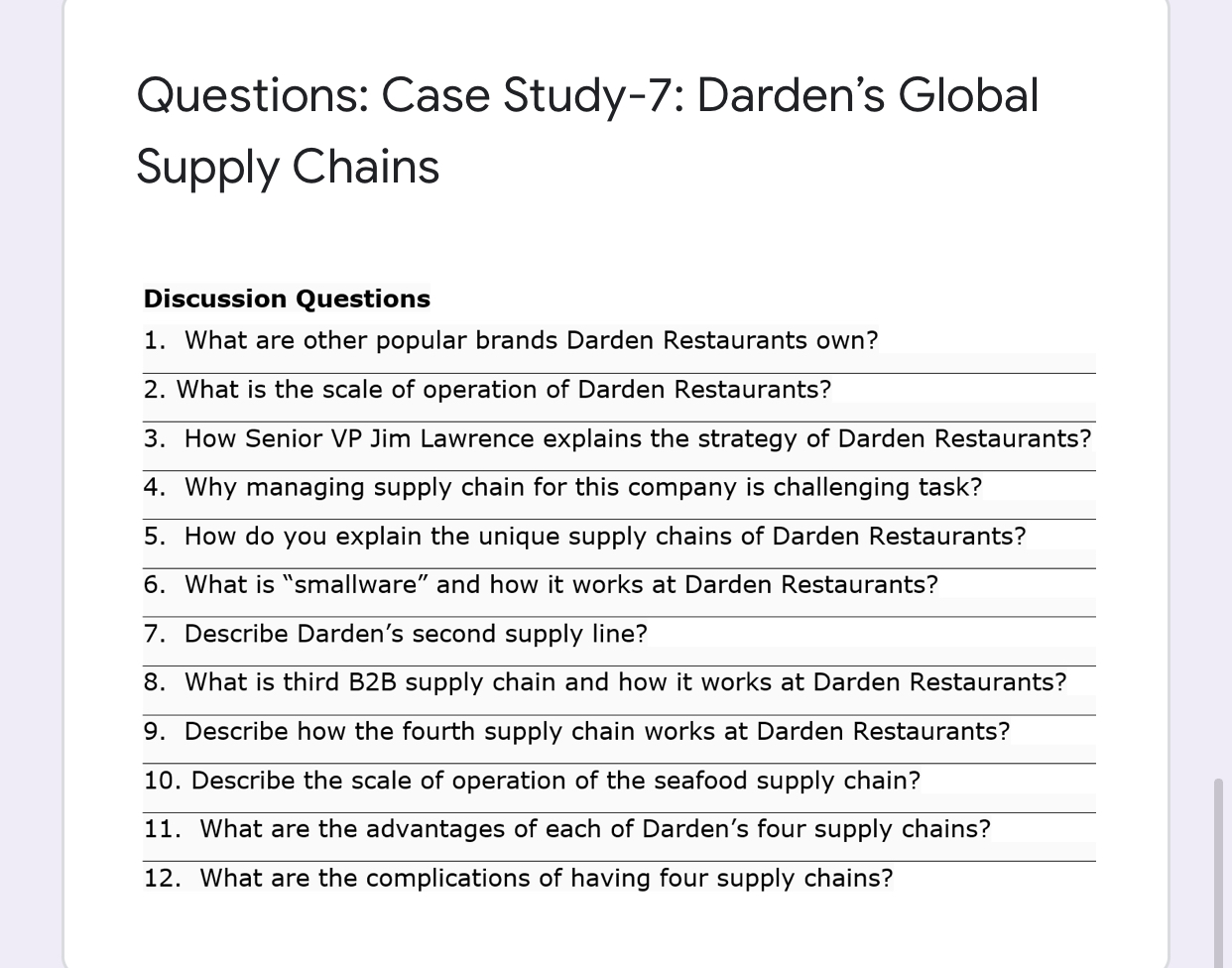
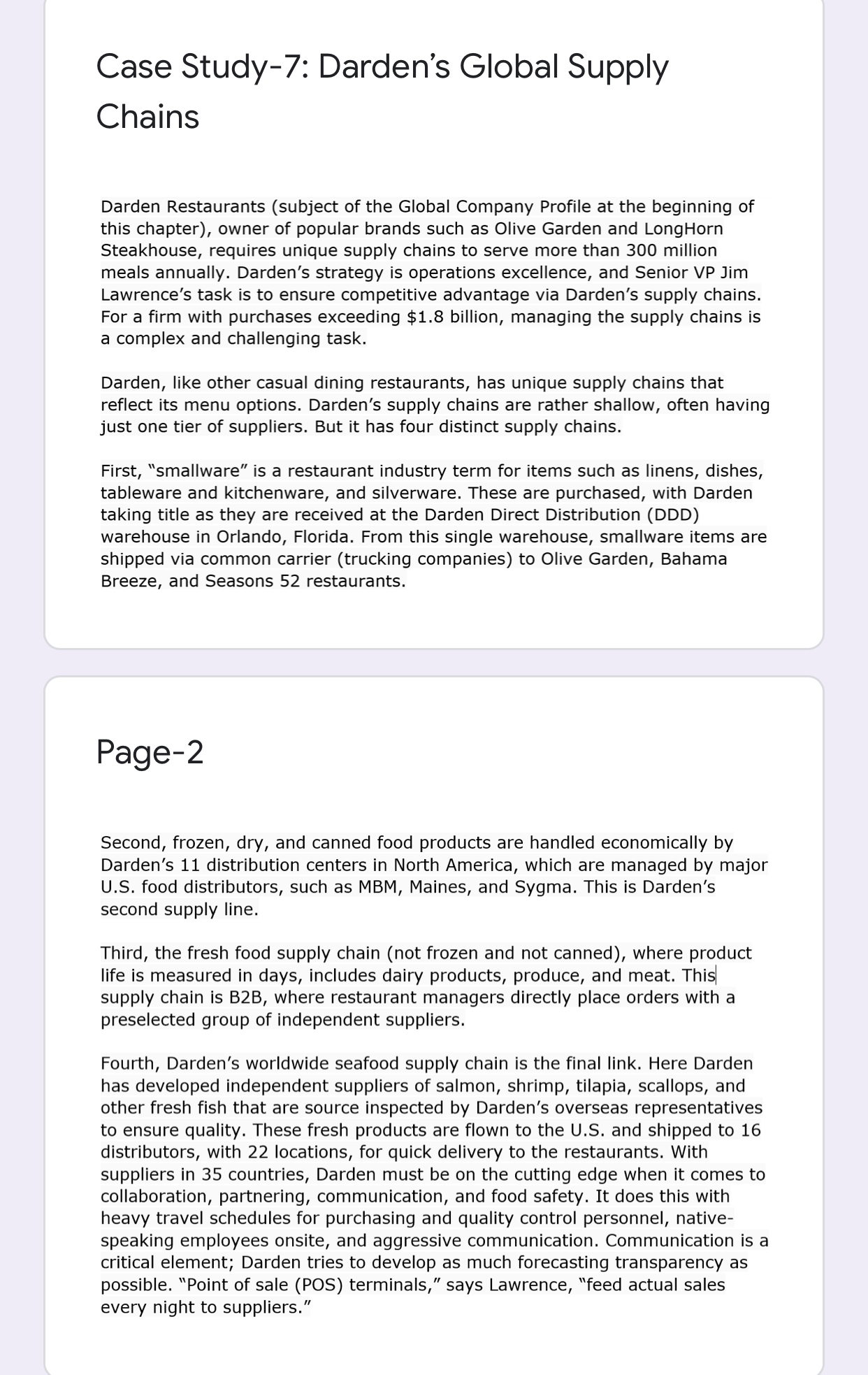
Questions: Case Study7: Darden's Global Supply Chains Discussion Questions 1. What are other popular brands Darden Restaurants own? 2. What is the scale of operation of Darden Restaurants? 3. How Senior VP Jim Lawrence explains the strategy of Darden Restaurants? Why managing supply chain for this company is challenging task? How do you explain the unique supply chains of Darden Restaurants? What is \"smallware\" and how it works at Darden Restaurants? Describe Darden's second supply line? What is third BZB supply chain and how it works at Darden Restaurants? 999N991!\" Describe how the fourth supply chain works at Darden Restaurants? 10. Describe the scale of operation of the seafood supply chain? 11. What are the advantages of each of Darden's four supply chains? 12. What are the complications of having four supply chains? Case Study-7: Darden's Global Supply Chains Darden Restaurants (subject of the Global Company Prole at the beginning of this chapter), owner of popular brands such as Olive Garden and LongHorn Steakhouse, requires unique supply chains to serve more than 300 million meals annually. Darden's strategy is operations excellence, and Senior VP Jim Lawrence's task is to ensure competitive advantage via Darden's supply chains. For a rm with purchases exceeding $1.8 billion, managing the supply chains is a complex and challenging task. Darden, like other casual dining restaurants, has unique supply chains that reflect its menu options. Darden's supply chains are rather shallow, often having just one tier of suppliers. But it has four distinct supply chains. First, \"smallware" is a restaurant industry term for items such as linens, dishes, tableware and kitchenware, and silverware. These are purchased, with Darden taking title as they are received at the Darden Direct Distribution (DDD) warehouse in Orlando, Florida. From this single warehouse, smallware items are shipped via common carrier (trucking companies) to Olive Garden, Bahama Breeze, and Seasons 52 restaurants. Page-2 Second, frozen, dry, and canned food products are handled economically by Darden's 11 distribution centers in North America, which are managed by major US. food distributors, such as MBM, Maines, and Sygma. This is Darden's second supply line. Third, the fresh food supply chain (not frozen and not canned), where product life is measured in days, includes dairy products, produce, and meat. This supply chain is BZB, where restaurant managers directly place orders with a preselected group of Independent suppllers. Fourth, Darden's worldwide seafood supply chain is the final link. Here Darden has developed independent suppliers of salmon, shrimp, tilapia, scallops, and other fresh fish that are source inspected by Darden's overseas representatives to ensure quality. These fresh products are flown to the US. and shipped to 16 dlstrlbutors, with 22 locations, for quick delivery to the restaurants. With suppliers In 35 countrles, Darden must be on the cutting edge when It comes to collaboration, partnering, communication, and food safety. It does this with heavy travel schedules for purchasing and quality control personnel, native- speaking employees onsite, and aggressive communication. Communication is a critical element; Darden tries to develop as much forecasting transparency as possible. \"Point of sale (POS) terminals," says Lawrence, \"feed actual sales every night to suppliers.\