







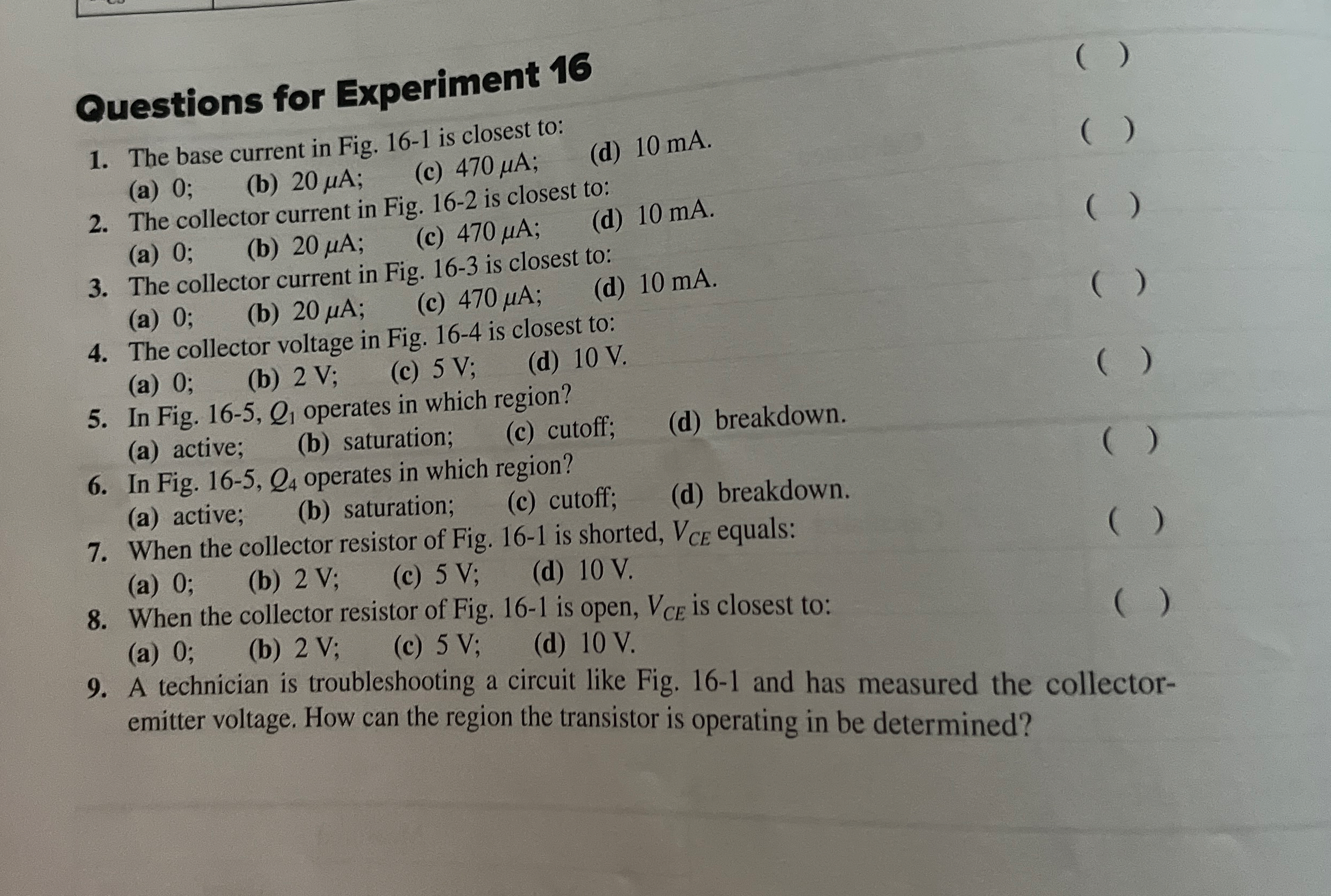
Question: Questions for Experiment 1 6 The base current in Fig. 1 6 - 1 is closest to: ( a ) 0 ; ( b )
Questions for Experiment
The base current in Fig. is closest to:
a ;
b;
c;
d mA
The collector current in Fig. is closest to:
a ;
b;
c;
d mA
The collector current in Fig. is closest to:
a ;
b;
c;
d mA
The collector voltage in Fig. is closest to:
a ;
b V ;
c V ;
d V
In Fig. operates in which region?
a active;
b saturation;
c cutoff;
d breakdown.
In Fig. operates in which region?
a active;
b saturation;
c cutoff;
d breakdown.
When the collector resistor of Fig. is shorted, equals:
a ;
b V ;
c V ;
d V
When the collector resistor of Fig. is open, is closest to:
a ;
b V ;
c V ;
d V
A technician is troubleshooting a circuit like Fig. and has measured the collectoremitter voltage. How can the region the transistor is operating in be determined?
Step by Step Solution
There are 3 Steps involved in it
1 Expert Approved Answer
Step: 1 Unlock

Question Has Been Solved by an Expert!
Get step-by-step solutions from verified subject matter experts
Step: 2 Unlock
Step: 3 Unlock
 Study Help