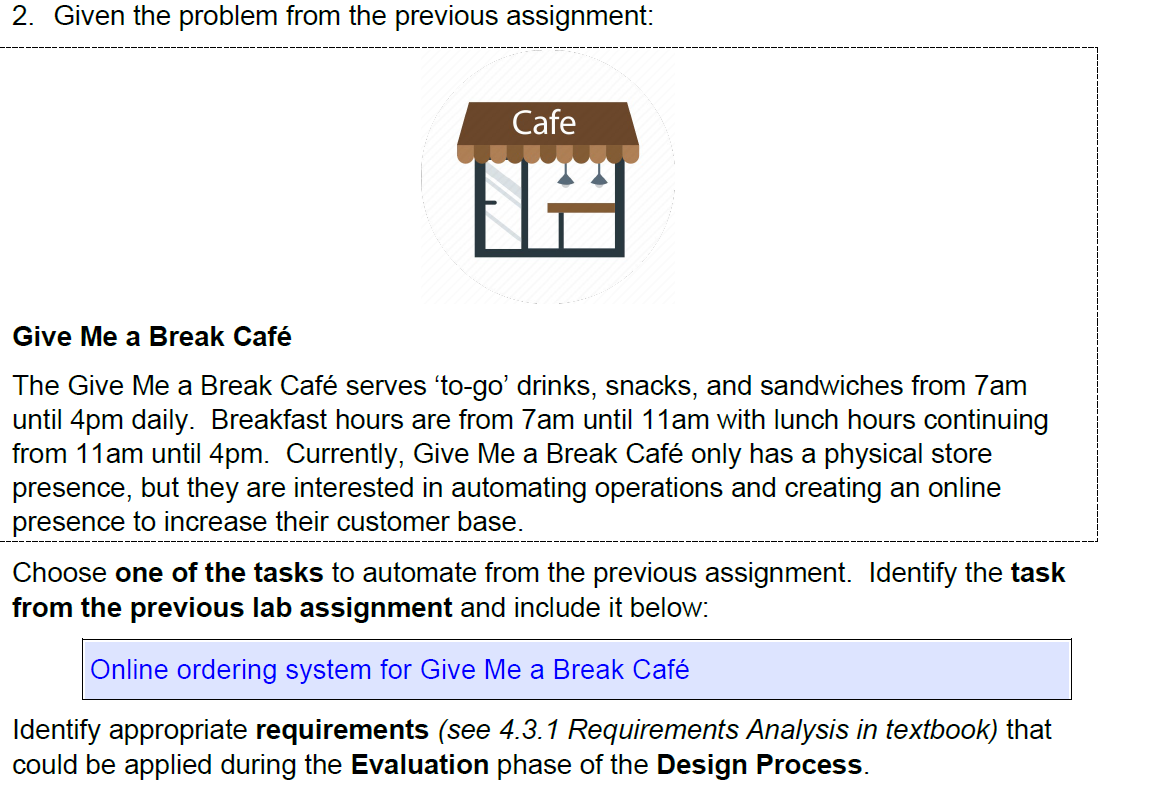
Question: Questions: Given the problem from the previous assignment: Give Me a Break Caf The Give Me a Break Caf serves 'to-go' drinks, snacks, and sandwiches
Questions: Given the problem from the previous assignment:
Give Me a Break Caf The Give Me a Break Caf serves 'to-go' drinks, snacks, and sandwiches from 7am until 4pm daily. Breakfast hours are from 7am until 11am with lunch hours continuing from 11am until 4pm. Currently, Give Me a Break Caf only has a physical store presence, but they are interested in automating operations and creating an online presence to increase their customer base.
Choose one of the tasks to automate from the previous assignment. Identify the task selected below:
1. Identify and describe the evaluation process you recommend for the selected task, the identified method or format to be used during evaluation, the recommended frequency of testing, and the rationale behind each choice. Recommended evaluation process:
Expert Reviews (see 5.2 Expert Reviews and Heuristics in textbook for expert review methods)
Usability Testing (see 5.3.4 The Spectrum of Usability Testing in textbook for user testing formats)
a) Description and rationale for recommended evaluation process selected above:
b)Which specific expert review method or user testing format (dependent upon evaluation process selected above) should be used during evaluation and why:
c) Frequency of testing (i.e. at which specific phase or phases of the Design Process?see 4.3 The Design Process in textbook) and why:
2. Please crete an example of a grammatically correct narrative representing an acceptance test to use for evaluation of the identified task interface design.
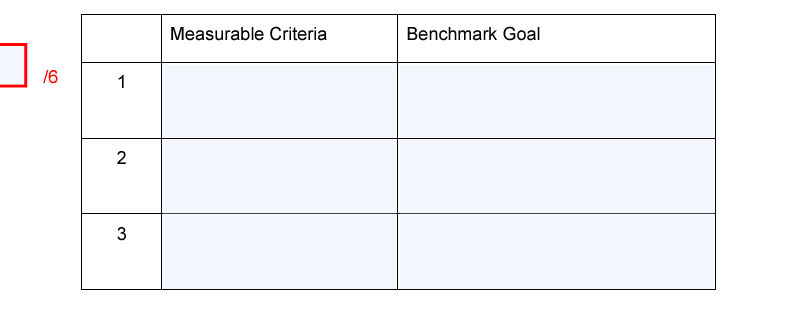
a) Include statements for at least three different objective and identified measurable criteria with corresponding benchmark goals. Remember the benchmark goals should contain specific details to measure during evaluation. (See 5.5 Acceptance Tests in textbook for example measurable criteria statements with benchmark goals.). Create the acceptance test narrative for your identified task below:
b) From the above acceptance test narrative, identify the measurable criteria (see 5.5 Acceptance Tests in textbook for measurable criteria) with their specific benchmark goals to use during evaluation:
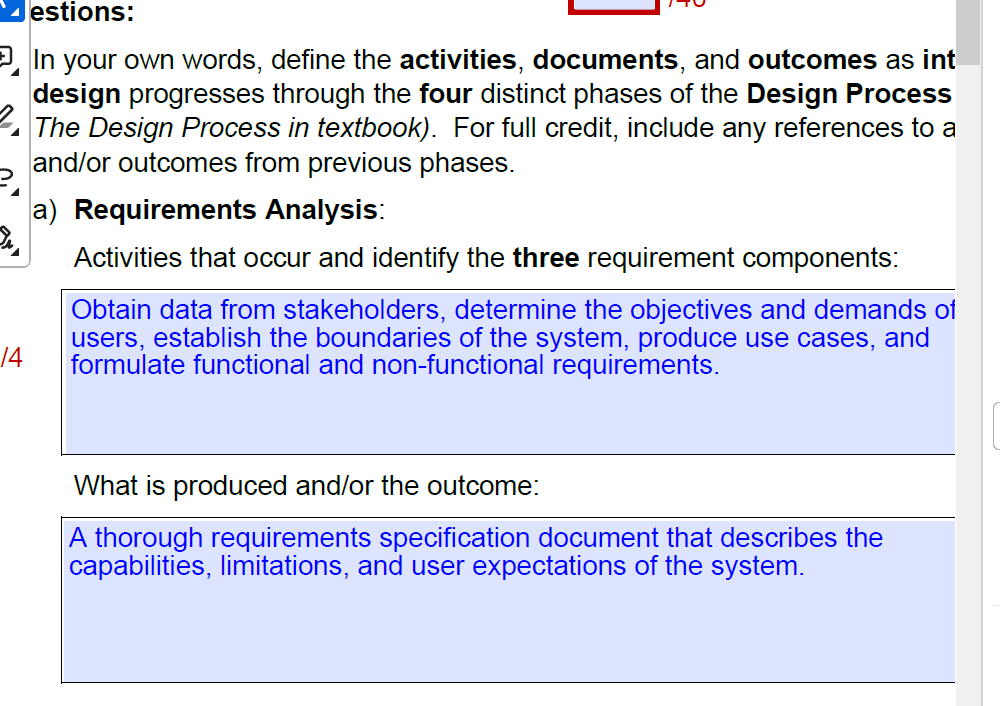
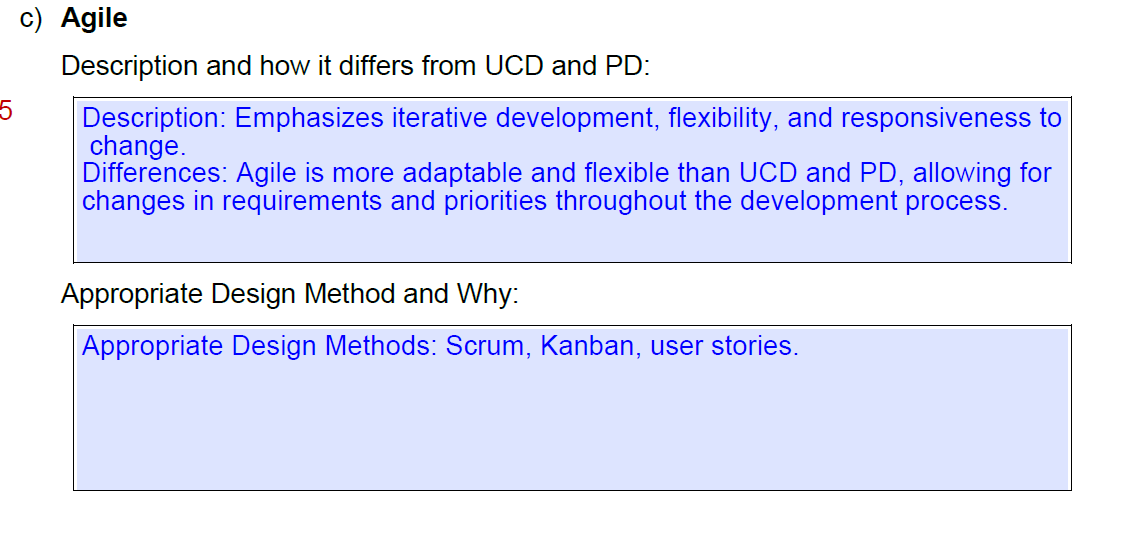
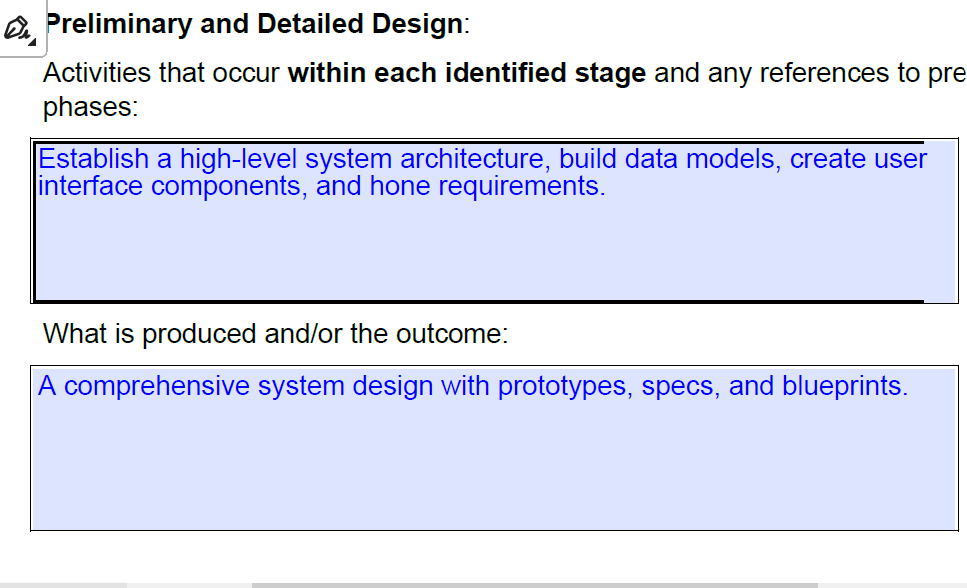
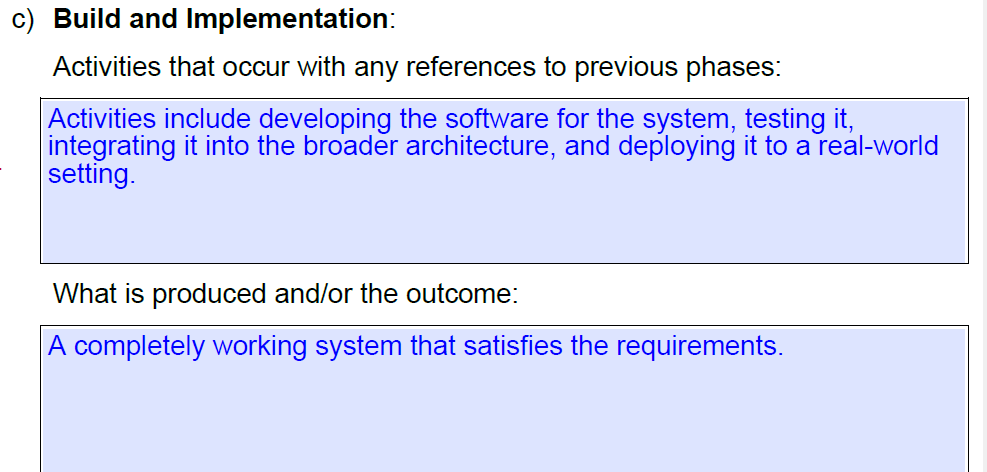
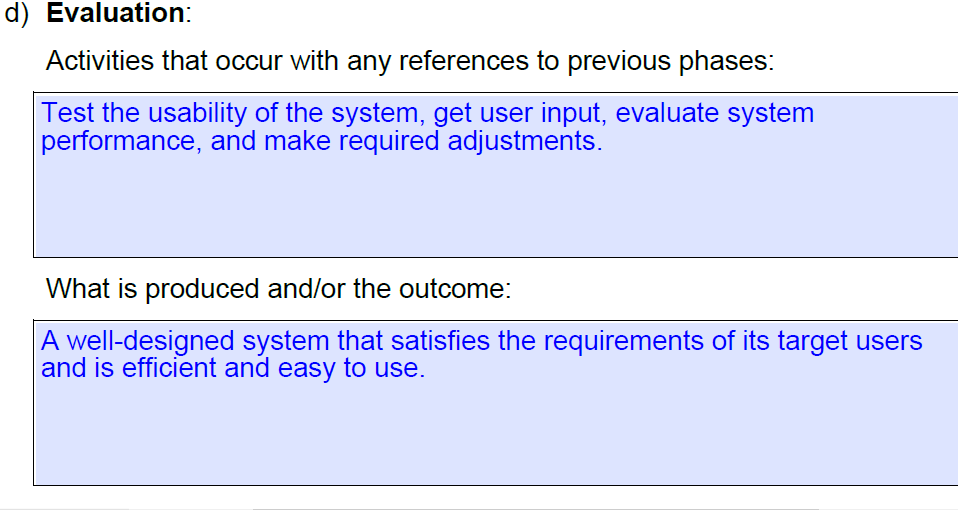
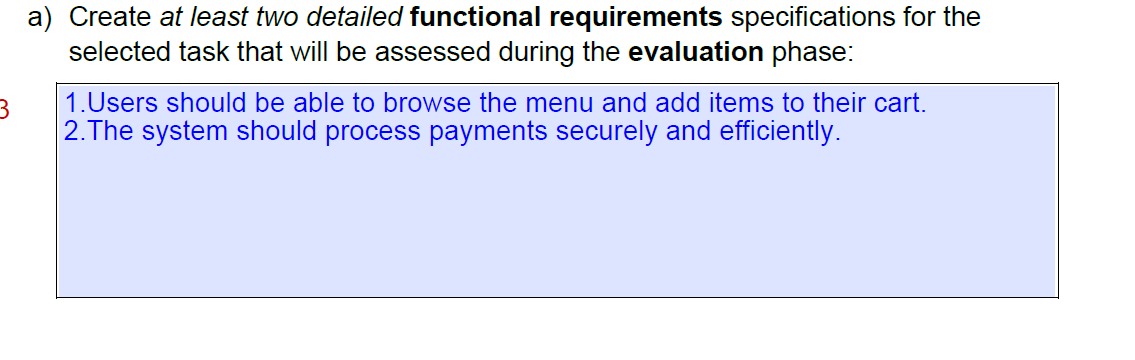
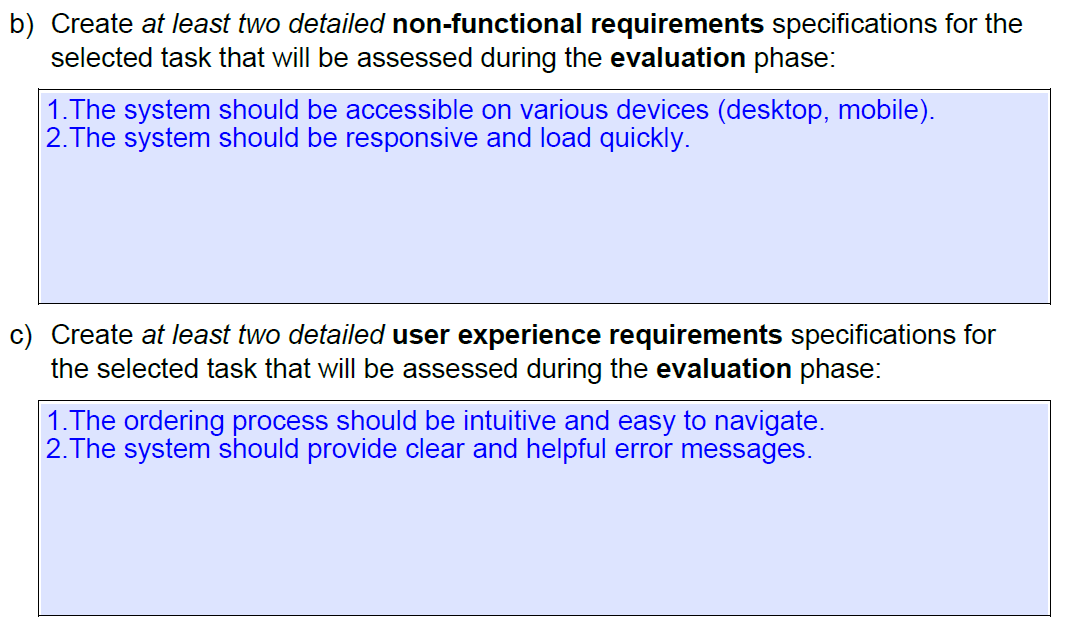
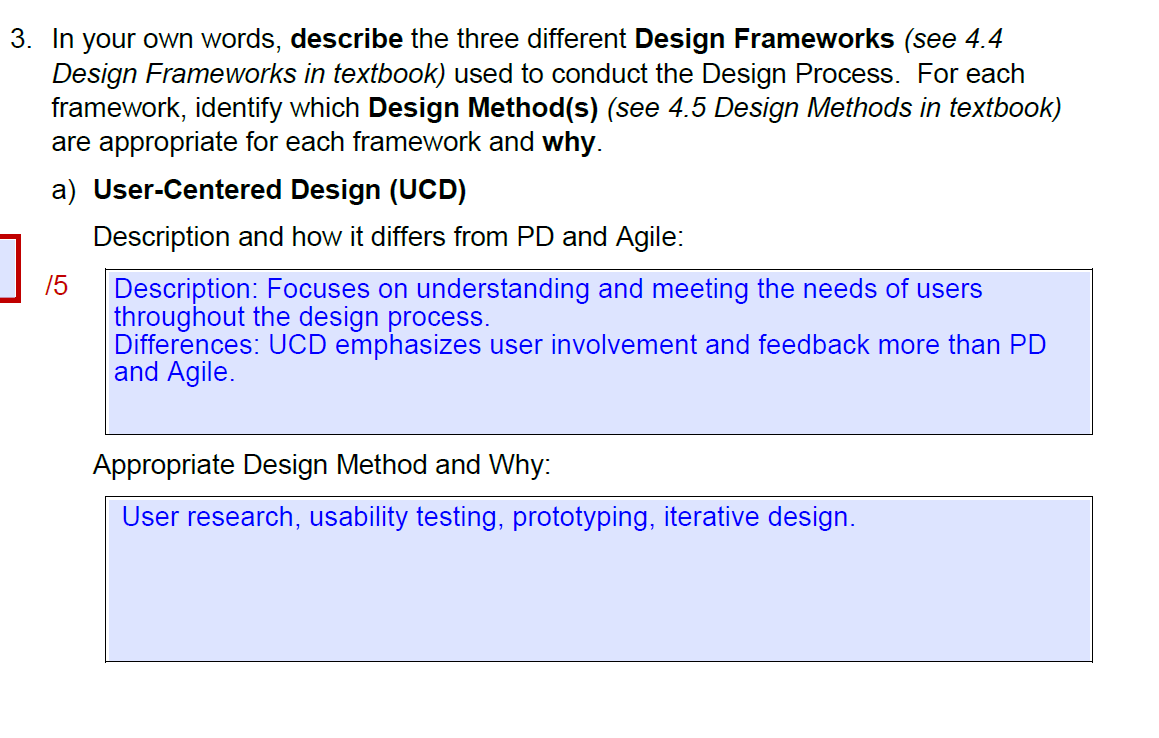
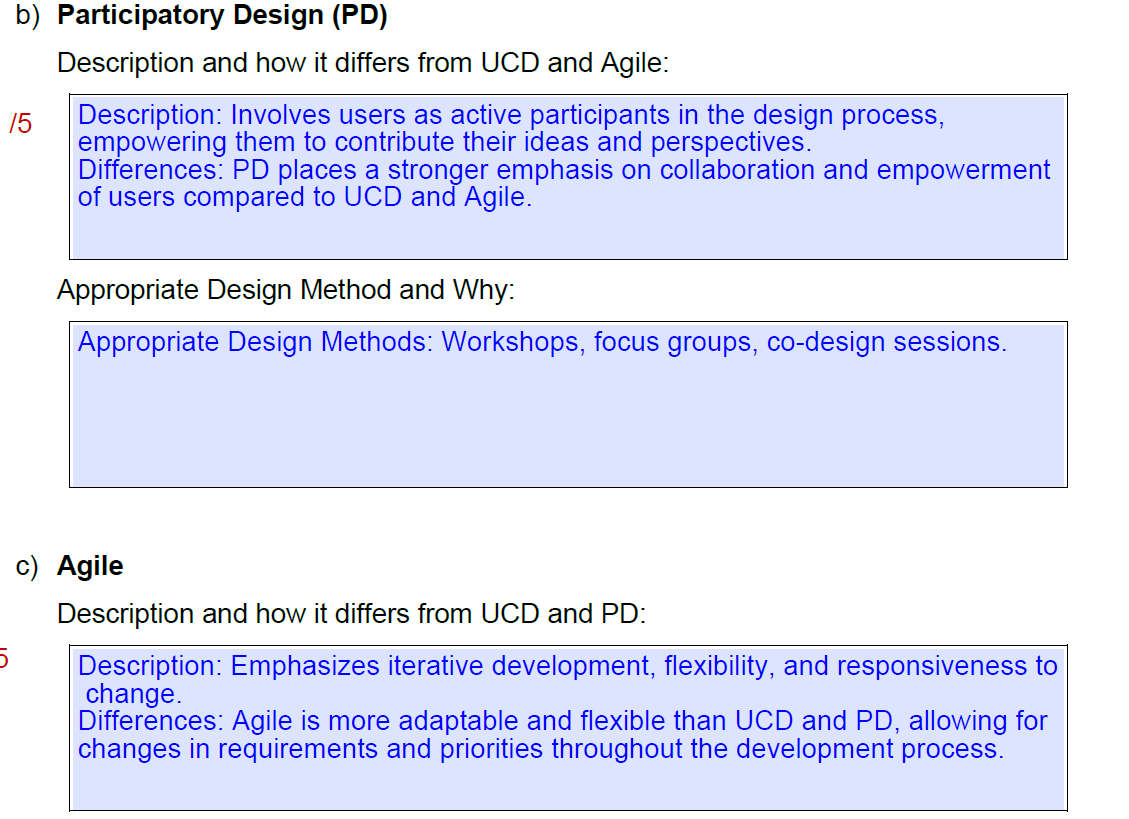
& estions: ] ' T B' In your own words, define the activities, documents, and outcomes as int design progresses through the four distinct phases of the Design Process 4 | The Design Process in textbook). For full credit, include any references to a - and/or outcomes from previous phases. ' a) Requirements Analysis: " Activities that occur and identify the three requirement components: Obtain data from stakeholders, determine the objectives and demands of users, establish the boundaries of the system, produce use cases, and /4 | formulate functional and non-functional requirements. What is produced and/or the outcome: A thorough requirements specification document that describes the capabilities, limitations, and user expectations of the system. c) Agile Description and how it differs from UCD and PD: Description: Emphasizes iterative development, flexibility, and responsiveness to change. Differences: Agile is more adaptable and flexible than UCD and PD, allowing for changes in requirements and priorities throughout the development process. Appropriate Design Method and Why: Appropriate Design Methods: Scrum, Kanban, user stories. 2, \"reliminary and Detailed Design: Activities that occur within each identified stage and any references to pre phases: Establish a high-level system architecture, build data models, create user interface components, and hone requirements. What is produced and/or the outcome: A comprehensive system design with prototypes, specs, and blueprints. c) Build and Implementation: Activities that occur with any references to previous phases: Activities include developing the software for the system, testing it, integrating it into the broader architecture, and deploying it to a real-world setting. What is produced and/or the outcome: A completely working system that satisfies the requirements. d) Evaluation: Activities that occur with any references to previous phases: Test the usabllity of the system, get user input, evaluate system performance, and make required adjustments. What is produced and/or the outcome: A well-designed system that satisfies the requirements of its target users and is efficient and easy to use. 2. Given the problem from the previous assignment: Cafe Give Me a Break Cafe The Give Me a Break Cafe serves 'to-go' drinks, snacks, and sandwiches from 7am until 4pm daily. Breakfast hours are from 7am until 11am with lunch hours continuing from 11am until 4pm. Currently, Give Me a Break Cafe only has a physical store presence, but they are interested in automating operations and creating an online presence to increase their customer base. Choose one of the tasks to automate from the previous assignment. Identify the task from the previous lab assignment and include it below: Online ordering system for Give Me a Break Cafe Identify appropriate requirements (see 4.3.1 Requirements Analysis in textbook) that could be applied during the Evaluation phase of the Design Process.a) Create af least two detailed functional requirements specifications for the selected task that will be assessed during the evaluation phase: 1.Users should be able to browse the menu and add items to their cart. 2. The system should process payments securely and efficiently. b) Create at least two detailed non-functional requirements specifications for the selected task that will be assessed during the evaluation phase: 1.The system should be accessible on various devices (desktop, mobile). 2.The system should be responsive and load quickly. c) Create at least two detailed user experience requirements specifications for the selected task that will be assessed during the evaluation phase: 1.The ordering process should be intuitive and easy to navigate. 2.The system should provide clear and helpful error messages. 3. In your own words, describe the three different Design Frameworks (see 4.4 Design Frameworks in textbook) used to conduct the Design Process. For each framework, identify which Designh Method(s) (see 4.5 Design Methods in textbook) are appropriate for each framework and why. a) User-Centered Design (UCD) :l Description and how it differs from PD and Agile: /5 Description: Focuses on understanding and meeting the needs of users throughout the design process. Differences: UCD emphasizes user involvement and feedback more than PD and Agile. Appropriate Design Method and Why: User research, usability testing, prototyping, iterative design. b) Participatory Design (PD) Description and how it differs from UCD and Agile: /5 | Description: Involves users as active participants in the design process, empowering them to contribute their ideas and perspectives. Differences: PD places a stronger emphasis on collaboration and empowerment of users compared to UCD and Agile. Appropriate Design Method and Why: Appropriate Design Methods: Workshops, focus groups, co-design sessions. c) Agile Description and how it differs from UCD and PD: ) | Description: Emphasizes iterative development, flexibility, and responsiveness to | change. Differences: Agile is more adaptable and flexible than UCD and PD, allowing for changes in requirements and priorities throughout the development process. \f
Step by Step Solution
There are 3 Steps involved in it
1 Expert Approved Answer
Step: 1 Unlock
Question Has Been Solved by an Expert!
Get step-by-step solutions from verified subject matter experts
Step: 2 Unlock
Step: 3 Unlock
Students Have Also Explored These Related General Management Questions!









 Study Help