







Question: Questions in memory. Short Answer 1. A value is a value directly specified by the programmer rather than the result of an expression. 2. By
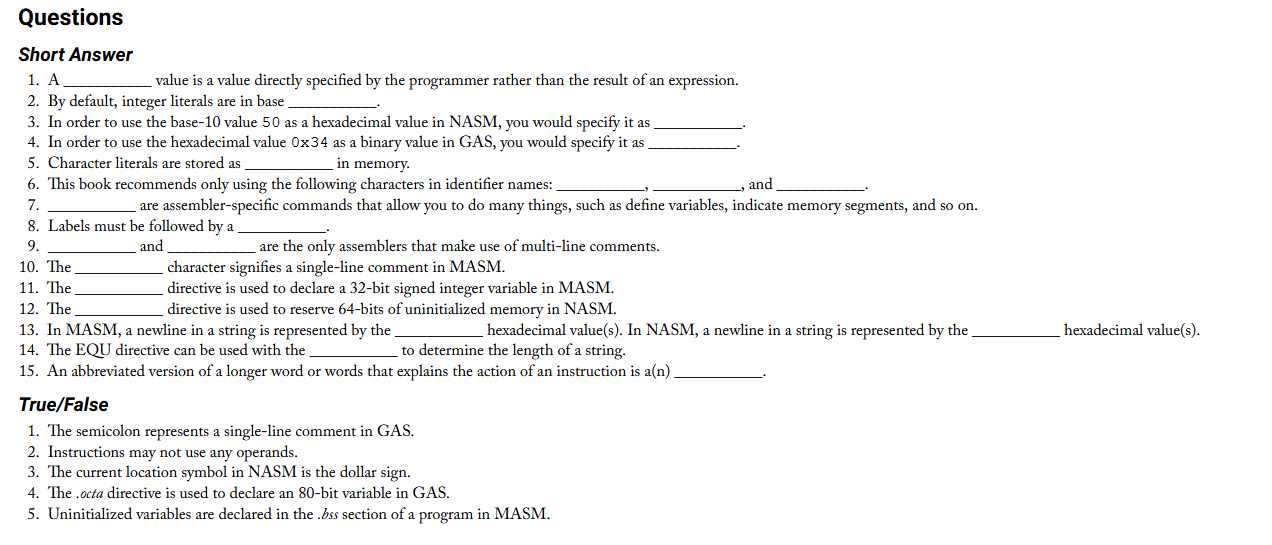
Questions in memory. Short Answer 1. A value is a value directly specified by the programmer rather than the result of an expression. 2. By default, integer literals are in base 3. In order to use the base-10 value 50 as a hexadecimal value in NASM, you would specify it as 4. In order to use the hexadecimal value 0x34 as a binary value in GAS, you would specify it as 5. Character literals are stored as 6. This book recommends only using the following characters in identifier names: and 7. are assembler-specific commands that allow you to do many things, such as define variables, indicate memory segments, and so on. 8. Labels must be followed by a 9. and are the only assemblers that make use of multi-line comments. 10. The character signifies a single-line comment in MASM. directive is used to declare a 32-bit signed integer variable in MASM. 12. The directive is used to reserve 64-bits of uninitialized memory in NASM. 13. In MASM, a newline in a string is represented by the hexadecimal value(s). In NASM, a newline in a string is represented by the 14. The EQU directive can be used with the to determine the length of a string. 15. An abbreviated version of a longer word or words that explains the action of an instruction is a(n) True/False 1. The semicolon represents a single-line comment in GAS. 2. Instructions may not use any operands. 3. The current location symbol in NASM is the dollar sign. 4. The .octa directive is used to declare an 80-bit variable in GAS. 5. Uninitialized variables are declared in the .bss section of a program in MASM. 11. The hexadecimal value(s)
Step by Step Solution
There are 3 Steps involved in it

Get step-by-step solutions from verified subject matter experts
 Study Help