







Question: questions please help Question 5. Point allocation: (a) 20%; (b) 20%; (c) 10%; (d) 10%; (e) 10%; (f) 30%. Consider the regression model yi =
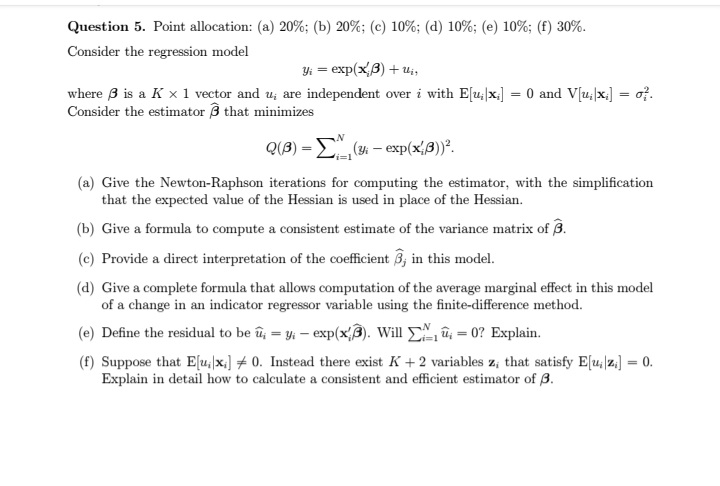
![1 vector and u; are independent over i with Elu;(x;] = 0](https://s3.amazonaws.com/si.experts.images/answers/2024/06/66751897e979d_03966751897db5b7.jpg)
![and Vu,|xi] = of. Consider the estimator / that minimizes Q(3) =](https://s3.amazonaws.com/si.experts.images/answers/2024/06/667518985bba9_040667518983437f.jpg)
questions please help
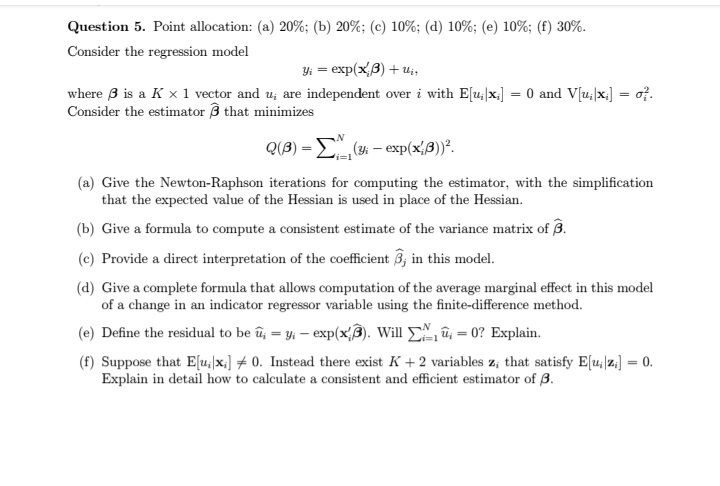
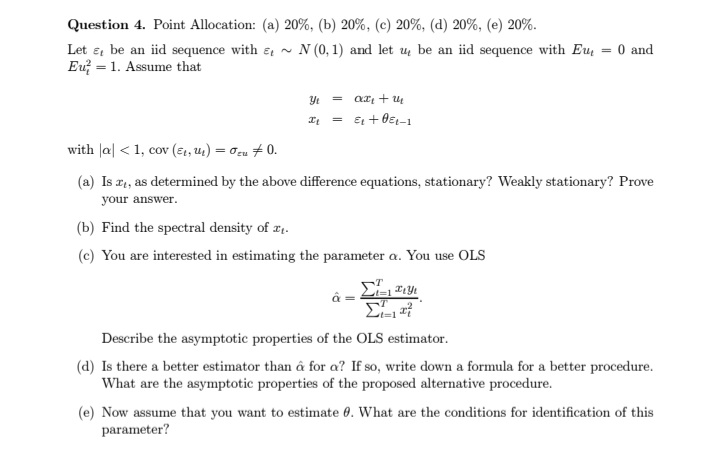
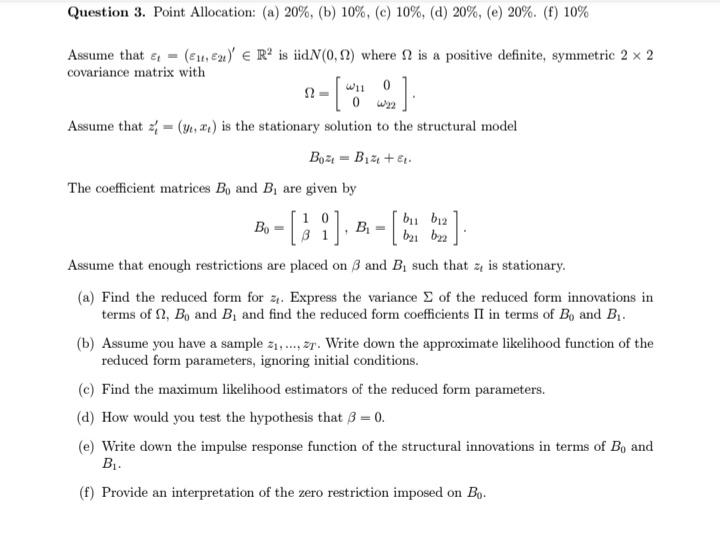
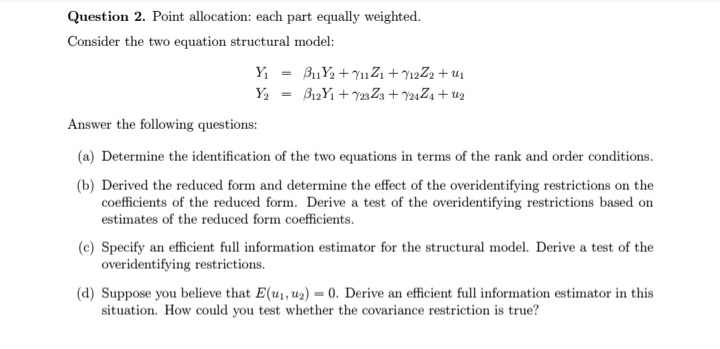
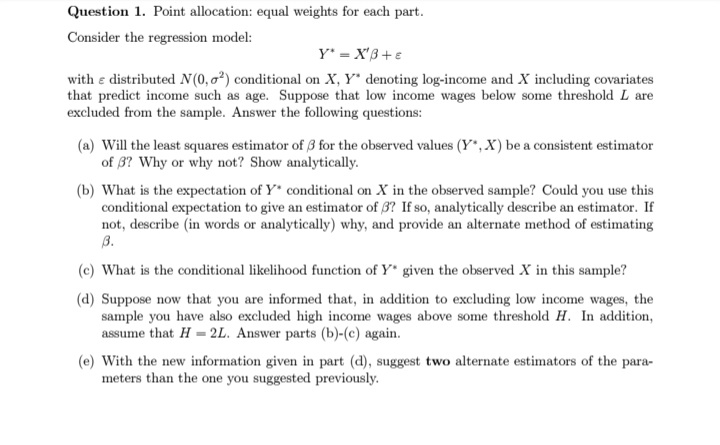
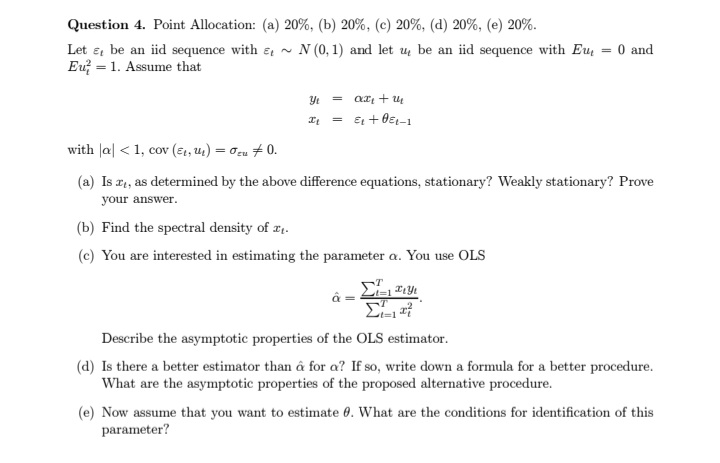
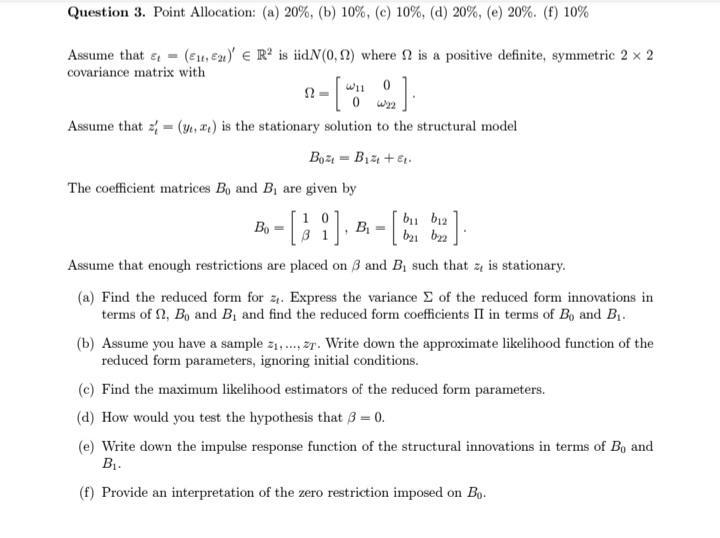
Question 5. Point allocation: (a) 20%; (b) 20%; (c) 10%; (d) 10%; (e) 10%; (f) 30%. Consider the regression model yi = exp(x 3) + ui, where 3 is a K x 1 vector and u; are independent over i with Elu;(x;] = 0 and Vu,|xi] = of. Consider the estimator / that minimizes Q(3) = _ (y: - exp (x,3))?. (a) Give the Newton-Raphson iterations for computing the estimator, with the simplification that the expected value of the Hessian is used in place of the Hessian. (b) Give a formula to compute a consistent estimate of the variance matrix of 3. (c) Provide a direct interpretation of the coefficient 3, in this model. (d) Give a complete formula that allows computation of the average marginal effect in this model of a change in an indicator regressor variable using the finite-difference method. (e) Define the residual to be u; = y - exp(x,P). Will ), u, = 0? Explain. (f) Suppose that Eux;] # 0. Instead there exist K + 2 variables z, that satisfy Eu; |z;] = 0. Explain in detail how to calculate a consistent and efficient estimator of B.Question 4. Point Allocation: (a) 20%, (b) 20%, (c) 20%, (d) 20%, (e) 20%. Let , be an iid sequence with &, ~ N (0, 1) and let u, be an iid sequence with Eu, = 0 and Eu, = 1. Assume that y = at + u It = En + 06-1 with Ja|
Step by Step Solution
There are 3 Steps involved in it

Get step-by-step solutions from verified subject matter experts
 Study Help