Question: Questions Using the evidence in the Haier case study, and other publicly available material on the company, address the following questions: 1. lf, as Allaire
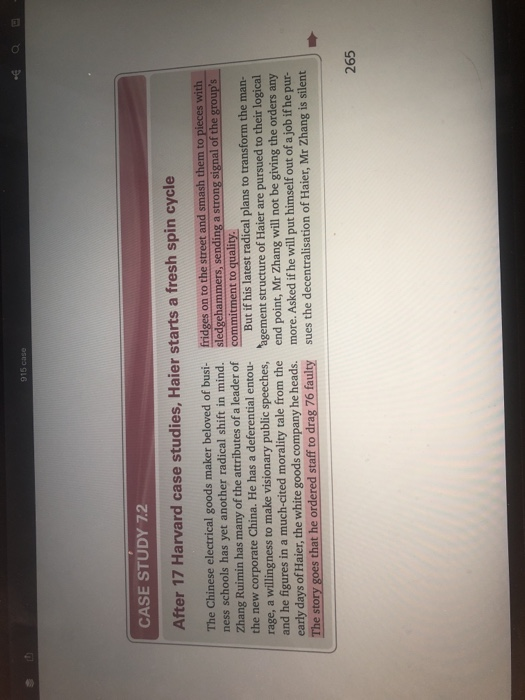
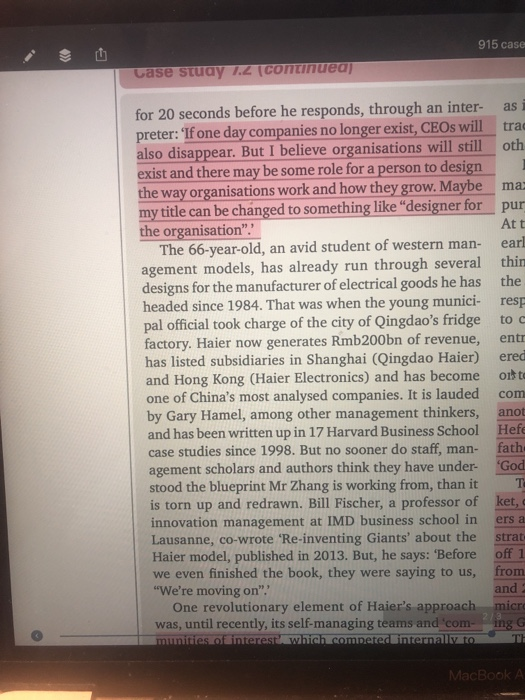
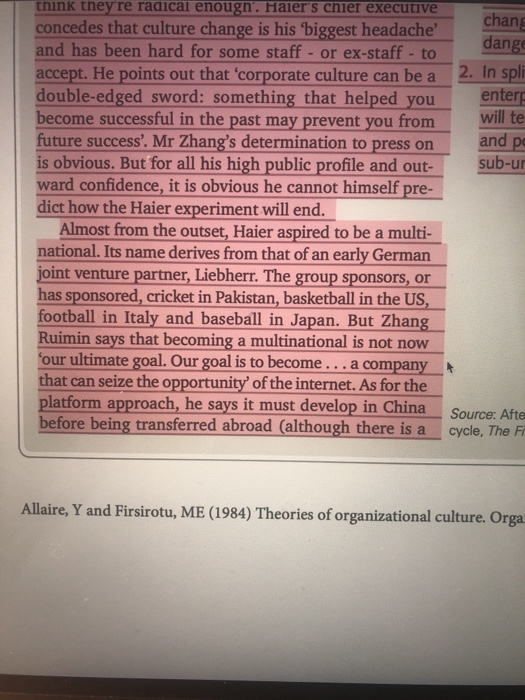
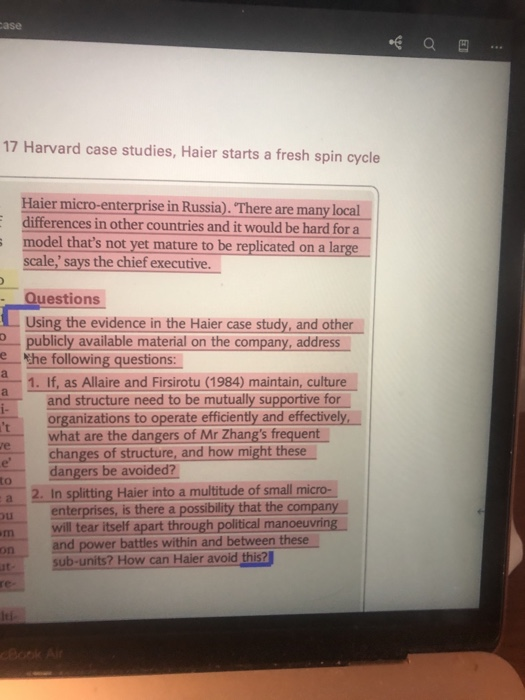
Questions Using the evidence in the Haier case study, and other publicly available material on the company, address the following questions: 1. lf, as Allaire and Firsirotu (1984) maintain, culture and structure need to be mutually supportive for organizations to operate efficiently and effectively, what are the dangers of Mr Zhang's frequent changes of structure, and how might these dangers be avoided? 2. In splitting Haier into multitude of small micro- enterprises, is there a possibility that the company will tear itself apart through political manoeuvring and power battles within and between these sub-units? How can Haier avoid this? Book Air Questions Using the evidence in the Haier case study, and other publicly available material on the company, address the following questions: 1. lif, as Allaire and Firsirotu (1984) maintain, culture and structure need to be mutually supportive for organizations to operate efficiently and effectively. what are the dangers of Mr Zhang's frequent changes of structure, and how might these dangers be avoided? 2. In splitting Haier into multitude of small micro- enterprises, is there a possibility that the company will tear itself apart through political manoeuvring and power battles within and between these sub-units? How can Haier avoid this? Book Air 915 case CASE STUDY 7.2 After 17 Harvard case studies, Haier starts a fresh spin cycle The Chinese electrical goods maker beloved of busi- fridges on to the street and smash them to pieces with ness schools has yet another radical shift in mind. sledgehammers, sending a strong signal of the group's Zhang Ruimin has many of the attributes of a leader of commitment to quality. the new corporate China. He has a deferential entou. But if his latest radical plans to transform the man- rage, a willingness to make visionary public speeches, "agement structure of Haier are pursued to their logical and he figures in a much-cited morality tale from the end point, Mr Zhang will not be giving the orders any early days of Haier, the white goods company he heads. more. Asked if he will put himself out of a job if he pur- The story goes that he ordered staff to drag 76 faulty sues the decentralisation of Haier, Mr Zhang is silent 265 915 case case study 1.2 (Continued for 20 seconds before he responds, through an inter- asi preter: 'If one day companies no longer exist, CEOs will trad also disappear. But I believe organisations will still oth exist and there may be some role for a person to design the way organisations work and how they grow. Maybe ma my title can be changed to something like "designer for pur the organisation". Att The 66-year-old, an avid student of western man earl agement models, has already run through several thin designs for the manufacturer of electrical goods he has the headed since 1984. That was when the young munici resp pal official took charge of the city of Qingdao's fridge to factory. Haier now generates Rmb200bn of revenue, entr has listed subsidiaries in Shanghai (Qingdao Haier) ered and Hong Kong (Haier Electronics) and has become oste one of China's most analysed companies. It is lauded com by Gary Hamel, among other management thinkers. anot and has been written up in 17 Harvard Business School Hefe case studies since 1998. But no sooner do staff, man- fath agement scholars and authors think they have under "God stood the blueprint Mr Zhang is working from, than it is torn up and redrawn. Bill Fischer, a professor of ket, innovation management at IMD business school in ers a Lausanne, co-wrote 'Re-inventing Giants' about the strat Haier model, published in 2013. But, he says: 'Before off 1 we even finished the book, they were saying to us from "We're moving on". and One revolutionary element of Haier's approach micro was, until recently, its self-managing teams and com ing munities of interest, which competed internalv to TH MacBook A 918 stood the blueprint Mr Zhang is working from, than it is torn up and redrawn. Bill Fischer, a professor of innovation management at IMD business school in Lausanne, co-wrote 'Re-inventing Giants' about the Haier model, published in 2013. But, he says: 'Before we even finished the book, they were saying to us, "We're moving on". One revolutionary element of Haier's approach was, until recently, its self-managing teams and 'com- munities of interest', which competed internally to run the next production or design project. Haier now wants to break down even these basic building blocks. In its home country, the group is re- inventing itself again as a set of open 'entrepreneurial platforms', serving - and served by - hundreds of "micro-enterprises'. Not only will these micro- enterprises compete to design, build and distribute products Haier users say they want, but they will also be able to vie with one another for staff and for capi- tal, from Haier and from outside investors. Haier is, in Prof Fischer's words, 'de-Haierising' Its 20 platforms include its 'diet ecosystem' (based around smart fridges), its 'atmosphere ecosystem' (air conditioners and purifiers) and Goodaymart Logistics, a distribution network that is the key to fulfilling the com- pany's promise that it can deliver anywhere in China within 24 hours. Goodaymart now operates indepen dently, in partnership with Alibaba, the ecommerce group, distributing goods for Haier's competitors as well case as its original parent. It works through some subcon- tracted vehicle micro-enterprises' (truck owners, in other words) Mr Zhang has absorbed and put into action the maxim of Peter Drucker, whom he reveres, that the purpose of business is to create and keep a customer. At the Global Peter Drucker Forum, a conference held earlier this month in honour of the late management thinker, he made clear he wanted to go further. He says the arrival of the internet makes it vital to free Haier to respond directly and at speed to users' demands, and to customise goods that others mass-produce. One eibtrepreneurial team, calling itself iSee Mini, uncov- ered a market for televisions that projected the image on to the ceiling so pregnant women could watch more comfortably, China Daily recounted recently that another part of the group had supplied a loving son in Hefei with an air-conditioner for his calligrapher father, embossed with his dad's favourite phrase - "God Rewards the Diligent. Ten years ago, Mr Zhang's job was to study the mar ket, develop strategies, hold meetings with his manag- ers and follow up to check they had implemented the strategies. But faced with slowing growth, Haier laid off 10,000 middle managers as part of a reduction from 86,000 to 60,000 full-time employees in 2013 and 2014. Mr Zhang claims many have found roles at miese entertaises such as the truck companies.se cBook Air 15 case f 1 Ten years ago, Mr Zhang's job was to study the mar ket, develop strategies, hold meetings with his manag- ers and follow up to check they had implemented the strategies. But faced with slowing growth, Haier laid off 10,000 middle managers as part of a reduction from 86,000 to 60,000 full-time employees in 2013 and 2014. Mr Zhang claims many have found roles at micro-enterprises, such as the truck companies serv- ing Goodaymart. The chief executive says he now devotes himself to ensuring our organisation is open to outside 2 resources'. Haier itself, while still providing some cen- - tral services such as accounting, finance and human- 1 resources support, will ultimately turn into a of shareholder in a network of micro-enterprises, he says, - owning both majority and minority stakes. In theory, it will look more like a venture capital incubator for O growing businesses than a multi-national manufac- turer. Is it an experiment? 'Yes. We are facing a lot of s, risks,' Mr Zhang responds. Is it a gamble? He laughs and there is another long pause: 'When faced with a huge challenge, you can choose to just sit there, but the only result is that you're going to die. We think it's a better choice to fight ... So you could say that this is 1 a gamble, but we have a determined direction, and that's what makes it different from other gambles.' On 7 the one hand, Haier could slip back into more conven tional ways. The longstanding dominance of sclerotic ell state-owned enterprises means it is hard to sustain Case study 7.2: After 17 innovative management structures in China. Recidivism is quite a powerful force,' agrees Prof Fischer. 'But at Haier you have younger entrepreneurs who don't have state-owned enterprise mentality.' On the other hand, having split existing units into potentially less-efficient pieces, and given up tradi- tional levers of corporate power, Haier's experiment could spiral out of control. Mr Zhang, always alive to new management models, has studied Zappos, the Amazon shoe-retail subsidiary that is moving to a managerless system known as Holacracy. Zappos is a fraction of Haier's size and the well-publicised transi- tion is proving painful. But Mr Zhang says 'we don't think they're radical enough'. Haier's chief executive concedes that culture change is his 'biggest headache and has been hard for some staff - or ex-staff - to accept. He points out that 'corporate culture can be a double-edged sword: something that helped you become successful in the past may prevent you from future success'. Mr Zhang's determination to press on is obvious. But for all his high public profile and out- ward confidence, it is obvious he cannot himself pre- dict how the Haier experiment will end. Almost from the outset, Haier aspired to be a multi- national. Its name derives from that of an early German joint venture partner, Liebherr. The group sponsors, or has sponsored, cricket in Pakistan, basketball in the US, football in Italy and baseball in Japan. But Zhang Ruimin says that becoming a multinational is not now chan dang 2. In spli enter will te and p sub-ur think they re radical enough. Haier's chier executive concedes that culture change is his 'biggest headache' and has been hard for some staff - or ex-staff - to accept. He points out that 'corporate culture can be a double-edged sword: something that helped you become successful in the past may prevent you from future success'. Mr Zhang's determination to press on is obvious. But for all his high public profile and out- ward confidence, it is obvious he cannot himself pre- dict how the Haier experiment will end. Almost from the outset, Haier aspired to be a multi- national. Its name derives from that of an early German joint venture partner, Liebherr. The group sponsors, or has sponsored, cricket in Pakistan, basketball in the US, football in Italy and baseball in Japan. But Zhang Ruimin says that becoming a multinational is not now 'our ultimate goal. Our goal is to become... a company that can seize the opportunity of the internet. As for the platform approach, he says it must develop in China before being transferred abroad (although there is a Source: Afte cycle, The F Allaire, Y and Firsirotu, ME (1984) Theories of organizational culture. Orga case 17 Harvard case studies, Haier starts a fresh spin cycle Haier micro-enterprise in Russia). There are many local differences in other countries and it would be hard for a model that's not yet mature to be replicated on a large scale,' says the chief executive. Questions Using the evidence in the Haier case study, and other publicly available material on the company, address Whe following questions: 1. If, as Allaire and Firsirotu (1984) maintain, culture and structure need to be mutually supportive for organizations to operate efficiently and effectively, what are the dangers of Mr Zhang's frequent changes of structure, and how might these dangers be avoided? 2. In splitting Haier into a multitude of small micro- enterprises, is there a possibility that the company will tear itself apart through political manoeuvring and power battles within and between these sub-units? How can Haier avoid this? to









 Study Help