







Question: Queueing system with three servers in series: Consider a three server system in which customers arrive in accordance with a nonhomogeneous Poisson process with the
Queueing system with three servers in series:
Consider a three server system in which customers arrive in accordance with a nonhomogeneous Poisson process with the intensity function as follows:
(t) = 0.0001t^2 + 0.05t, 0 t 480.
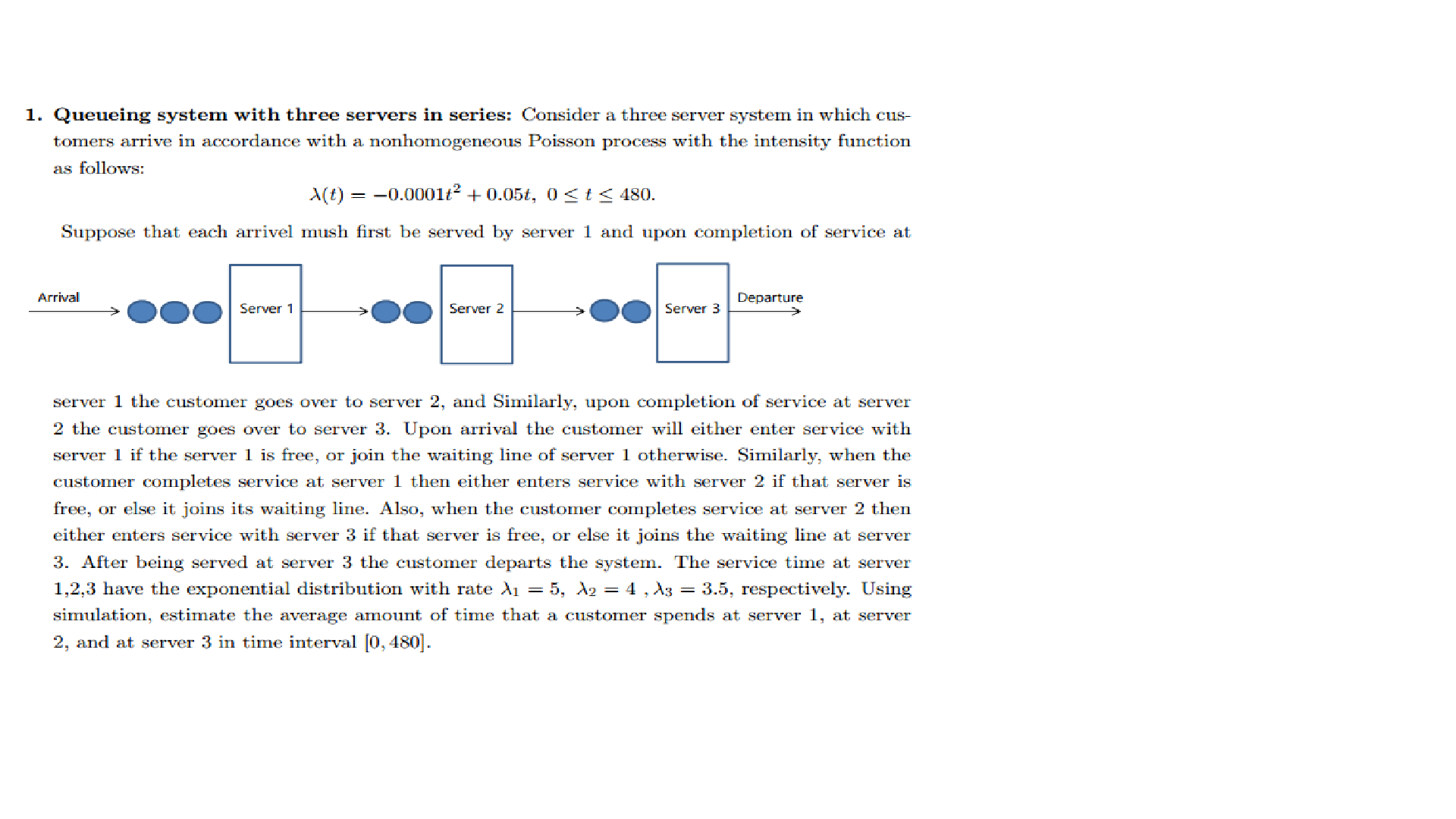
Suppose that each arrivel mush first be served by server 1 and upon completion of service at server 1 the customer go es over to server 2, and Similarly, upon completion of service at server 2 the customer goes over to server 3.
Upon arrival the customer will either enter service with server 1 if the server 1 is free, or join the waiting line of server 1 otherwise.
Similarly, when the customer completes service at server 1 then either enters service with server 2 if that server is free, or else it joins its waiting line.
Also, when the customer completes service at server 2 then either enters service with server 3 if that server is free, or else it joins the waiting line at server 3.
After being served at server 3 the customer departs the system.
The service time at server 1,2,3 have the exponential distribution with rate 1 = 5, 2 = 4 , 3 = 3.5, respectively.
Using simulation, estimate the average amount of time that a customer spends at server 1, at server 2, and at server 3 in time interval [0, 480].
l. Queueing system with three servers in series: Consider a three server system in which curr tumers arrive in amnnience with a nonhnmogeneous Poisson process with the intensity function as follows: M1} = 41.0001:2 + 0.05:, 0 g i g 480. Suppose that each arrive] mush rst he served by server 1 and upon completion of service at server 1 the customer goes ever to server 2, and Similarly, upon completion of service at server 2 the customer goes over to server 3. Upun arrival the customer will either enter service with server 1 if the server 1 is free, or join the waiting line of server 1 otherwise. Similarly, when the customer completes service at server 1 then either enters service with server 2 if that server is free, or else it joins its waiting ne. Also, when the customer completes service at server 2 then either enters service with server 3 if that server is free, or else it joins the waiting line at server 3. After being served at server 3 the customer departs the system. The service time at server 1,2,3 have the exponential distribution with rate A1 = 5, A2 = 4 , A3 = 3.5, respectively. Using simulation, estimate the average amount of time that a customer spends at. server 1, at server 2, and at server 3 in time interval [0,480]
Step by Step Solution
There are 3 Steps involved in it

Get step-by-step solutions from verified subject matter experts
 Study Help