







Question: Queuing system; 1. Consider a Poisson arrival process with average arrival rate 1. We know that the inter- arrival time from such a process has
Queuing system;
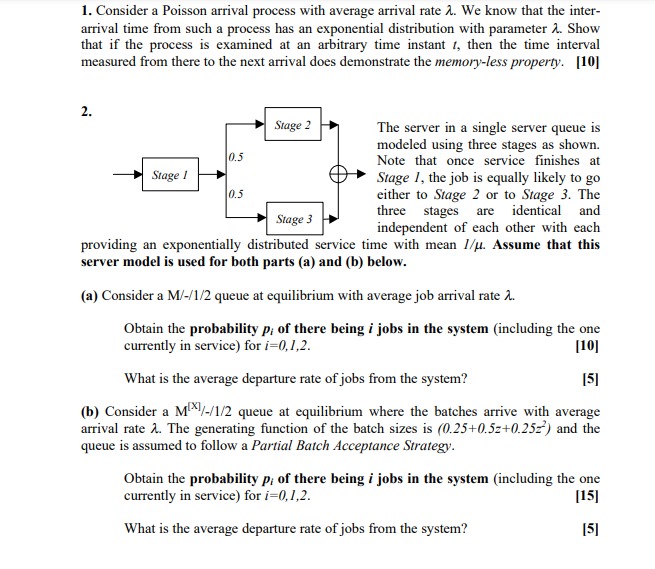
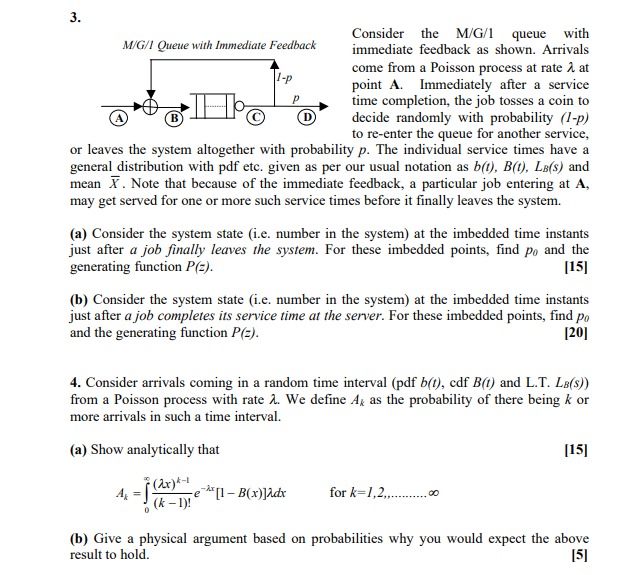
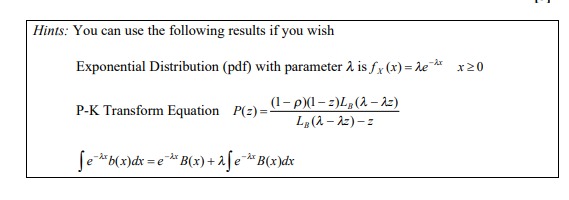
1. Consider a Poisson arrival process with average arrival rate 1. We know that the inter- arrival time from such a process has an exponential distribution with parameter 1. Show that if the process is examined at an arbitrary time instant /, then the time interval measured from there to the next arrival does demonstrate the memory-less property. [10] 2. Stage 2 The server in a single server queue is modeled using three stages as shown. 0.5 Note that once service finishes at Stage I Stage I, the job is equally likely to go 0.5 either to Stage 2 or to Stage 3. The Stage 3 three stages are identical and independent of each other with each providing an exponentially distributed service time with mean 1/J. Assume that this server model is used for both parts (a) and (b) below. (a) Consider a M/-/1/2 queue at equilibrium with average job arrival rate 1. Obtain the probability p; of there being / jobs in the system (including the one currently in service) for i=0,1,2. [10] What is the average departure rate of jobs from the system? (5] (b) Consider a M/-/1/2 queue at equilibrium where the batches arrive with average arrival rate 1. The generating function of the batch sizes is (0.25+0.5z+0.25 ) and the queue is assumed to follow a Partial Batch Acceptance Strategy. Obtain the probability p; of there being / jobs in the system (including the one currently in service) for i=0,1,2. [15] What is the average departure rate of jobs from the system? [5]3. Consider the M/G/1 queue with M/G/1 Queue with Immediate Feedback immediate feedback as shown. Arrivals come from a Poisson process at rate 1 at I-p point A. Immediately after a service time completion, the job tosses a coin to decide randomly with probability (1-p) to re-enter the queue for another service, or leaves the system altogether with probability p. The individual service times have a general distribution with pdf etc. given as per our usual notation as b(1), B(t), Le(s) and mean X . Note that because of the immediate feedback, a particular job entering at A. may get served for one or more such service times before it finally leaves the system. (a) Consider the system state (i.e. number in the system) at the imbedded time instants just after a job finally leaves the system. For these imbedded points, find po and the generating function P(=). [15] (b) Consider the system state (i.e. number in the system) at the imbedded time instants just after a job completes its service time at the server. For these imbedded points, find po and the generating function P(=). [20] 4. Consider arrivals coming in a random time interval (pdf b(1), cdf B(t) and L.T. La(s)) from a Poisson process with rate 1. We define A, as the probability of there being & or more arrivals in such a time interval. (a) Show analytically that [15] (Ar)4-1 -MY [1 - B(x)]Adx for k=1,2,..........90 (k - 1)! e (b) Give a physical argument based on probabilities why you would expect the above result to hold. [5]Hints: You can use the following results if you wish Exponential Distribution (pdf) with parameter A is fy (x) = le-Ax x20 P-K Transform Equation P(=) =- (1- p)(1-=)L,(2-15) Lp (2 - 25) -2 [erb(x)dx = e "B(x) + A e " B(x)dx
Step by Step Solution
There are 3 Steps involved in it

Get step-by-step solutions from verified subject matter experts
 Study Help