







Question: QUICK SORT and ALGORITHM ANALYSIS Using Quick Sort algorithms implement a Program in any language you desire (C++ or java or Python) to sort an
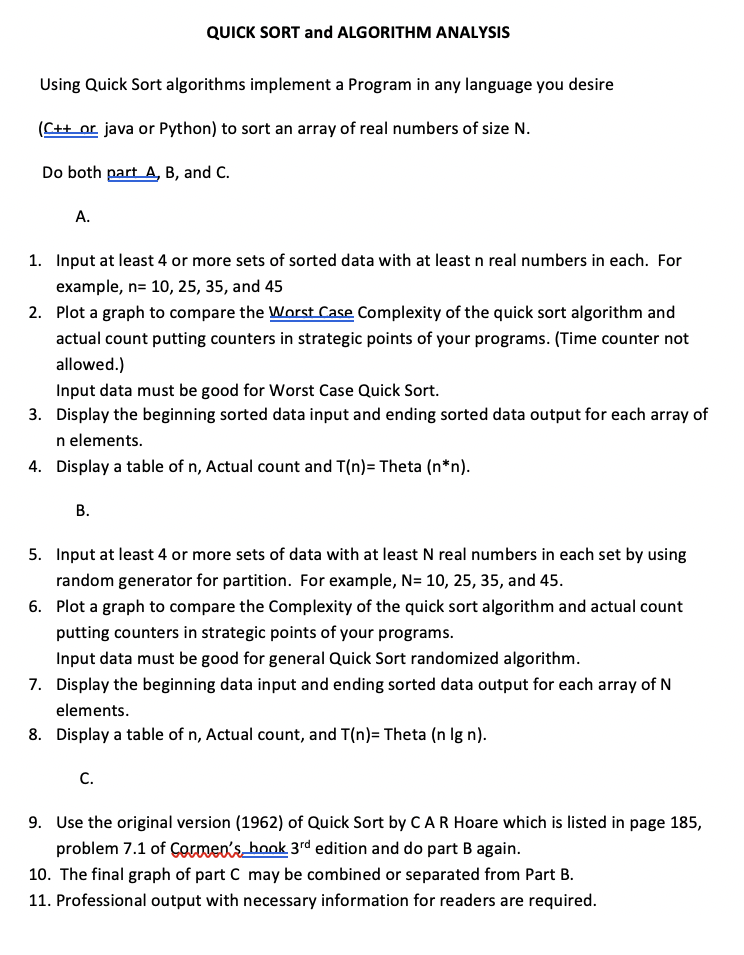
QUICK SORT and ALGORITHM ANALYSIS Using Quick Sort algorithms implement a Program in any language you desire (C++ or java or Python) to sort an array of real numbers of size N. Do both part A, B, and C. A. 1. Input at least 4 or more sets of sorted data with at least n real numbers in each. For example, n= 10, 25, 35, and 45 2. Plot a graph to compare the Worst Case Complexity of the quick sort algorithm and actual count putting counters in strategic points of your programs. (Time counter not allowed.) Input data must be good for Worst Case Quick Sort. 3. Display the beginning sorted data input and ending sorted data output for each array of n elements. 4. Display a table of n, Actual count and T(n)= Theta (n*n). B. 5. Input at least 4 or more sets of data with at least N real numbers in each set by using random generator for partition. For example, N= 10, 25, 35, and 45. 6. Plot a graph to compare the Complexity of the quick sort algorithm and actual count putting counters in strategic points of your programs. Input data must be good for general Quick Sort randomized algorithm. 7. Display the beginning data input and ending sorted data output for each array of N elements. 8. Display a table of n, Actual count, and T(n)= Theta (n Ig n). C. 9. Use the original version (1962) of Quick Sort by CAR Hoare which is listed in page 185, problem 7.1 of Cormen's book 3rd edition and do part B again. 10. The final graph of part C may be combined or separated from Part B. 11. Professional output with necessary information for readers are required
Step by Step Solution
There are 3 Steps involved in it

Get step-by-step solutions from verified subject matter experts
 Study Help