



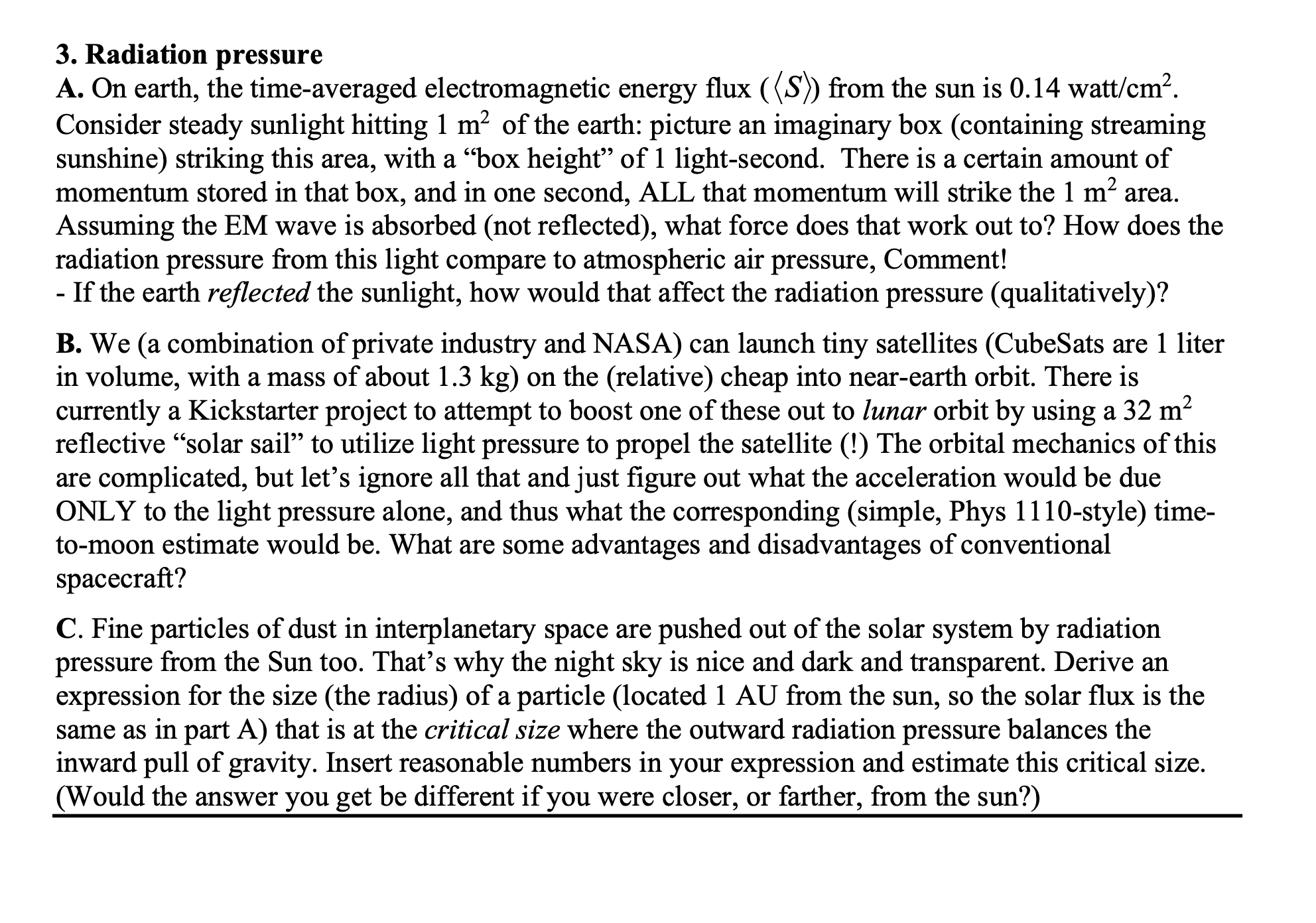
Question: Radiation pressure A . On earth, the time - averaged electromagnetic energy flux ( ( : S : ) ) from the sun is 0
Radiation pressure
A On earth, the timeaveraged electromagnetic energy flux :: from the sun is wat
Consider steady sunlight hitting of the earth: picture an imaginary box containing streaming
sunshine striking this area, with a "box height" of lightsecond. There is a certain amount of
momentum stored in that box, and in one second, ALL that momentum will strike the area.
Assuming the EM wave is absorbed not reflected what force does that work out to How does the
radiation pressure from this light compare to atmospheric air pressure, Comment!
If the earth reflected the sunlight, how would that affect the radiation pressure qualitatively
B We a combination of private industry and NASA can launch tiny satellites CubeSats are liter
in volume, with a mass of about on the relative cheap into nearearth orbit. There is
currently a Kickstarter project to attempt to boost one of these out to lunar orbit by using a
reflective "solar sail" to utilize light pressure to propel the satellite The orbital mechanics of this
are complicated, but let's ignore all that and just figure out what the acceleration would be due
ONLY to the light pressure alone, and thus what the corresponding simple Phys style time
tomoon estimate would be What are some advantages and disadvantages of conventional
spacecraft?
C Fine particles of dust in interplanetary space are pushed out of the solar system by radiation
pressure from the Sun too. That's why the night sky is nice and dark and transparent. Derive an
expression for the size the radius of a particle located from the sun, so the solar flux is the
same as in part A that is at the critical size where the outward radiation pressure balances the
inward pull of gravity. Insert reasonable numbers in your expression and estimate this critical size.
Would the answer you get be different if you were closer, or farther, from the sun?
Step by Step Solution
There are 3 Steps involved in it
1 Expert Approved Answer
Step: 1 Unlock

Question Has Been Solved by an Expert!
Get step-by-step solutions from verified subject matter experts
Step: 2 Unlock
Step: 3 Unlock