







Question: Random Early Detection (RED) is a buffer management mechanism that is intended to avoid congestion in a router by keeping average queue length small. The
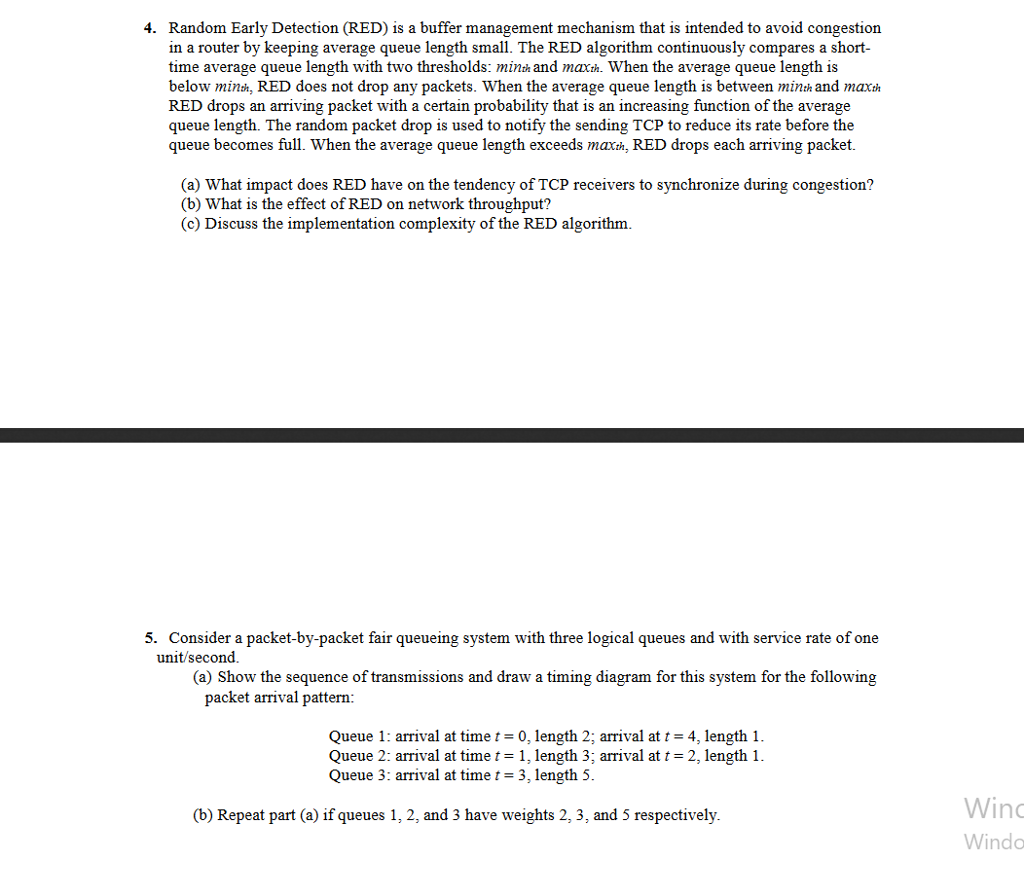
Random Early Detection (RED) is a buffer management mechanism that is intended to avoid congestion in a router by keeping average queue length small. The RED algorithm continuously compares a short time average queue length with two thresholds: minth and maxih. When the average queue length is below minsh, RED does not drop any packets. When the average queue length is between minth and maxh RED drops an arriving packet with a certain probability that is an increasing function of the average queue length. The random packet drop is used to notify the sending TCP to reduce its rate before the queue becomes full. When the average queue length exceeds maxth, RED drops each arriving packet. 4. (a) What impact does RED have on the tendency of TCP receivers to synchronize during congestion? (b) What is the effect of RED on network throughput? (c) Discuss the implementation complexity of the RED algorithm. 5. Consider a packet-by-packet fair queueing system with three logical queues and with service rate of one unit/second. (a) Show the sequence of transmissions and draw a timing diagram for this system for the following packet arrival pattern: Queue 1: arrival at time t = 0, length 2: arrival at t = 4, length 1. Queue 2: arrival at time t = 1, length 3: arrival at t-2, length 1. Queue 3: arrival at time t- 3, length 5 Win Windo (b) Repeat part (a) if queues 1, 2, and 3 have weights 2, 3, and 5 respectively. Random Early Detection (RED) is a buffer management mechanism that is intended to avoid congestion in a router by keeping average queue length small. The RED algorithm continuously compares a short time average queue length with two thresholds: minth and maxih. When the average queue length is below minsh, RED does not drop any packets. When the average queue length is between minth and maxh RED drops an arriving packet with a certain probability that is an increasing function of the average queue length. The random packet drop is used to notify the sending TCP to reduce its rate before the queue becomes full. When the average queue length exceeds maxth, RED drops each arriving packet. 4. (a) What impact does RED have on the tendency of TCP receivers to synchronize during congestion? (b) What is the effect of RED on network throughput? (c) Discuss the implementation complexity of the RED algorithm. 5. Consider a packet-by-packet fair queueing system with three logical queues and with service rate of one unit/second. (a) Show the sequence of transmissions and draw a timing diagram for this system for the following packet arrival pattern: Queue 1: arrival at time t = 0, length 2: arrival at t = 4, length 1. Queue 2: arrival at time t = 1, length 3: arrival at t-2, length 1. Queue 3: arrival at time t- 3, length 5 Win Windo (b) Repeat part (a) if queues 1, 2, and 3 have weights 2, 3, and 5 respectively
Step by Step Solution
There are 3 Steps involved in it

Get step-by-step solutions from verified subject matter experts
 Study Help