







Question: Rationale about this case study Case Study - The Priceline Group and Expedia Inc. Since the late 1990s, travel distribution has seen a considerable shift
Rationale about this case study 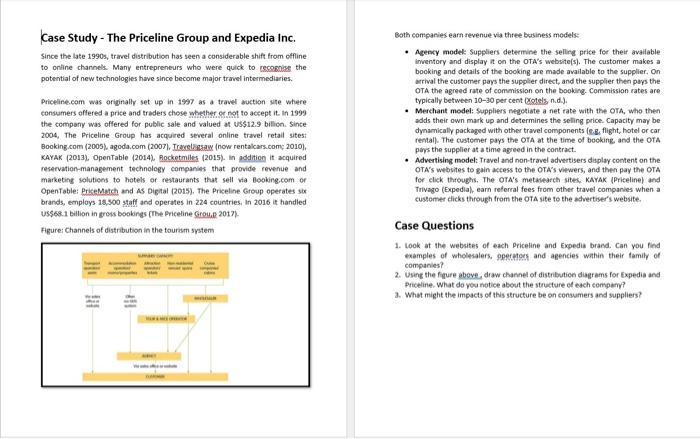
Case Study - The Priceline Group and Expedia Inc. Since the late 1990s, travel distribution has seen a considerable shift from offline to online channels. Many entrepreneurs who were quick to recognize the potential of new technologies have since become major travel intermediaries. Priceline.com was originally set up in 1997 as a travel auction site where consumers offered a price and traders chose whether or not to accept it. In 1999 the company was offered for public sale and valued at US$12.9 billion. Since 2004, The Priceline Group has acquired several online travel retail sitesi Booking.com (2005), agoda.com (2007). Travelaw now rentalcars.com 2010), KAYAK (2013). OpenTable (2014), Rocketmiles (2015). In addition it acquired reservation management technology companies that provide revenue and marketing solutions to hotels or restaurants that sell va Booking.com or OpenTable: Drie Match and As Digital (2015), The Priceline Group operates se brands, employs 18,500 staff and operates in 224 countries. In 2016 it handled US$68.1 billion in gross bookings (The Priceline Grou. 2017) Figure: Channels of distribution in the tourism system Both companies earn revenue via three business models Agency model: Suppliers determine the selleg price for their available inventory and display it on the OTA's website(s). The customer makes a booking and details of the booking are made available to the supplier. On arrival the customer pays the supplier direct, and the supplier then pays the OTA the agreed rate of commission on the booking Commission rates are typically between 10-30 per cent otels n.d.). Merchant model: Suppliers negotiate a net rate with the OTA, who then adds their own mark up and determines the selling price. Capacity may be dynamically packaged with other travel components (eg, flight, hotel or car rental). The customer pays the OTA at the time of booking and the OTA pays the supplier at a time agreed in the contract. Advertising model: Travel and non-travel advertisers display content on the OTA's websites to gain access to the OTA's viewers, and then pay the OTA for click throughs. The OTA's metasearch sites, KAYAK (Priceline) and Trivago (Expedia), earn referral fees from other travel companies when a customer clicks through from the OTA site to the advertiser's website Case Questions 1. Look at the websites of each Priceline and Expedia brand. Can you find examples of wholesalers, operators and agencies within their family of companies? 2. Using the figure above draw channel of distribution diagrams for Expedia and Priceline. What do you notice about the structure of each company? 2. What might the impacts of this structure be on consumers and suppliers
Step by Step Solution
There are 3 Steps involved in it
1 Expert Approved Answer
Step: 1 Unlock

Question Has Been Solved by an Expert!
Get step-by-step solutions from verified subject matter experts
Step: 2 Unlock
Step: 3 Unlock
 Study Help