







Question: Raw C 8x4 Needle Tip 0.7 L 2. (4 points) Which sum occurred most often? 3. (4 points) Which sum occurred least often? / (40
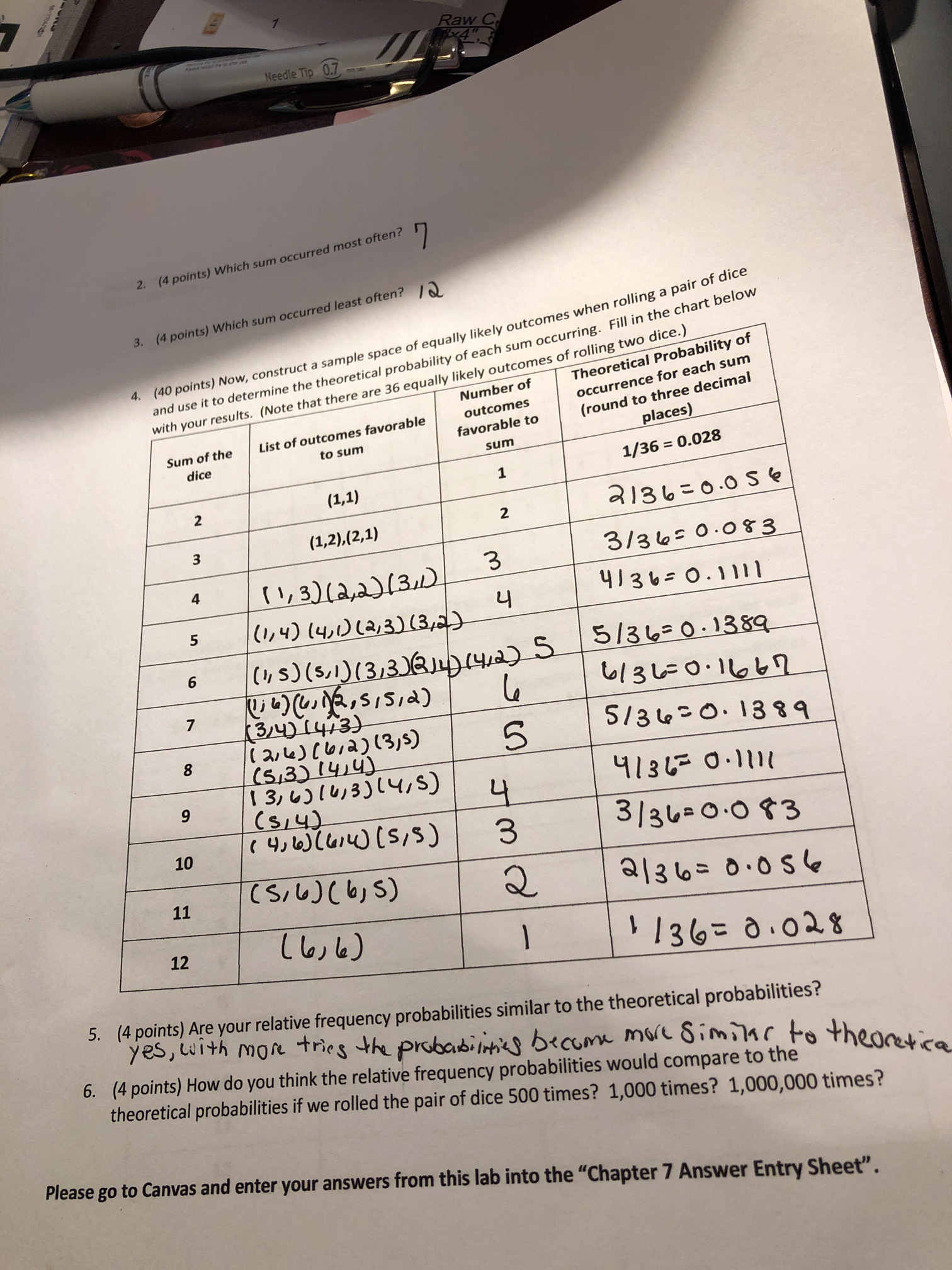
Raw C 8x4" Needle Tip 0.7 L 2. (4 points) Which sum occurred most often? 3. (4 points) Which sum occurred least often? / (40 points) Now, construct a sample space of equally likely outcomes when rolling a pair of dice and use it to determine the theoretical probability of each sum occurring. Fill in the chart below Theoretical Probability of with your results. (Note that there are 36 equally likely outcomes of rolling two dice.) Number of occurrence for each sum outcomes (round to three decimal places) List of outcomes favorable favorable to sum 1/36 = 0.028 Sum of the to sum dice 1 (1,1) 2136=0.0S 2 (1,2),(2,1) 3/360.083 3 (1, 3) (2,2)(3.D 3 4136 = 0 . 111 1 h 5 (1, 4) (4,1) (a,3) (3,30 (), S) (s,1) (3,3 BJ (425 5 5/36= 0 . 1389 6 t/36=0 . 16 67 3/4) (413) 5/3420 . 1389 ( 2/ 4) [bra) (3,s) S (5,3) 1414) 1 3, 6) (4, 3)(4/S) 4 4136- 0 . 111 (s/4) ( 4,blurw (s,S) 3 3/36=0.0 $3 10 C 11 (S/() (b) s) |36= 0 .0S 1 136= 0 . 02 8 12 5. (4 points) Are your relative frequency probabilities similar to the theoretical probabilities? yes, with mon tries the probabilin's brame more Siminc to theoretical 6. (4 points) How do you think the relative frequency probabilities would compare to the theoretical probabilities if we rolled the pair of dice 500 times? 1,000 times? 1,000,000 times? Please go to Canvas and enter your answers from this lab into the "Chapter 7 Answer Entry Sheet"
Step by Step Solution
There are 3 Steps involved in it

Get step-by-step solutions from verified subject matter experts
 Study Help