







Question: re individual Consider two sets A, B C#. The Minkowski-sum of sets A, B is defined as, A+B:= {a+b:0 A,b B}, i.e. it is the
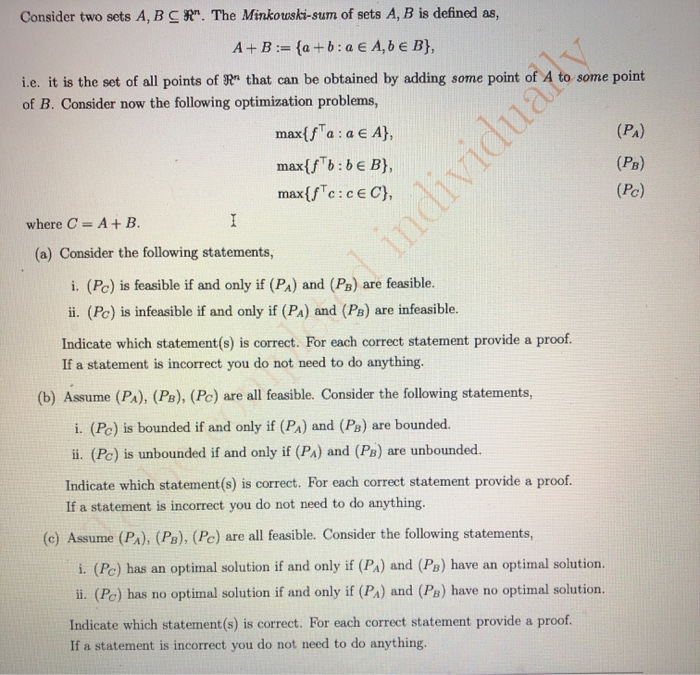
re individual Consider two sets A, B C#". The Minkowski-sum of sets A, B is defined as, A+B:= {a+b:0 A,b B}, i.e. it is the set of all points of Rn that can be obtained by adding some point of some point of B. Consider now the following optimization problems, max{"a : a A}, (PA) max{STb:be B}, (PB) max{STC:CEC), (Pc) where C=A+B. (a) Consider the following statements, i. (Pc) is feasible if and only if (P.) and (PB) are feasible. ii. (Pc) is infeasible if and only if (PA) and (PB) are infeasible. Indicate which statement(s) is correct. For each correct statement provide a proof. If a statement is incorrect you do not need to do anything. (b) Assume (PA), (PB), (Pc) are all feasible. Consider the following statements, i. (Pc) is bounded if and only if (PA) and (PB) are bounded. ii. (Pc) is unbounded if and only if (PA) and (PB) are unbounded. Indicate which statement(s) is correct. For each correct statement provide a proof. If a statement is incorrect you do not need to do anything, (c) Assume (PA), (PB), (Pc) are all feasible. Consider the following statements, i. (Pc) has an optimal solution if and only if (PA) and (Ps) have an optimal solution. ii. (Pc) has no optimal solution if and only if (PA) and (PB) have no optimal solution. Indicate which statement(s) is correct. For each correct statement provide a proof. If a statement is incorrect you do not need to do anything. re individual Consider two sets A, B C#". The Minkowski-sum of sets A, B is defined as, A+B:= {a+b:0 A,b B}, i.e. it is the set of all points of Rn that can be obtained by adding some point of some point of B. Consider now the following optimization problems, max{"a : a A}, (PA) max{STb:be B}, (PB) max{STC:CEC), (Pc) where C=A+B. (a) Consider the following statements, i. (Pc) is feasible if and only if (P.) and (PB) are feasible. ii. (Pc) is infeasible if and only if (PA) and (PB) are infeasible. Indicate which statement(s) is correct. For each correct statement provide a proof. If a statement is incorrect you do not need to do anything. (b) Assume (PA), (PB), (Pc) are all feasible. Consider the following statements, i. (Pc) is bounded if and only if (PA) and (PB) are bounded. ii. (Pc) is unbounded if and only if (PA) and (PB) are unbounded. Indicate which statement(s) is correct. For each correct statement provide a proof. If a statement is incorrect you do not need to do anything, (c) Assume (PA), (PB), (Pc) are all feasible. Consider the following statements, i. (Pc) has an optimal solution if and only if (PA) and (Ps) have an optimal solution. ii. (Pc) has no optimal solution if and only if (PA) and (PB) have no optimal solution. Indicate which statement(s) is correct. For each correct statement provide a proof. If a statement is incorrect you do not need to do anything
Step by Step Solution
There are 3 Steps involved in it

Get step-by-step solutions from verified subject matter experts
 Study Help