



Question: Read above the Stress of Screening case study. Then, using the FIORD method for critical thinking and ethical reasoning, analyze the case using Questions #1,
Read above the Stress of Screening case study.
Then, using the FIORD method for critical thinking and ethical reasoning, analyze the case using Questions #1, 3, and 4 at the end of the chapter as your guide.
- Introduction of the Case: Overview of the FACTS
- Use Questions 3 and 4
- Describe the levels of hierarchy that exist
- Describe the kind of interdependence that seems to exist
- Describe the coordination requirements that are necessary and how achieved
2. Analysis of Situation: Description of the Ethical ISSUES
- Use the Job Characteristics Approach for part of Question 1
- What are the ethical implication who is being affected
- Give some examples of what might be causing the ethical situation
- Skill Variety
- Task Identity
- Task Significance
- Autonomy
- Feedback
3. Discussion: Explanation of OPTIONS and Consequences
- Use Chapter Concepts to give you some ideas
- What are some options available
- What would be the consequences of each
4. Proposed Change: Your RECOMMENDATION from the Options discussed above
- Use the second part of Question 1 for your proposal
- In your opinion, what would be the best option described above
- How would that be more engaging and motivating for the employees
5. Defend and support your suggestion: What is your DECISION-BASIS
- Give your basis for the Recommendation
- How would you defend your suggestion
- How would you support your suggestion (theory, experience, prior case, etc.)
6. References
- List your sources
- Did you use concepts from the text
- Did you use any other resources (internet, books, publications, etc.)
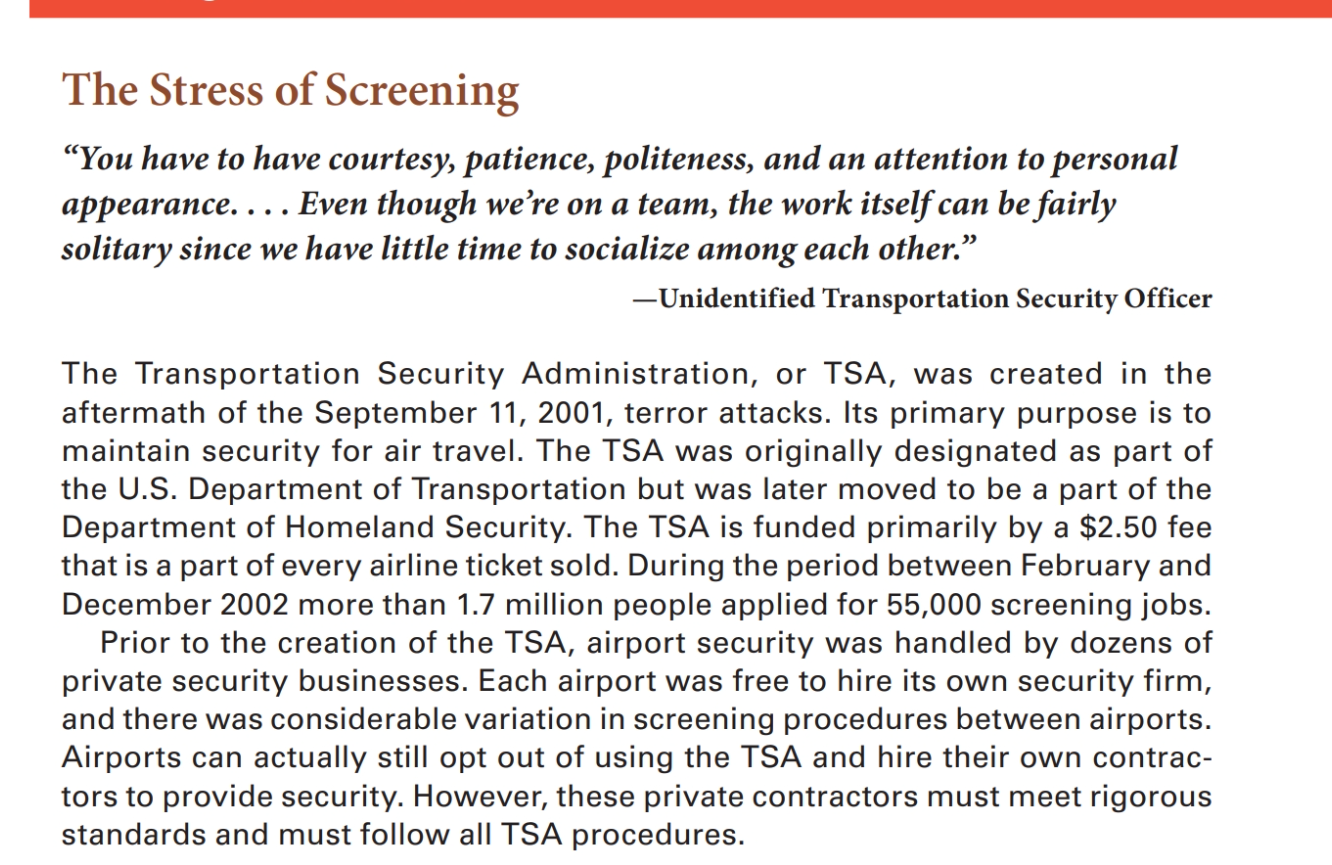
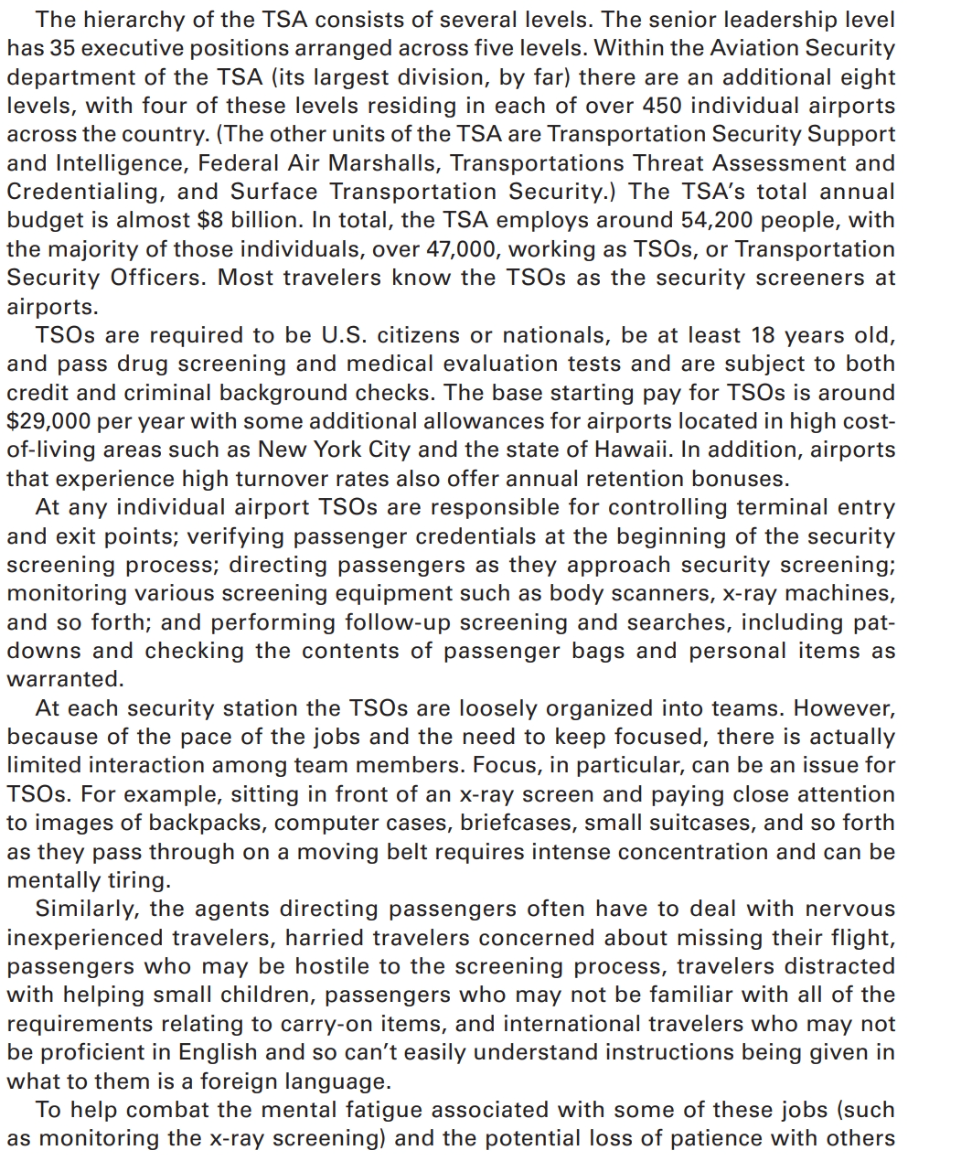
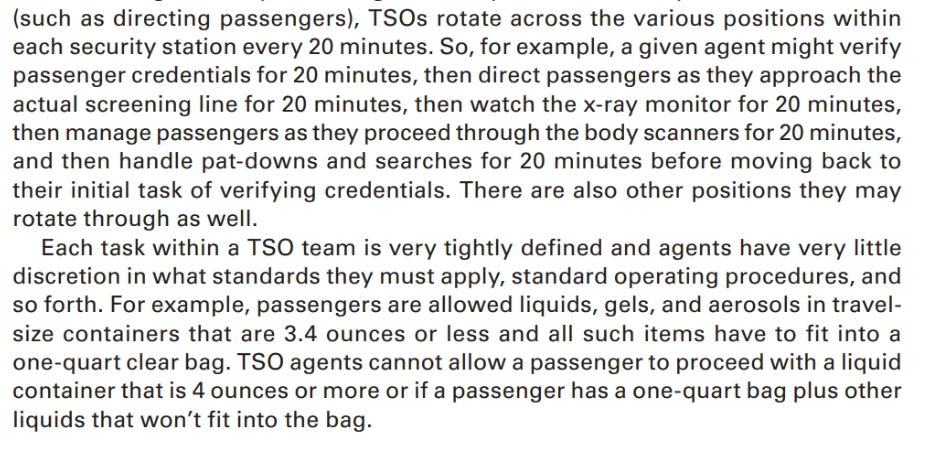
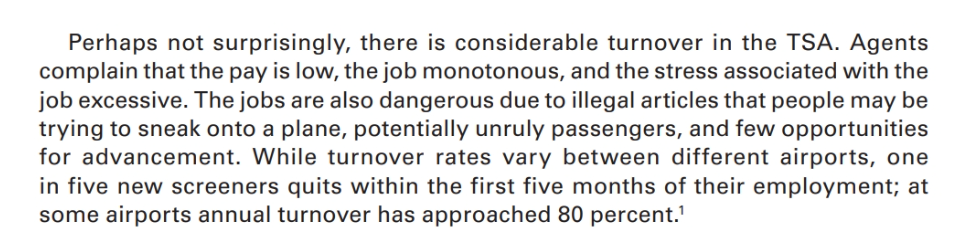
The Stress of Screening "You have to have courtesy, patience, politeness, and an attention to personal appearance. ... Even though we're on a team, the work itself can be fairly solitary since we have little time to socialize among each other." -Unidentified Transportation Security Officer The Transportation Security Administration, or TSA, was created in the aftermath of the September 11, 2001, terror attacks. Its primary purpose is to maintain security for air travel. The TSA was originally designated as part of the U.S. Department of Transportation but was later moved to be a part of the Department of Homeland Security. The TSA is funded primarily by a $2.50 fee that is a part of every airline ticket sold. During the period between February and December 2002 more than 1.7 million people applied for 55,000 screening jobs. Prior to the creation of the TSA, airport security was handled by dozens of private security businesses. Each airport was free to hire its own security firm, and there was considerable variation in screening procedures between airports. Airports can actually still opt out of using the TSA and hire their own contractors to provide security. However, these private contractors must meet rigorous standards and must follow all TSA procedures. The hierarchy of the TSA consists of several levels. The senior leadership level has 35 executive positions arranged across five levels. Within the Aviation Security department of the TSA (its largest division, by far) there are an additional eight levels, with four of these levels residing in each of over 450 individual airports across the country. (The other units of the TSA are Transportation Security Support and Intelligence, Federal Air Marshalls, Transportations Threat Assessment and Credentialing, and Surface Transportation Security.) The TSA's total annual budget is almost $8 billion. In total, the TSA employs around 54,200 people, with the majority of those individuals, over 47,000, working as TSOs, or Transportation Security Officers. Most travelers know the TSOs as the security screeners at airports. TSOs are required to be U.S. citizens or nationals, be at least 18 years old, and pass drug screening and medical evaluation tests and are subject to both credit and criminal background checks. The base starting pay for TSOs is around $29,000 per year with some additional allowances for airports located in high costof-living areas such as New York City and the state of Hawaii. In addition, airports that experience high turnover rates also offer annual retention bonuses. At any individual airport TSOs are responsible for controlling terminal entry and exit points; verifying passenger credentials at the beginning of the security screening process; directing passengers as they approach security screening; monitoring various screening equipment such as body scanners, x-ray machines, and so forth; and performing follow-up screening and searches, including patdowns and checking the contents of passenger bags and personal items as warranted. At each security station the TSOs are loosely organized into teams. However, because of the pace of the jobs and the need to keep focused, there is actually limited interaction among team members. Focus, in particular, can be an issue for TSOs. For example, sitting in front of an x-ray screen and paying close attention to images of backpacks, computer cases, briefcases, small suitcases, and so forth as they pass through on a moving belt requires intense concentration and can be mentally tiring. Similarly, the agents directing passengers often have to deal with nervous inexperienced travelers, harried travelers concerned about missing their flight, passengers who may be hostile to the screening process, travelers distracted with helping small children, passengers who may not be familiar with all of the requirements relating to carry-on items, and international travelers who may not be proficient in English and so can't easily understand instructions being given in what to them is a foreign language. To help combat the mental fatigue associated with some of these jobs (such as monitoring the x-ray screening) and the potential loss of patience with others (such as directing passengers), TSOs rotate across the various positions within each security station every 20 minutes. So, for example, a given agent might verify passenger credentials for 20 minutes, then direct passengers as they approach the actual screening line for 20 minutes, then watch the x-ray monitor for 20 minutes, then manage passengers as they proceed through the body scanners for 20 minutes, and then handle pat-downs and searches for 20 minutes before moving back to their initial task of verifying credentials. There are also other positions they may rotate through as well. Each task within a TSO team is very tightly defined and agents have very little discretion in what standards they must apply, standard operating procedures, and so forth. For example, passengers are allowed liquids, gels, and aerosols in travelsize containers that are 3.4 ounces or less and all such items have to fit into a one-quart clear bag. TSO agents cannot allow a passenger to proceed with a liquid container that is 4 ounces or more or if a passenger has a one-quart bag plus other liquids that won't fit into the bag. Perhaps not surprisingly, there is considerable turnover in the TSA. Agents complain that the pay is low, the job monotonous, and the stress associated with the job excessive. The jobs are also dangerous due to illegal articles that people may be trying to sneak onto a plane, potentially unruly passengers, and few opportunities for advancement. While turnover rates vary between different airports, one in five new screeners quits within the first five months of their employment; at some airports annual turnover has approached 80 percent. 1
Step by Step Solution
There are 3 Steps involved in it

Get step-by-step solutions from verified subject matter experts