Question: READ AND CRITICALLY ANALYZE THE ARTICLE (could you please make it at least five sentences each paragraph without just repeating question) (please follow the formatting)
"READ AND CRITICALLY ANALYZE THE ARTICLE"
(could you please make it at least five sentences each paragraph without just repeating question)
(please follow the formatting)
THANK YOU !
FIRST PARAGRAPH
Pls summarize the article "your own interpretation of the article"
SECOND PARAGRAPH
Why did you pick this article?
What are the things that fascinated to you about this topic?
THIRD PARAGRAPH
Discuss the shortcoming in research
Do you agree with the results?
How to improve that research
FOURTH PARAGRAPH
Discuss how this research will be beneficial
What would you change about the experiment?
What did you gain/learn from this article?
FIFTH PARAGRAPH
Conclusion
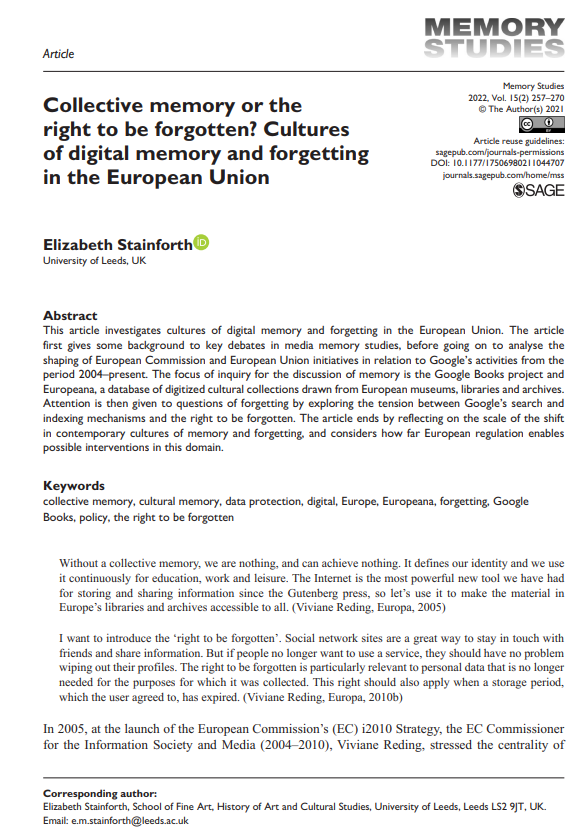
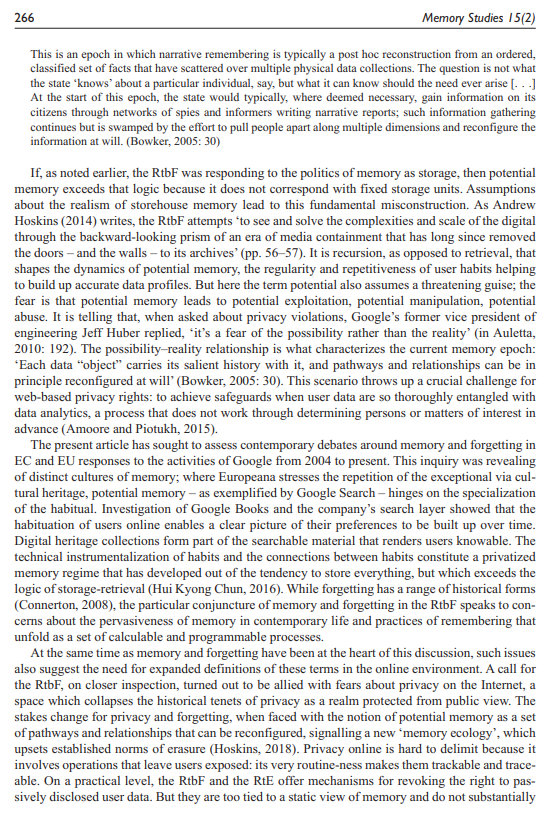
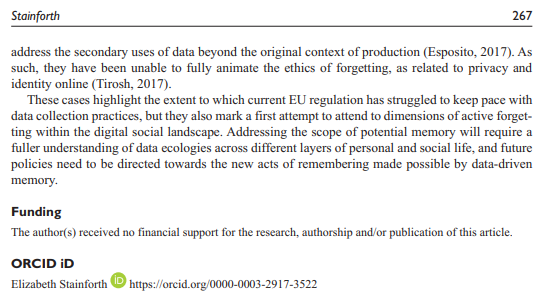
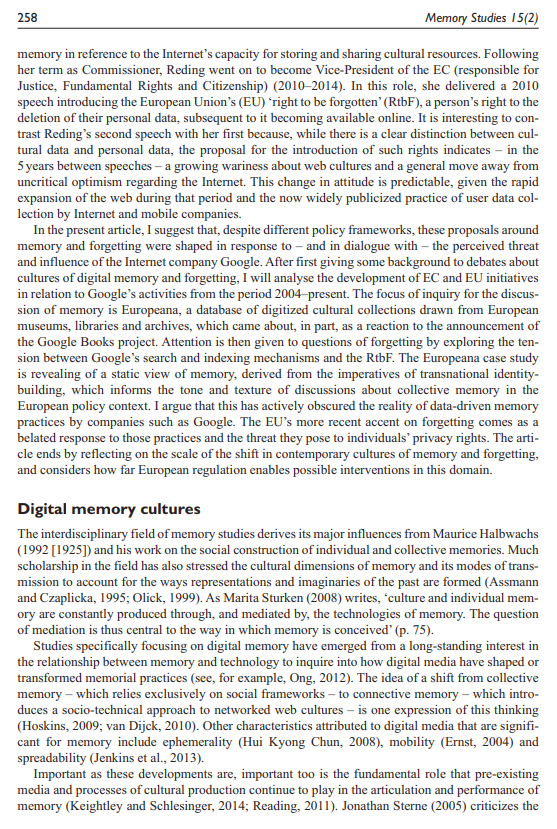
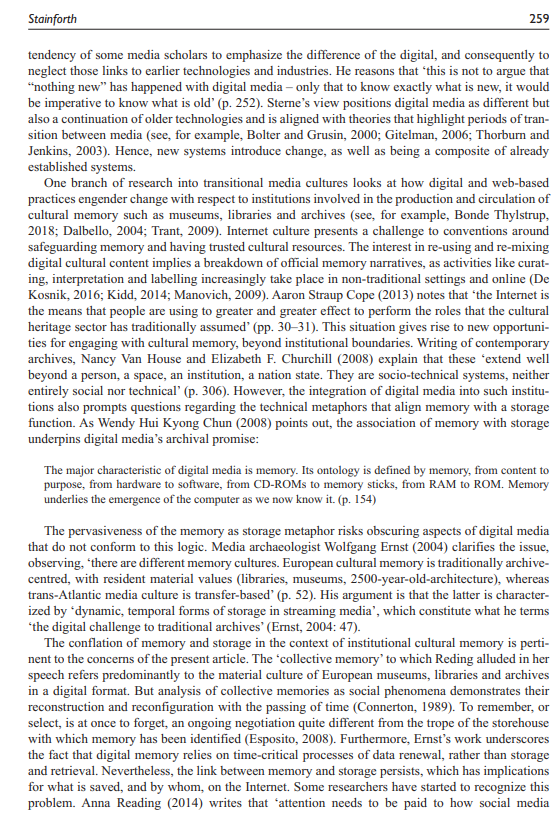
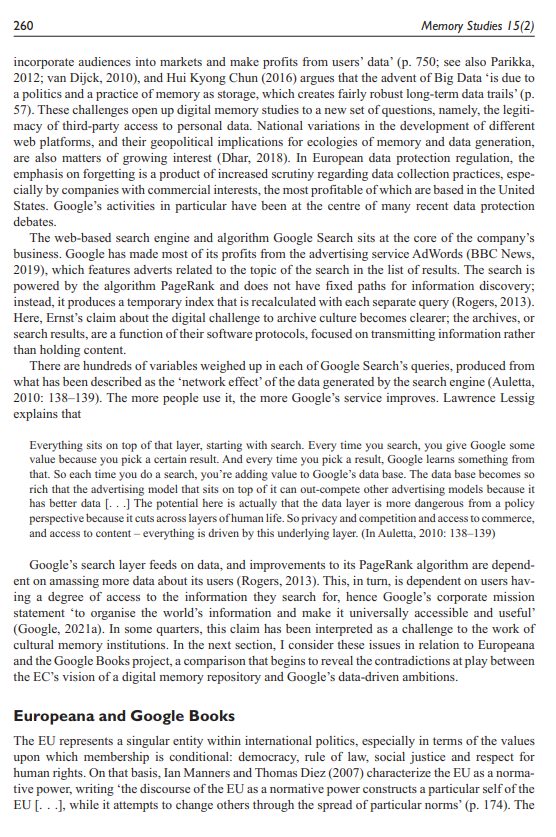
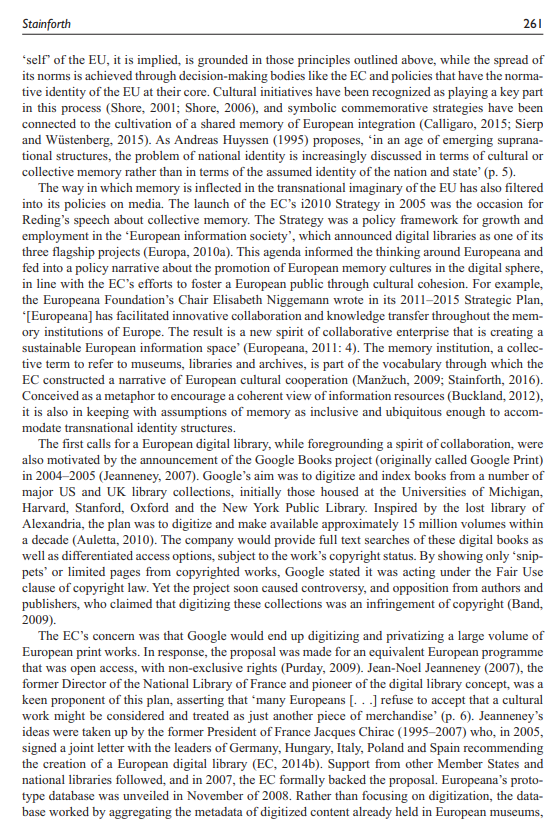
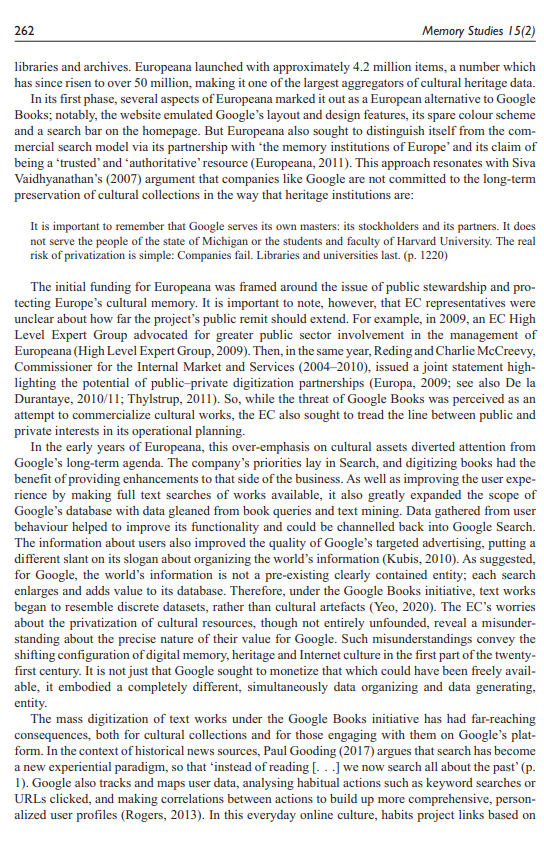
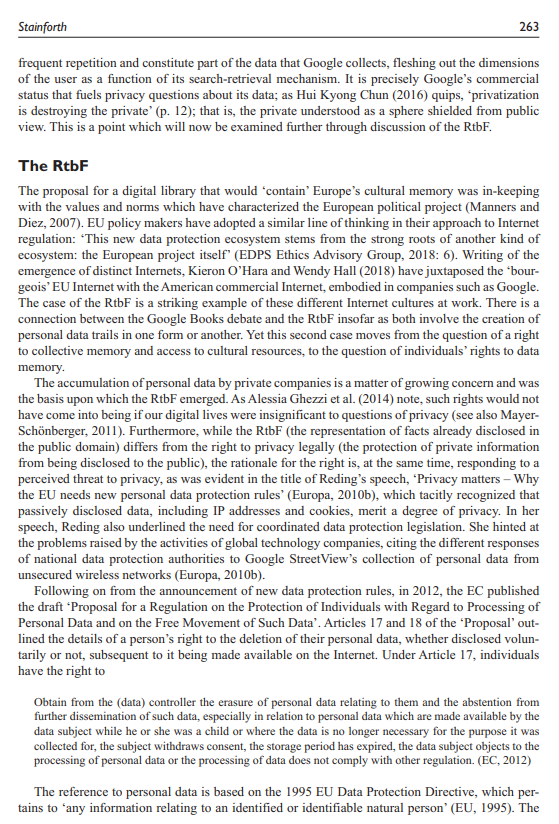
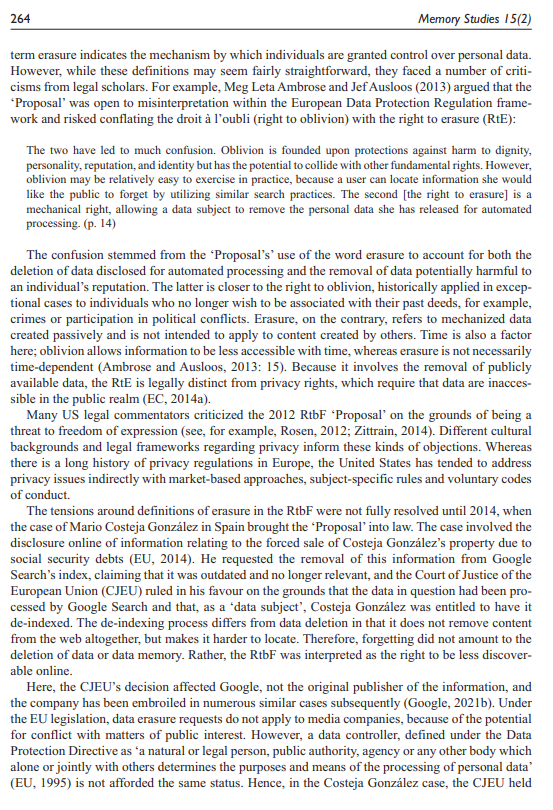
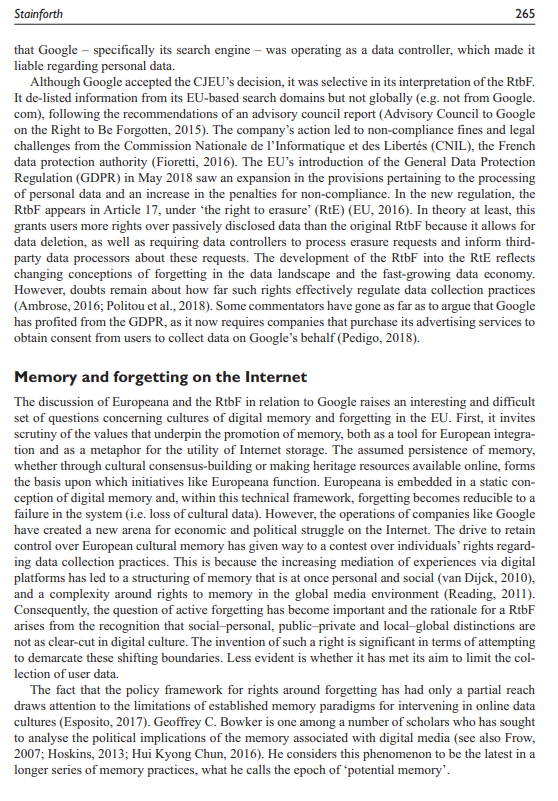
MEMORY Article STUDIES Memory Studies Collective memory or the 2022, Vol. 15(2) 257-270 The Author(s) 2021 right to be forgotten? Cultures Article reuse guidelines: of digital memory and forgetting sagepub.com/journals-permissions DOI: 10.1 177/1750698021 1044707 in the European Union journals.sagepub.com/home/mss SSAGE Elizabeth Stainforth University of Leeds, UK Abstract This article investigates cultures of digital memory and forgetting in the European Union. The article first gives some background to key debates in media memory studies, before going on to analyse the shaping of European Commission and European Union initiatives in relation to Google's activities from the period 2004-present. The focus of inquiry for the discussion of memory is the Google Books project and Europeana, a database of digitized cultural collections drawn from European museums, libraries and archives. Attention is then given to questions of forgetting by exploring the tension between Google's search and indexing mechanisms and the right to be forgotten. The article ends by reflecting on the scale of the shift in contemporary cultures of memory and forgetting, and considers how far European regulation enables possible interventions in this domain. Keywords collective memory, cultural memory, data protection, digital, Europe, Europeana, forgetting, Google Books, policy, the right to be forgotten Without a collective memory, we are nothing, and can achieve nothing. It defines our identity and we use it continuously for education, work and leisure. The Internet is the most powerful new tool we have had for storing and sharing information since the Gutenberg press, so let's use it to make the material in Europe's libraries and archives accessible to all. (Viviane Reding, Europa, 2005) I want to introduce the "right to be forgotten'. Social network sites are a great way to stay in touch with friends and share information. But if people no longer want to use a service, they should have no problem wiping out their profiles. The right to be forgotten is particularly relevant to personal data that is no longer needed for the purposes for which it was collected. This right should also apply when a storage period, which the user agreed to, has expired. (Viviane Reding, Europa, 2010b) In 2005, at the launch of the European Commission's (EC) 12010 Strategy, the EC Commissioner for the Information Society and Media (2004-2010), Viviane Reding, stressed the centrality of Corresponding author: Elizabeth Stainforth, School of Fine Art, History of Art and Cultural Studies, University of Leeds, Leeds LS2 9/T, UK. Email: e.m.stainforth@leeds.ac.uk266 Memory Studies 15(2) This is an epoch in which narrative remembering is typically a post hoc reconstruction from an ordered, classified set of facts that have scattered over multiple physical data collections. The question is not what the state 'knows' about a particular individual, say, but what it can know should the need ever arise [. . .] At the start of this epoch, the state would typically, where deemed necessary, gain information on its citizens through networks of spies and informers writing narrative reports; such information gathering continues but is swamped by the effort to pull people apart along multiple dimensions and reconfigure the information at will. (Bowker, 2005: 30) If, as noted earlier, the RibF was responding to the politics of memory as storage, then potential memory exceeds that logic because it does not correspond with fixed storage units. Assumptions about the realism of storehouse memory lead to this fundamental misconstruction. As Andrew Hoskins (2014) writes, the RtbF attempts "to see and solve the complexities and scale of the digital through the backward-looking prism of an era of media containment that has long since removed the doors - and the walls - to its archives' (pp. 56-57). It is recursion, as opposed to retrieval, that shapes the dynamics of potential memory, the regularity and repetitiveness of user habits helping to build up accurate data profiles. But here the term potential also assumes a threatening guise; the fear is that potential memory leads to potential exploitation, potential manipulation, potential abuse. It is telling that, when asked about privacy violations, Google's former vice president of engineering Jeff Huber replied, "it's a fear of the possibility rather than the reality' (in Auletta, 2010: 192). The possibility-reality relationship is what characterizes the current memory epoch: Each data "object" carries its salient history with it, and pathways and relationships can be in principle reconfigured at will' (Bowker, 2005: 30). This scenario throws up a crucial challenge for web-based privacy rights: to achieve safeguards when user data are so thoroughly entangled with data analytics, a process that does not work through determining persons or matters of interest in advance (Amoore and Piotukh, 2015). The present article has sought to assess contemporary debates around memory and forgetting in EC and EU responses to the activities of Google from 2004 to present. This inquiry was revealing of distinct cultures of memory; where Europeana stresses the repetition of the exceptional via cul- tural heritage, potential memory - as exemplified by Google Search - hinges on the specialization of the habitual. Investigation of Google Books and the company's search layer showed that the habituation of users online enables a clear picture of their preferences to be built up over time. Digital heritage collections form part of the searchable material that renders users knowable. The technical instrumentalization of habits and the connections between habits constitute a privatized memory regime that has developed out of the tendency to store everything, but which exceeds the logic of storage-retrieval (Hui Kyong Chun, 2016). While forgetting has a range of historical forms (Connerton, 2008), the particular conjuncture of memory and forgetting in the RtbF speaks to con- cerns about the pervasiveness of memory in contemporary life and practices of remembering that unfold as a set of calculable and programmable processes. At the same time as memory and forgetting have been at the heart of this discussion, such issues also suggest the need for expanded definitions of these terms in the online environment. A call for the RtbF, on closer inspection, turned out to be allied with fears about privacy on the Internet, a space which collapses the historical tenets of privacy as a realm protected from public view. The stakes change for privacy and forgetting, when faced with the notion of potential memory as a set of pathways and relationships that can be reconfigured, signalling a new *memory ecology', which upsets established norms of erasure (Hoskins, 2018). Privacy online is hard to delimit because it involves operations that leave users exposed: its very routine-ness makes them trackable and trace- able. On a practical level, the RibF and the RtE offer mechanisms for revoking the right to pas- sively disclosed user data. But they are too tied to a static view of memory and do not substantiallyStainforth 267 address the secondary uses of data beyond the original context of production (Esposito, 2017). As such, they have been unable to fully animate the ethics of forgetting, as related to privacy and identity online (Tirosh, 2017). These cases highlight the extent to which current EU regulation has struggled to keep pace with data collection practices, but they also mark a first attempt to attend to dimensions of active forget- ting within the digital social landscape. Addressing the scope of potential memory will require a fuller understanding of data ecologies across different layers of personal and social life, and future policies need to be directed towards the new acts of remembering made possible by data-driven memory. Funding The author(s) received no financial support for the research, authorship and/or publication of this article. ORCID ID Elizabeth Stainforth https://orcid.org/0000-0003-2917-3522258 Memory Studies 15(2) memory in reference to the Internet's capacity for storing and sharing cultural resources. Following her term as Commissioner, Reding went on to become Vice-President of the EC (responsible for Justice, Fundamental Rights and Citizenship) (2010-2014). In this role, she delivered a 2010 speech introducing the European Union's (EU) 'right to be forgotten' (RtbF), a person's right to the deletion of their personal data, subsequent to it becoming available online. It is interesting to con- trast Reding's second speech with her first because, while there is a clear distinction between cul- tural data and personal data, the proposal for the introduction of such rights indicates - in the 5 years between speeches - a growing wariness about web cultures and a general move away from uncritical optimism regarding the Internet. This change in attitude is predictable, given the rapid expansion of the web during that period and the now widely publicized practice of user data col- lection by Internet and mobile companies. In the present article, I suggest that, despite different policy frameworks, these proposals around memory and forgetting were shaped in response to - and in dialogue with - the perceived threat and influence of the Internet company Google. After first giving some background to debates about cultures of digital memory and forgetting, I will analyse the development of EC and EU initiatives in relation to Google's activities from the period 2004-present. The focus of inquiry for the discus- sion of memory is Europeana, a database of digitized cultural collections drawn from European museums, libraries and archives, which came about, in part, as a reaction to the announcement of the Google Books project. Attention is then given to questions of forgetting by exploring the ten- sion between Google's search and indexing mechanisms and the RtbF. The Europeana case study is revealing of a static view of memory, derived from the imperatives of transnational identity- building, which informs the tone and texture of discussions about collective memory in the European policy context. I argue that this has actively obscured the reality of data-driven memory practices by companies such as Google. The EU's more recent accent on forgetting comes as a belated response to those practices and the threat they pose to individuals' privacy rights. The arti- cle ends by reflecting on the scale of the shift in contemporary cultures of memory and forgetting, and considers how far European regulation enables possible interventions in this domain. Digital memory cultures The interdisciplinary field of memory studies derives its major influences from Maurice Halbwachs (1992 [1925]) and his work on the social construction of individual and collective memories. Much scholarship in the field has also stressed the cultural dimensions of memory and its modes of trans- mission to account for the ways representations and imaginaries of the past are formed (Assmann and Czaplicka, 1995; Olick, 1999). As Marita Sturken (2008) writes, 'culture and individual mem- ory are constantly produced through, and mediated by, the technologies of memory. The question of mediation is thus central to the way in which memory is conceived' (p. 75). Studies specifically focusing on digital memory have emerged from a long-standing interest in the relationship between memory and technology to inquire into how digital media have shaped or transformed memorial practices (see, for example, Ong, 2012). The idea of a shift from collective memory - which relies exclusively on social frameworks - to connective memory - which intro- duces a socio-technical approach to networked web cultures - is one expression of this thinking (Hoskins, 2009; van Dijck, 2010). Other characteristics attributed to digital media that are signifi- cant for memory include ephemerality (Hui Kyong Chun, 2008), mobility (Ernst, 2004) and spreadability (Jenkins et al., 2013). Important as these developments are, important too is the fundamental role that pre-existing media and processes of cultural production continue to play in the articulation and performance of memory (Keightley and Schlesinger, 2014; Reading, 2011). Jonathan Sterne (2005) criticizes theStainforth 259 tendency of some media scholars to emphasize the difference of the digital, and consequently to neglect those links to earlier technologies and industries. He reasons that "this is not to argue that "nothing new" has happened with digital media - only that to know exactly what is new, it would be imperative to know what is old' (p. 252). Sterne's view positions digital media as different but also a continuation of older technologies and is aligned with theories that highlight periods of tran- sition between media (see, for example, Bolter and Grusin, 2000; Gitelman, 2006; Thorburn and Jenkins, 2003). Hence, new systems introduce change, as well as being a composite of already established systems. One branch of research into transitional media cultures looks at how digital and web-based practices engender change with respect to institutions involved in the production and circulation of cultural memory such as museums, libraries and archives (see, for example, Bonde Thylstrup, 2018; Dalbello, 2004; Trant, 2009). Internet culture presents a challenge to conventions around safeguarding memory and having trusted cultural resources. The interest in re-using and re-mixing digital cultural content implies a breakdown of official memory narratives, as activities like curat- ing, interpretation and labelling increasingly take place in non-traditional settings and online (De Kosnik, 2016; Kidd, 2014; Manovich, 2009). Aaron Straup Cope (2013) notes that 'the Internet is the means that people are using to greater and greater effect to perform the roles that the cultural heritage sector has traditionally assumed' (pp. 30-31). This situation gives rise to new opportuni- ties for engaging with cultural memory, beyond institutional boundaries. Writing of contemporary archives, Nancy Van House and Elizabeth F. Churchill (2008) explain that these extend well beyond a person, a space, an institution, a nation state. They are socio-technical systems, neither entirely social nor technical' (p. 306). However, the integration of digital media into such institu- tions also prompts questions regarding the technical metaphors that align memory with a storage function. As Wendy Hui Kyong Chun (2008) points out, the association of memory with storage underpins digital media's archival promise: The major characteristic of digital media is memory. Its ontology is defined by memory, from content to purpose, from hardware to software, from CD-ROMs to memory sticks, from RAM to ROM. Memory underlies the emergence of the computer as we now know it. (p. 154) The pervasiveness of the memory as storage metaphor risks obscuring aspects of digital media that do not conform to this logic. Media archaeologist Wolfgang Ernst (2004) clarifies the issue, observing, 'there are different memory cultures. European cultural memory is traditionally archive- centred, with resident material values (libraries, museums, 2500-year-old-architecture), whereas trans-Atlantic media culture is transfer-based' (p. 52). His argument is that the latter is character- ized by 'dynamic, temporal forms of storage in streaming media', which constitute what he terms the digital challenge to traditional archives' (Ernst, 2004: 47). The conflation of memory and storage in the context of institutional cultural memory is perti- nent to the concerns of the present article. The 'collective memory' to which Reding alluded in her speech refers predominantly to the material culture of European museums, libraries and archives in a digital format. But analysis of collective memories as social phenomena demonstrates their reconstruction and reconfiguration with the passing of time (Connerton, 1989). To remember, or select, is at once to forget, an ongoing negotiation quite different from the trope of the storehouse with which memory has been identified (Esposito, 2008). Furthermore, Ernst's work underscores the fact that digital memory relies on time-critical processes of data renewal, rather than storage and retrieval. Nevertheless, the link between memory and storage persists, which has implications for what is saved, and by whom, on the Internet. Some researchers have started to recognize this problem. Anna Reading (2014) writes that *attention needs to be paid to how social media260 Memory Studies 15(2) incorporate audiences into markets and make profits from users' data' (p. 750; see also Parikka, 2012; van Dijck, 2010), and Hui Kyong Chun (2016) argues that the advent of Big Data 'is due to a politics and a practice of memory as storage, which creates fairly robust long-term data trails' (p. 57). These challenges open up digital memory studies to a new set of questions, namely, the legiti- macy of third-party access to personal data. National variations in the development of different web platforms, and their geopolitical implications for ecologies of memory and data generation, are also matters of growing interest (Dhar, 2018). In European data protection regulation, the emphasis on forgetting is a product of increased scrutiny regarding data collection practices, espe- cially by companies with commercial interests, the most profitable of which are based in the United States. Google's activities in particular have been at the centre of many recent data protection debates. The web-based search engine and algorithm Google Search sits at the core of the company's business. Google has made most of its profits from the advertising service AdWords (BBC News, 2019), which features adverts related to the topic of the search in the list of results. The search is powered by the algorithm PageRank and does not have fixed paths for information discovery; instead, it produces a temporary index that is recalculated with each separate query (Rogers, 2013). Here, Ernst's claim about the digital challenge to archive culture becomes clearer; the archives, or search results, are a function of their software protocols, focused on transmitting information rather than holding content. There are hundreds of variables weighed up in each of Google Search's queries, produced from what has been described as the 'network effect" of the data generated by the search engine (Auletta, 2010: 138-139). The more people use it, the more Google's service improves. Lawrence Lessig explains that Everything sits on top of that layer, starting with search. Every time you search, you give Google some value because you pick a certain result. And every time you pick a result, Google learns something from that. So each time you do a search, you're adding value to Google's data base. The data base becomes so rich that the advertising model that sits on top of it can out-compete other advertising models because it has better data [. . .] The potential here is actually that the data layer is more dangerous from a policy perspective because it cuts across layers of human life. So privacy and competition and access to commerce, and access to content - everything is driven by this underlying layer. (In Auletta, 2010: 138-139) Google's search layer feeds on data, and improvements to its PageRank algorithm are depend- ent on amassing more data about its users (Rogers, 2013). This, in turn, is dependent on users hav- ing a degree of access to the information they search for, hence Google's corporate mission statement "to organise the world's information and make it universally accessible and useful' (Google, 2021a). In some quarters, this claim has been interpreted as a challenge to the work of cultural memory institutions. In the next section, I consider these issues in relation to Europeana and the Google Books project, a comparison that begins to reveal the contradictions at play between the EC's vision of a digital memory repository and Google's data-driven ambitions. Europeana and Google Books The EU represents a singular entity within international politics, especially in terms of the values upon which membership is conditional: democracy, rule of law, social justice and respect for human rights. On that basis, Ian Manners and Thomas Diez (2007) characterize the EU as a norma- tive power, writing 'the discourse of the EU as a normative power constructs a particular self of the EU [. . .], while it attempts to change others through the spread of particular norms' (p. 174). TheStainforth 261 'self" of the EU, it is implied, is grounded in those principles outlined above, while the spread of its norms is achieved through decision-making bodies like the EC and policies that have the norma- tive identity of the EU at their core. Cultural initiatives have been recognized as playing a key part in this process (Shore, 2001; Shore, 2006), and symbolic commemorative strategies have been connected to the cultivation of a shared memory of European integration (Calligaro, 2015; Sierp and Wustenberg, 2015). As Andreas Huyssen (1995) proposes, 'in an age of emerging suprana- tional structures, the problem of national identity is increasingly discussed in terms of cultural or collective memory rather than in terms of the assumed identity of the nation and state' (p. 5). The way in which memory is inflected in the transnational imaginary of the EU has also filtered into its policies on media. The launch of the EC's 12010 Strategy in 2005 was the occasion for Reding's speech about collective memory. The Strategy was a policy framework for growth and employment in the 'European information society', which announced digital libraries as one of its three flagship projects (Europa, 2010a). This agenda informed the thinking around Europeana and fed into a policy narrative about the promotion of European memory cultures in the digital sphere, in line with the EC's efforts to foster a European public through cultural cohesion. For example, the Europeana Foundation's Chair Elisabeth Niggemann wrote in its 2011-2015 Strategic Plan, [Europeana] has facilitated innovative collaboration and knowledge transfer throughout the mem- ory institutions of Europe. The result is a new spirit of collaborative enterprise that is creating a sustainable European information space' (Europeana, 2011: 4). The memory institution, a collec tive term to refer to museums, libraries and archives, is part of the vocabulary through which the EC constructed a narrative of European cultural cooperation (Manzuch, 2009; Stainforth, 2016). Conceived as a metaphor to encourage a coherent view of information resources (Buckland, 2012), it is also in keeping with assumptions of memory as inclusive and ubiquitous enough to accom- modate transnational identity structures. The first calls for a European digital library, while foregrounding a spirit of collaboration, were also motivated by the announcement of the Google Books project (originally called Google Print) in 2004-2005 (Jeanneney, 2007). Google's aim was to digitize and index books from a number of major US and UK library collections, initially those housed at the Universities of Michigan, Harvard, Stanford, Oxford and the New York Public Library. Inspired by the lost library of Alexandria, the plan was to digitize and make available approximately 15 million volumes within a decade (Auletta, 2010). The company would provide full text searches of these digital books as well as differentiated access options, subject to the work's copyright status. By showing only 'snip- pets' or limited pages from copyrighted works, Google stated it was acting under the Fair Use clause of copyright law. Yet the project soon caused controversy, and opposition from authors and publishers, who claimed that digitizing these collections was an infringement of copyright (Band, 2009). The EC's concern was that Google would end up digitizing and privatizing a large volume of European print works. In response, the proposal was made for an equivalent European programme that was open access, with non-exclusive rights (Purday, 2009). Jean-Noel Jeanneney (2007), the former Director of the National Library of France and pioneer of the digital library concept, was a keen proponent of this plan, asserting that *many Europeans [. . .] refuse to accept that a cultural work might be considered and treated as just another piece of merchandise' (p. 6). Jeanneney's ideas were taken up by the former President of France Jacques Chirac (1995-2007) who, in 2005, signed a joint letter with the leaders of Germany, Hungary, Italy, Poland and Spain recommending the creation of a European digital library (EC, 2014b). Support from other Member States and national libraries followed, and in 2007, the EC formally backed the proposal. Europeana's proto- type database was unveiled in November of 2008. Rather than focusing on digitization, the data- base worked by aggregating the metadata of digitized content already held in European museums,262 Memory Studies 15(2) libraries and archives. Europeana launched with approximately 4.2 million items, a number which has since risen to over 50 million, making it one of the largest aggregators of cultural heritage data. In its first phase, several aspects of Europeana marked it out as a European alternative to Google Books; notably, the website emulated Google's layout and design features, its spare colour scheme and a search bar on the homepage. But Europeana also sought to distinguish itself from the com- mercial search model via its partnership with "the memory institutions of Europe' and its claim of being a 'trusted" and 'authoritative' resource (Europeana, 2011). This approach resonates with Siva Vaidhyanathan's (2007) argument that companies like Google are not committed to the long-term preservation of cultural collections in the way that heritage institutions are: It is important to remember that Google serves its own masters: its stockholders and its partners. It does not serve the people of the state of Michigan or the students and faculty of Harvard University. The real risk of privatization is simple: Companies fail. Libraries and universities last. (p. 1220) The initial funding for Europeana was framed around the issue of public stewardship and pro- tecting Europe's cultural memory. It is important to note, however, that EC representatives were unclear about how far the project's public remit should extend. For example, in 2009, an EC High Level Expert Group advocated for greater public sector involvement in the management of Europeana (High Level Expert Group, 2009). Then, in the same year, Reding and Charlie McCreevy, Commissioner for the Internal Market and Services (2004-2010), issued a joint statement high- lighting the potential of public-private digitization partnerships (Europa, 2009; see also De la Durantaye, 2010/1 1; Thylstrup, 2011). So, while the threat of Google Books was perceived as an attempt to commercialize cultural works, the EC also sought to tread the line between public and private interests in its operational planning. In the early years of Europeana, this over-emphasis on cultural assets diverted attention from Google's long-term agenda. The company's priorities lay in Search, and digitizing books had the benefit of providing enhancements to that side of the business. As well as improving the user expe rience by making full text searches of works available, it also greatly expanded the scope of Google's database with data gleaned from book queries and text mining. Data gathered from user behaviour helped to improve its functionality and could be channelled back into Google Search. The information about users also improved the quality of Google's targeted advertising, putting a different slant on its slogan about organizing the world's information (Kubis, 2010). As suggested, for Google, the world's information is not a pre-existing clearly contained entity; each search enlarges and adds value to its database. Therefore, under the Google Books initiative, text works began to resemble discrete datasets, rather than cultural artefacts (Yeo, 2020). The EC's worries about the privatization of cultural resources, though not entirely unfounded, reveal a misunder- standing about the precise nature of their value for Google. Such misunderstandings convey the shifting configuration of digital memory, heritage and Internet culture in the first part of the twenty- first century. It is not just that Google sought to monetize that which could have been freely avail- able, it embodied a completely different, simultaneously data organizing and data generating, entity. The mass digitization of text works under the Google Books initiative has had far-reaching consequences, both for cultural collections and for those engaging with them on Google's plat- form. In the context of historical news sources, Paul Gooding (2017) argues that search has become a new experiential paradigm, so that 'instead of reading [. . .] we now search all about the past' (p. 1). Google also tracks and maps user data, analysing habitual actions such as keyword searches or URLs clicked, and making correlations between actions to build up more comprehensive, person- alized user profiles (Rogers, 2013). In this everyday online culture, habits project links based onStainforth 263 frequent repetition and constitute part of the data that Google collects, fleshing out the dimensions of the user as a function of its search-retrieval mechanism. It is precisely Google's commercial status that fuels privacy questions about its data; as Hui Kyong Chun (2016) quips, 'privatization is destroying the private' (p. 12); that is, the private understood as a sphere shielded from public view. This is a point which will now be examined further through discussion of the RtbF. The RtbF The proposal for a digital library that would 'contain' Europe's cultural memory was in-keeping with the values and norms which have characterized the European political project (Manners and Diez, 2007). EU policy makers have adopted a similar line of thinking in their approach to Internet regulation: "This new data protection ecosystem stems from the strong roots of another kind of ecosystem: the European project itself" (EDPS Ethics Advisory Group, 2018: 6). Writing of the emergence of distinct Internets, Kieron O'Hara and Wendy Hall (2018) have juxtaposed the *bour- geois' EU Internet with the American commercial Internet, embodied in companies such as Google. The case of the RtbF is a striking example of these different Internet cultures at work. There is a connection between the Google Books debate and the RtbF insofar as both involve the creation of personal data trails in one form or another. Yet this second case moves from the question of a right to collective memory and access to cultural resources, to the question of individuals' rights to data memory. The accumulation of personal data by private companies is a matter of growing concern and was the basis upon which the RtbF emerged. As Alessia Ghezzi et al. (2014) note, such rights would not have come into being if our digital lives were insignificant to questions of privacy (see also Mayer- Schonberger, 2011). Furthermore, while the RibF (the representation of facts already disclosed in the public domain) differs from the right to privacy legally (the protection of private information from being disclosed to the public), the rationale for the right is, at the same time, responding to a perceived threat to privacy, as was evident in the title of Reding's speech, 'Privacy matters - Why the EU needs new personal data protection rules' (Europa, 2010b), which tacitly recognized that passively disclosed data, including IP addresses and cookies, merit a degree of privacy. In her speech, Reding also underlined the need for coordinated data protection legislation. She hinted at the problems raised by the activities of global technology companies, citing the different responses of national data protection authorities to Google StreetView's collection of personal data from unsecured wireless networks (Europa, 2010b). Following on from the announcement of new data protection rules, in 2012, the EC published the draft 'Proposal for a Regulation on the Protection of Individuals with Regard to Processing of Personal Data and on the Free Movement of Such Data'. Articles 17 and 18 of the 'Proposal' out- lined the details of a person's right to the deletion of their personal data, whether disclosed volun- tarily or not, subsequent to it being made available on the Internet. Under Article 17, individuals have the right to Obtain from the (data) controller the erasure of personal data relating to them and the abstention from further dissemination of such data, especially in relation to personal data which are made available by the data subject while he or she was a child or where the data is no longer necessary for the purpose it was collected for, the subject withdraws consent, the storage period has expired, the data subject objects to the processing of personal data or the processing of data does not comply with other regulation. (EC, 2012) The reference to personal data is based on the 1995 EU Data Protection Directive, which per- tains to 'any information relating to an identified or identifiable natural person' (EU, 1995). The264 Memory Studies 15(2) term erasure indicates the mechanism by which individuals are granted control over personal data. However, while these definitions may seem fairly straightforward, they faced a number of criti- cisms from legal scholars. For example, Meg Leta Ambrose and Jef Ausloos (2013) argued that the "Proposal' was open to misinterpretation within the European Data Protection Regulation frame- work and risked conflating the droit a l'oubli (right to oblivion) with the right to erasure (RtE): The two have led to much confusion. Oblivion is founded upon protections against harm to dignity, personality, reputation, and identity but has the potential to collide with other fundamental rights. However, oblivion may be relatively easy to exercise in practice, because a user can locate information she would like the public to forget by utilizing similar search practices. The second [the right to erasure] is a mechanical right, allowing a data subject to remove the personal data she has released for automated processing. (p. 14) The confusion stemmed from the "Proposal's' use of the word erasure to account for both the deletion of data disclosed for automated processing and the removal of data potentially harmful to an individual's reputation. The latter is closer to the right to oblivion, historically applied in excep tional cases to individuals who no longer wish to be associated with their past deeds, for example, crimes or participation in political conflicts. Erasure, on the contrary, refers to mechanized data created passively and is not intended to apply to content created by others. Time is also a factor here; oblivion allows information to be less accessible with time, whereas erasure is not necessarily time-dependent (Ambrose and Ausloos, 2013: 15). Because it involves the removal of publicly available data, the RtE is legally distinct from privacy rights, which require that data are inacces- sible in the public realm (EC, 2014a). Many US legal commentators criticized the 2012 RtbF 'Proposal' on the grounds of being a threat to freedom of expression (see, for example, Rosen, 2012; Zittrain, 2014). Different cultural backgrounds and legal frameworks regarding privacy inform these kinds of objections. Whereas there is a long history of privacy regulations in Europe, the United States has tended to address privacy issues indirectly with market-based approaches, subject-specific rules and voluntary codes of conduct. The tensions around definitions of erasure in the RtbF were not fully resolved until 2014, when the case of Mario Costeja Gonzalez in Spain brought the 'Proposal' into law. The case involved the disclosure online of information relating to the forced sale of Costeja Gonzalez's property due to social security debts (EU, 2014). He requested the removal of this information from Google Search's index, claiming that it was outdated and no longer relevant, and the Court of Justice of the European Union (CJEU) ruled in his favour on the grounds that the data in question had been pro- cessed by Google Search and that, as a 'data subject', Costeja Gonzalez was entitled to have it de-indexed. The de-indexing process differs from data deletion in that it does not remove content from the web altogether, but makes it harder to locate. Therefore, forgetting did not amount to the deletion of data or data memory. Rather, the RtbF was interpreted as the right to be less discover- able online. Here, the CJEU's decision affected Google, not the original publisher of the information, and the company has been embroiled in numerous similar cases subsequently (Google, 2021b). Under the EU legislation, data erasure requests do not apply to media companies, because of the potential for conflict with matters of public interest. However, a data controller, defined under the Data Protection Directive as 'a natural or legal person, public authority, agency or any other body which alone or jointly with others determines the purposes and means of the processing of personal data" (EU, 1995) is not afforded the same status. Hence, in the Costeja Gonzalez case, the CJEU heldStainforth 265 that Google - specifically its search engine - was operating as a data controller, which made it liable regarding personal data. Although Google accepted the CJEU's decision, it was selective in its interpretation of the RtbF. It de-listed information from its EU-based search domains but not globally (e-g. not from Google. com), following the recommendations of an advisory council report (Advisory Council to Google on the Right to Be Forgotten, 2015). The company's action led to non-compliance fines and legal challenges from the Commission Nationale de l'Informatique et des Libertes (CNIL), the French data protection authority (Fioretti, 2016). The EU's introduction of the General Data Protection Regulation (GDPR) in May 2018 saw an expansion in the provisions pertaining to the processing of personal data and an increase in the penalties for non-compliance. In the new regulation, the RtbF appears in Article 17, under "the right to erasure' (RE) (EU, 2016). In theory at least, this grants users more rights over passively disclosed data than the original RtbF because it allows for data deletion, as well as requiring data controllers to process erasure requests and inform third- party data processors about these requests. The development of the RtbF into the RtE reflects changing conceptions of forgetting in the data landscape and the fast-growing data economy. However, doubts remain about how far such rights effectively regulate data collection practices (Ambrose, 2016; Politou et al., 2018). Some commentators have gone as far as to argue that Google has profited from the GDPR, as it now requires companies that purchase its advertising services to obtain consent from users to collect data on Google's behalf (Pedigo, 2018). Memory and forgetting on the Internet The discussion of Europeana and the RtbF in relation to Google raises an interesting and difficult set of questions concerning cultures of digital memory and forgetting in the EU. First, it invites scrutiny of the values that underpin the promotion of memory, both as a tool for European integra- tion and as a metaphor for the utility of Internet storage. The assumed persistence of memory, whether through cultural consensus-building or making heritage resources available online, forms the basis upon which initiatives like Europeana function. Europeana is embedded in a static con- ception of digital memory and, within this technical framework, forgetting becomes reducible to a failure in the system (i.e. loss of cultural data). However, the operations of companies like Google have created a new arena for economic and political struggle on the Internet. The drive to retain control over European cultural memory has given way to a contest over individuals' rights regard- ing data collection practices. This is because the increasing mediation of experiences via digital platforms has led to a structuring of memory that is at once personal and social (van Dijck, 2010), and a complexity around rights to memory in the global media environment (Reading, 2011). Consequently, the question of active forgetting has become important and the rationale for a RtbF arises from the recognition that social-personal, public-private and local-global distinctions are not as clear-cut in digital culture. The invention of such a right is significant in terms of attempting to demarcate these shifting boundaries. Less evident is whether it has met its aim to limit the col- lection of user data. The fact that the policy framework for rights around forgetting has had only a partial reach draws attention to the limitations of established memory paradigms for intervening in online data cultures (Esposito, 2017). Geoffrey C. Bowker is one among a number of scholars who has sought to analyse the political implications of the memory associated with digital media (see also Frow, 2007; Hoskins, 2013; Hui Kyong Chun, 2016). He considers this phenomenon to be the latest in a longer series of memory practices, what he calls the epoch of 'potential memory'
Step by Step Solution
There are 3 Steps involved in it
1 Expert Approved Answer
Step: 1 Unlock
Question Has Been Solved by an Expert!
Get step-by-step solutions from verified subject matter experts
Step: 2 Unlock
Step: 3 Unlock
Students Have Also Explored These Related Mathematics Questions!









 Study Help