







Question: Read and evaluate the case study titled Can Technology Replace Managers? Then develop solutions to the questions shown below. You must write in full sentences;
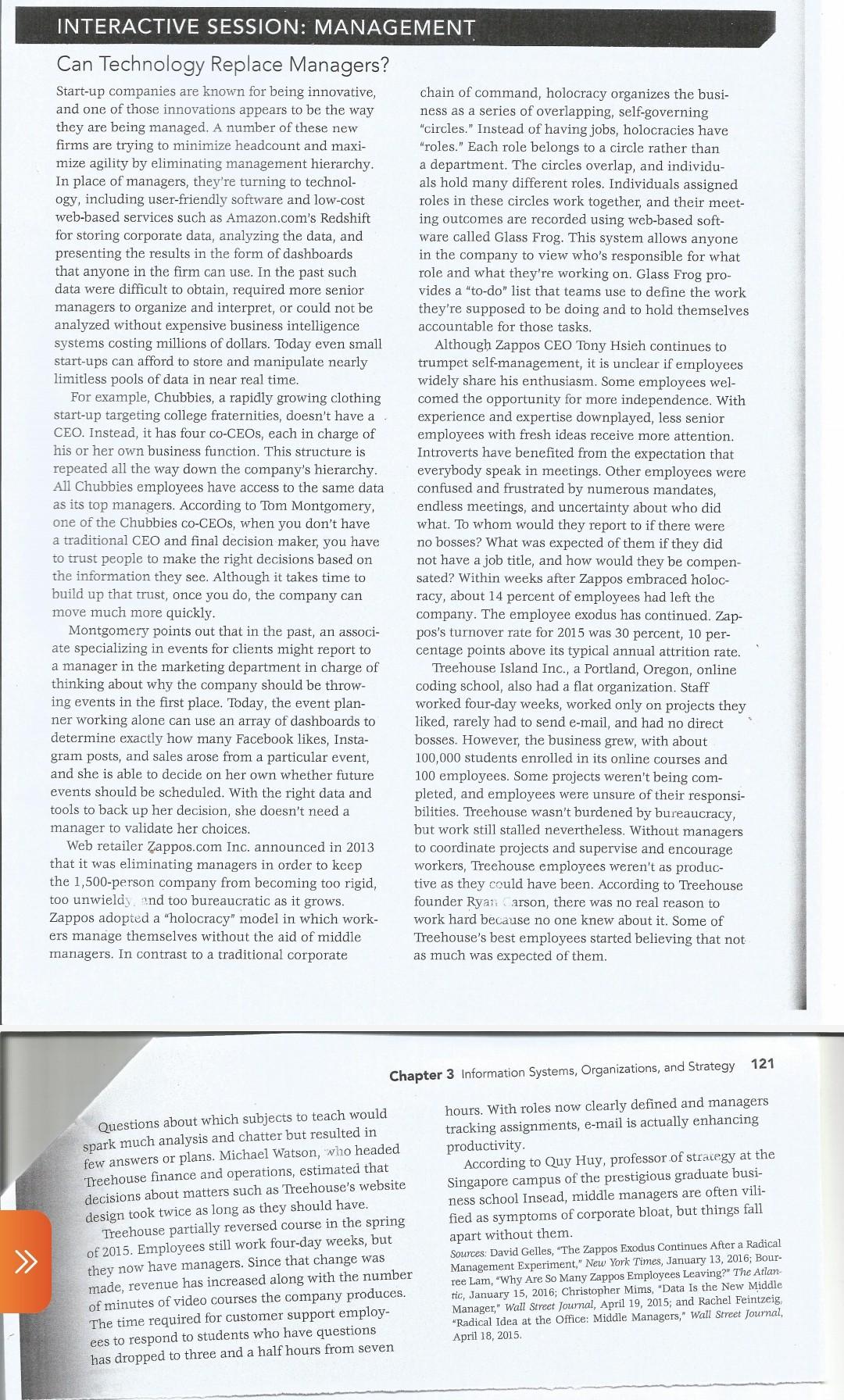
Read and evaluate the case study titled Can Technology Replace Managers? Then develop solutions to the questions shown below. You must write in full sentences; bullet points or lists are not acceptable. 1. What are organisations trying to achieve by removing middle management layers, what are they using to replace the managers, and what are they using it for?
INTERACTIVE SESSION: MANAGEMENT Can Technology Replace Managers? Start-up companies are known for being innovative, and one of those innovations appears to be the way they are being managed. A number of these new firms are trying to minimize headcount and maxi- mize agility by eliminating management hierarchy. In place of managers, they're turning to technol- ogy, including user-friendly software and low-cost web-based services such as Amazon.com's Redshift for storing corporate data, analyzing the data, and presenting the results in the form of dashboards that anyone in the firm can use. In the past such data were difficult to obtain, required more senior managers to organize and interpret, or could not be analyzed without expensive business intelligence systems costing millions of dollars. Today even small start-ups can afford to store and manipulate nearly limitless pools of data in near real time. For example, Chubbies, a rapidly growing clothing start-up targeting college fraternities, doesn't have a CEO. Instead, it has four co-CEOs, each in charge of his or her own business function. This structure is repeated all the way down the company's hierarchy. All Chubbies employees have access to the same data as its top managers. According to Tom Montgomery, one of the Chubbies Co-CEOs, when you don't have a traditional CEO and final decision maker, you have to trust people to make the right decisions based on the information they see. Although it takes time to build up that trust, once you do, the company can move much more quickly. Montgomery points out that in the past, an associ- ate specializing in events for clients might report to a manager in the marketing department in charge of thinking about why the company should be throw- ing events in the first place. Today, the event plan- ner working alone can use an array of dashboards to determine exactly how many Facebook likes, Insta- gram posts, and sales arose from a particular event, and she is able to decide on her own whether future events should be scheduled. With the right data and tools to back up her decision, she doesn't need a manager to validate her choices. Web retailer Zappos.com Inc. announced in 2013 that it was eliminating managers in order to keep the 1,500-person company from becoming too rigid, too unwieldy, and too bureaucratic as it grows. Zappos adopted a "holocracy" model in which work- ers manage themselves without the aid of middle managers. In contrast to a traditional corporate chain of command, holocracy organizes the busi- ness as a series of overlapping, self-governing "circles." Instead of having jobs, holocracies have "roles." Each role belongs to a circle rather than a department. The circles overlap, and individu- als hold many different roles. Individuals assigned roles in these circles work together, and their meet- ing outcomes are recorded using web-based soft- ware called Glass Frog. This system allows anyone in the company to view who's responsible for what role and what they're working on. Glass Frog pro- vides a "to-do list that teams use to define the work they're supposed to be doing and to hold themselves accountable for those tasks. Although Zappos CEO Tony Hsieh continues to trumpet self-management, it is unclear if employees widely share his enthusiasm. Some employees wel- comed the opportunity for more independence. With experience and expertise downplayed, less senior employees with fresh ideas receive more attention. Introverts have benefited from the expectation that everybody speak in meetings. Other employees were confused and frustrated by numerous mandates, endless meetings, and uncertainty about who did what. To whom would they report to if there were no bosses? What was expected of them if they did not have a job title, and how would they be compen- sated? Within weeks after Zappos embraced holoc- racy, about 14 percent of employees had left the company. The employee exodus has continued. Zap- pos's turnover rate for 2015 was 30 percent, 10 per- centage points above its typical annual attrition rate. Treehouse Island Inc., a Portland, Oregon, online coding school, also had a flat organization. Staff worked four-day weeks, worked only on projects they liked, rarely had to send e-mail, and had no direct bosses. However, the business grew, with about 100,000 students enrolled in its online courses and 100 employees. Some projects weren't being com- pleted, and employees were unsure of their responsi- bilities. Treehouse wasn't burdened by bureaucracy, but work still stalled nevertheless. Without managers to coordinate projects and supervise and encourage workers, Treehouse employees weren't as produc- tive as they could have been. According to Treehouse founder Ryan arson, there was no real reason to work hard because no one knew about it. Some of Treehouse's best employees started believing that not as much was expected of them. Chapter 3 Information Systems, Organizations, and Strategy 121 Questions about which subjects to teach would spark much analysis and chatter but resulted in few answers or plans. Michael Watson, who headed Treehouse finance and operations, estimated that decisions about matters such as Treehouse's website design took twice as long as they should have. Treehouse partially reversed course in the spring of 2015. Employees still work four-day weeks, but they now have managers. Since that change was made, revenue has increased along with the number of minutes of video courses the company produces. The time required for customer support employ- ees to respond to students who have questions has dropped to three and a half hours from seven hours. With roles now clearly defined and managers tracking assignments, e-mail is actually enhancing productivity According to Quy Huy, professor of strategy at the Singapore campus of the prestigious graduate busi- ness school Insead, middle managers are often vili- fied as symptoms of corporate bloat, but things fall apart without them. Sources: David Gelles, "The Zappos Exodus Continues After a Radical Management Experiment," New York Times, January 13, 2016; Bour- ree Lam, "Why Are So Many Zappos Employees Leaving?" The Atlan tic, January 15, 2016; Christopher Mims, "Data Is the New Middle Manager," Wall Street Journal, April 19, 2015; and Rachel Feintzeig, Radical Idea at the Office: Middle Managers," Wall Street Journal, April 18, 2015Step by Step Solution
There are 3 Steps involved in it
1 Expert Approved Answer
Step: 1 Unlock

Question Has Been Solved by an Expert!
Get step-by-step solutions from verified subject matter experts
Step: 2 Unlock
Step: 3 Unlock
 Study Help