







Question: read article and answer question icing International Management Case CHAPTER 10 . INTERNATIONAL MONETARY SYSTEM Practicing International 273 out na- ting the activi- is sys.
read article and answer question
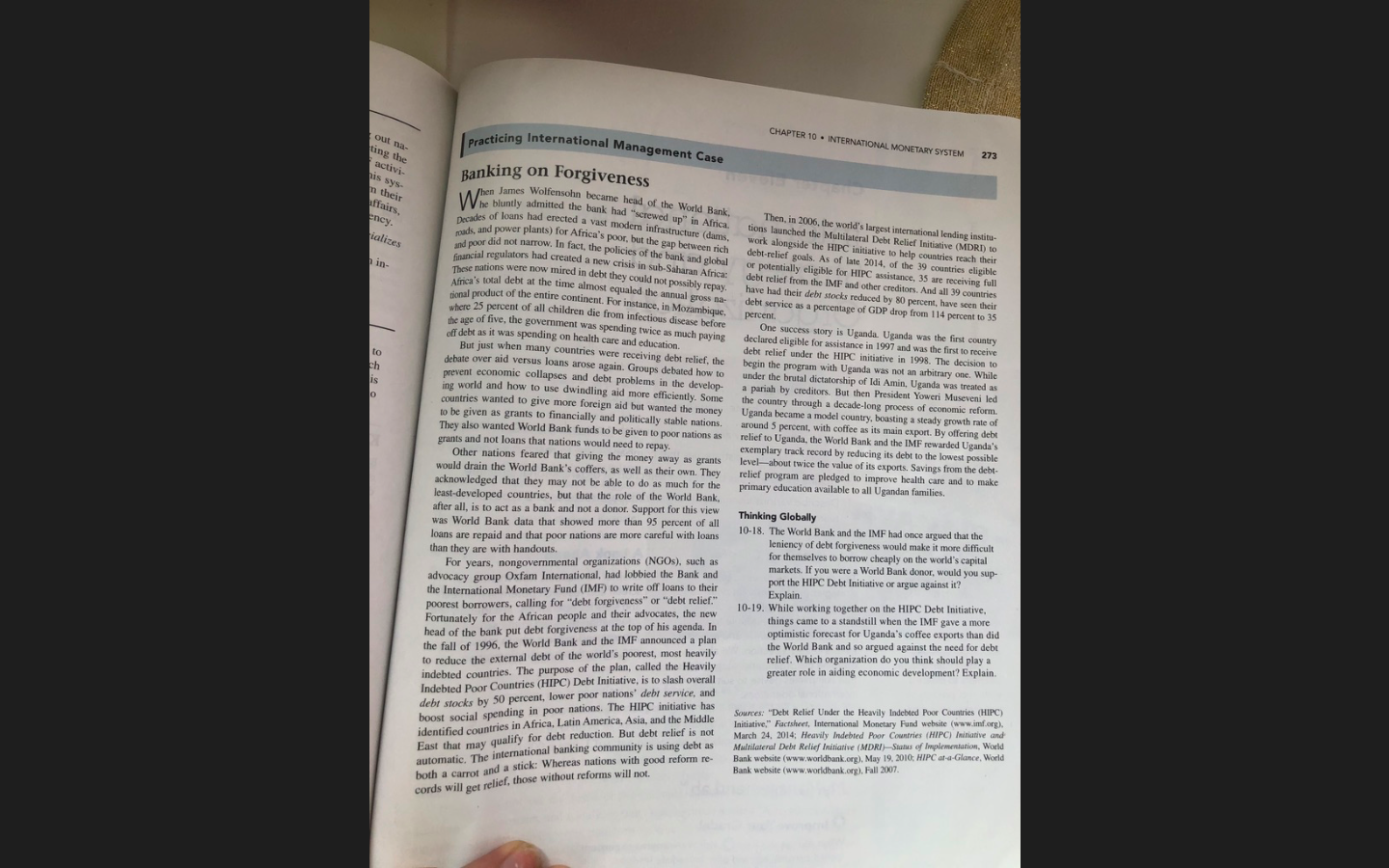
icing International Management Case CHAPTER 10 . INTERNATIONAL MONETARY SYSTEM Practicing International 273 out na- ting the activi- is sys. in their affairs, ency. ializes Afhen James Wolfe Decades of loans ha roads, and power financial regulators had Banking on Forgiveness lemes Wolfensohn became head of the World Bank, IN bluntly admitted the bank had "screwed up in Africa. os of loans had erected a vast modern infrastructure (dams, and power plants) for Africa's poor, but the gap between rich por did not narrow. In fact, the policies of the bank and global al regulators had created a new crisis in sub-Saharan Africa: nations were now mired in debt they could not possibly repay. rica's total debt at the time almost equaled the annual gross na- anal product of the entire continent. For instance, in Mozambique where 25 percent of all children die from infectious disease before he age of five, the government was spending twice as much paying of debt as it was spending on health care and education. But just when many countries were receiving debt relief, the dehate over aid versus loans arose again. Groups debated how to prevent economic collapses and debt problems in the develop ing world and how to use dwindling aid more efficiently. Some countries wanted to give more foreign aid but wanted the money to be given as grants to financially and politically stable nations They also wanted World Bank funds to be given to poor nations as grants and not loans that nations would need to repay. Other nations feared that giving the money away as grants would drain the World Bank's coffers, as well as their own. They acknowledged that they may not be able to do as much for the least-developed countries, but that the role of the World Bank, after all, is to act as a bank and not a donor. Support for this view was World Bank data that showed more than 95 percent of all Then, in 2006, the world's largest international lending instit- tions launched the Multilateral Debt Relief Initiative (MDRI) to work alongside the HIPC initiative to help countries reach their debt-relief goals. As of late 2014, of the 39 countries eligible or potentially eligible for HIPC assistance, 35 are receiving full debt relief from the IMF and other creditors. And all 39 countries have had their debt stocks reduced by 80 percent, have seen their debt service as a percentage of GDP drop from 114 percent to 35 percent One success story is Uganda Uganda was the first country declared eligible for assistance in 1997 and was the first to receive debt relief under the HIPC initiative in 1998. The decision to begin the program with Uganda was not an arbitrary one. While under the brutal dictatorship of Idi Amin, Uganda was treated as a pariah by creditors. But then President Yoweri Museveni led the country through a decade-long process of economic reform. Uganda became a model country, boasting a steady growth rate of around 5 percent, with coffee as its main export. By offering debt relief to Uganda, the World Bank and the IMF rewarded Uganda's exemplary track record by reducing its debt to the lowest possible level-about twice the value of its exports. Savings from the debt- relief program are pledged to improve health care and to make primary education available to all Ugandan families. loans are repaid and that poor nations are more careful with loans than they are with handouts. For years, nongovernmental organizations (NGOs), such as advocacy group Oxfam International, had lobbied the Bank and the International Monetary Fund (IMF) to write off loans to their poorest borrowers, calling for "debt forgiveness" or "debt relief." Fortunately for the African people and their advocates, the new head of the bank put debt forgiveness at the top of his agenda. In the fall of 1996, the World Bank and the IMF announced a plan to reduce the external debt of the world's poorest, most heavily indebted countries. The purpose of the plan, called the Heavily Indebted Poor Countries (HIPC) Debt Initiative, is to slash overall debt stocks by 50 percent, lower poor nations' debt service, and boost social spending in poor nations. The HIPC initiative has identified countries in Africa, Latin America, Asia, and the Middle East that may qualify for debt reduction. But debt relief is not automatic. The intem be international banking community is using debt as and a stick: Whereas nations with good reform re- both a carrot and a Thinking Globally 10-18. The World Bank and the IMF had once argued that the leniency of debt forgiveness would make it more difficult for themselves to borrow cheaply on the world's capital markets. If you were a World Bank donor, would you sup- port the HIPC Debt Initiative or argue against it? Explain 10-19. While working together on the HIPC Debt Initiative, things came to a standstill when the IMF gave a more optimistic forecast for Uganda's coffee exports than did the World Bank and so argued against the need for debt relief. Which organization do you think should play a greater role in aiding economic development? Explain. Sources: "Debt Relief Under the Heavily Indebted Poor Countries (HIPC) Initiative." Factsheet, International Monetary Fund website (www.imf.org). March 24, 2014; Heavily indebted Poor Countries (HIPC) Initiative and Multilateral Debt Relief Initiative (MDRI-Status of Implementation, World Bank website (www.worldbank.org), May 19, 2010: HIPCar-a-Glance, World Bank website (www.worldbank.org), Fall 2007. cords will get relief, those without reforms will notStep by Step Solution
There are 3 Steps involved in it
1 Expert Approved Answer
Step: 1 Unlock

Question Has Been Solved by an Expert!
Get step-by-step solutions from verified subject matter experts
Step: 2 Unlock
Step: 3 Unlock
 Study Help