







Question: read carefully Physical Flow, Equivaient Units, Unit Costs, No Beginning WIP Inventory, Activity-Based Costing, DaC Mckay, Inc., produces a subassembly used in the production of
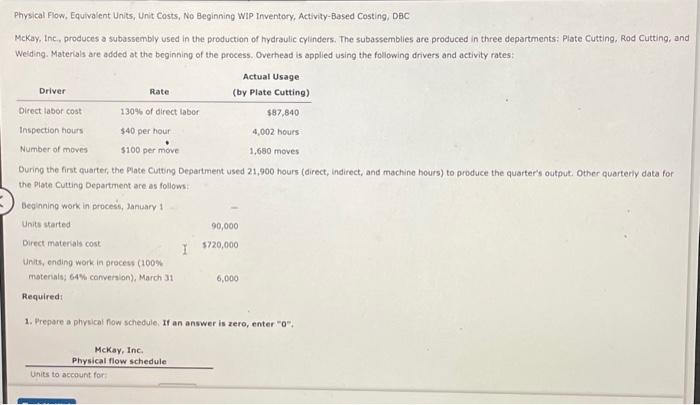
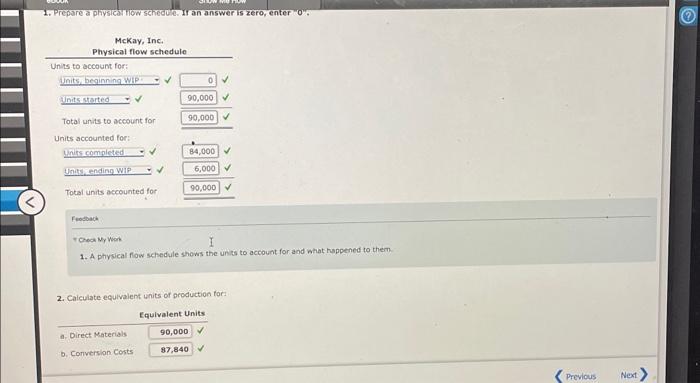
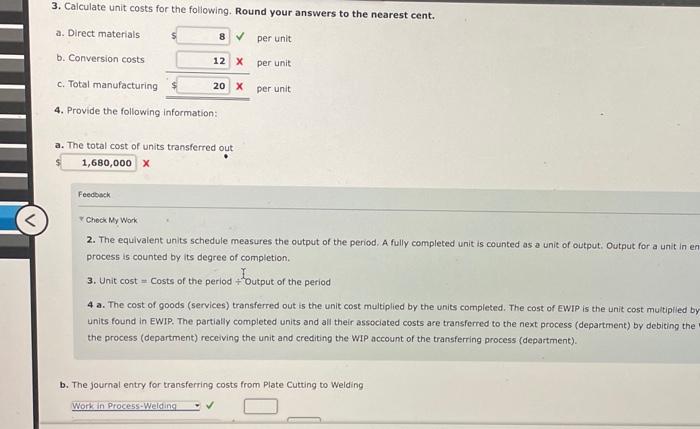
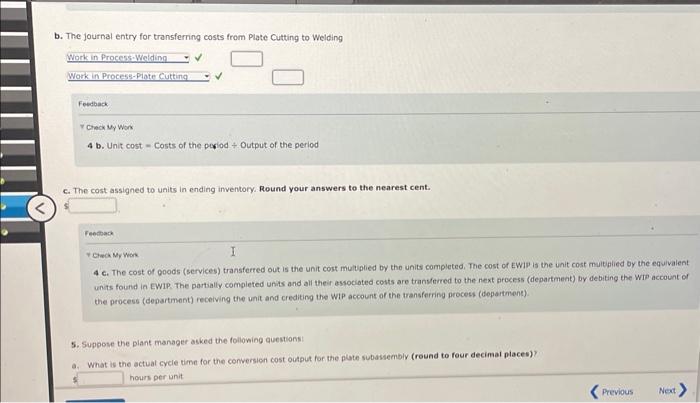
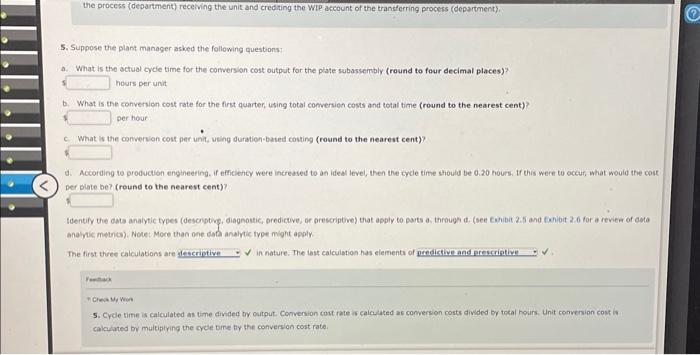
Physical Flow, Equivaient Units, Unit Costs, No Beginning WIP Inventory, Activity-Based Costing, DaC Mckay, Inc., produces a subassembly used in the production of hydraulic cylinders. The subassemblies are produced in three departments: Plate Cutting, Rod Cutting, and Weiding. Materials are added at the beginning of the process. Overhead is applied using the following drivers and activity rates: Ouring the first quarter, the Plate Cutting Department used 21,900 hours (direct, indirect, and machine hours) to produce the quarter's output. Other quarteriy data for the Plate Cutting Department are as follows: Required: 1. Prepore a phrvical fiow schedule, If an answer is zero, enter "0", 3. Calculate unit costs for the following. Round your answers to the nearest cent. a. Direct materials per unit b. Conversion costs x per unit c. Total manufacturing per unit 4. Provide the following information: a. The total cost of units transferred out s x Feecowek * Check My Work 2. The equivalent units schedule measures the output of the period. A fully completed unit is counted as a unit of output, Output for a unit in en process is counted by its degree of completion. 3. Unit cost = Costs of the period + Output of the period 4 a. The cost of goods (services) transferred out is the unit cost multiplied by the units completed. The cost of EWIP is the unit cost multiplied by units found in EWIP. The partially completed units and all their associated costs are transferred to the next process (department) by debiting the the process (department) receiving the unit and crediting the WIP account of the transferring process (department). b. The journal entry for transferring costs from Plate Cutting to Welding b. The journal entry for transferring costs from Plate Cutting to Weiding Tonock My Wors 4 b. Unit cost = Costs of the period + Output of the period c. The cost assigned to units in ending inventory. Round your answers to the nearest cent. 4 Cea Mr wor 4c. The cost of goods (services) transferted out is the unit cost multplied by the units completed. The cost of EWip is the unit cost multiplied by the equivalent units found in EWIP. The partially completed units and all their essociated costs are tranvitred to the next arocess (department) by debiting the WIP account of the process (departiment) receiving the unit and crediting the WiP account of the transferring process (department) 5. Suppose the plant manager asked the following questions! a. What is the actuat cycle time for the conversion cost ouput for the plate subassembly (round to four decimal places)? houns per unit 1. Prepare a physics thow schedule. If an answer is zero, enter "on" Feodback r Cheak My Work 1. A physical flow schedule shows the unis to account for and what happened to them. 2. Calculate equivalent units of production for: the process (department) receiving the unit and crediting the WIP account of the transferring process (department). 5. Suppose the plant manoger asked the following questions: a. What is the actual cycle time for the corversian cost output for the plate subassembly (round to four decimal places)? hours per unit b. What is the conversion cost rate for the first quarter, using total comersion costs and total time (round to the nearest cent)? per hour c. What is the convervien cost per unit, ving duration-based costing (round to the nearest cent)? d. According to production engineering. If efficiency were increased to an ideal level, then the cycle time stould be 0.20 hours. If this were to occur, what would the coit per blate be? (round to the nearest cent)? Identify the dats anaiytic types (descripting, diagnostic, predicuve, of prescriptwe) that apply to parts a. through d. (see Cohibit 2.5 and fohibit 2.6 for a revien of cata anavic metrica). Note: More than one dob analycic trpe might apoly. The first thee calculations are in nature. The lost calculation has elements of poedictive and erescriative 5. Cycle time is calculated as time divided by output. Conversion cost rate is calculated as comversion costs divided by tocal hours. Unit cooversion cost is calculated by multiptying the cycle bire by the conversion cost rate
Step by Step Solution
There are 3 Steps involved in it

Get step-by-step solutions from verified subject matter experts
 Study Help