







Question: Read Case 6: BP: Organizational Structure and Management Systems (R.M. Grant, Contemporary Strategy Analysis, 11th ed. Wiley, 2022). Remember that a case study is a
Read Case 6: BP: Organizational Structure and Management Systems (R.M. Grant, Contemporary Strategy Analysis, 11th ed. Wiley, 2022).
Remember that a case study is a puzzle to be solved, so before reading and discussing the specific case questions below, develop your proposed solution by following these five steps:
Read the case study to identify the key issues and underlying issues. These issues are the principles and concepts of the course module which apply to the situation described in the case study.
Record the facts from the case study which are relevant to the principles and concepts of the module. The case may have extraneous information not relevant to the current course module. Your ability to differentiate between relevant and irrelevant information is an important aspect of case analysis, as it will inform the focus of your answers.
Describe in some detail the actions that would address or correct the situation.
Complete this initial analysis and then read the discussion questions. Typically, you will already have the answers to the questions but with a broader consideration. At this point, you can add the details and/or analytical tools required to solve the case.
The disastrous explosions at BPs Texas City refinery and its Macondo oil well in the Gulf of Mexico have drawn attention to the organizational structure and management system created at BP by former CEO John Browne.
Discuss to what extent Brownes new model created the conditions for these accidents and was this model appropriate to the industry in which BP competed?
What structure is used in your organization and is this model appropriate to the industry in which you work?
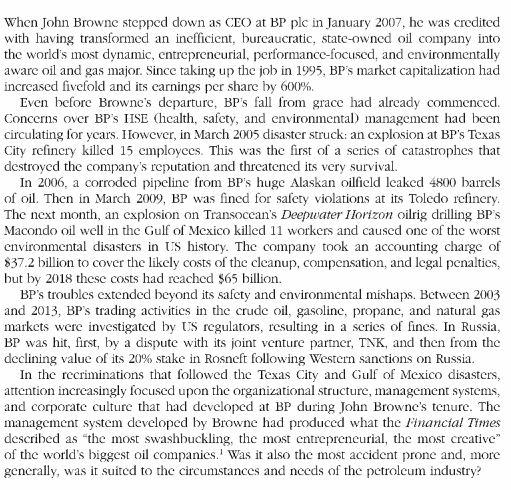
When John Browne stepped down as CEO at BP ple in January 2007, he was credited with having transformed an incfficient, bureaucratic, state-owned oil company into the world's most dynamic, entrepreneurial, performance-focused, and environmentally aware oil and gas major. Since taking up the job in 1995, BP's market capitalization had increased fivefold and its earnings per share by 600%. Even before Browne's departure, BP's fall from grace had already commenced. Concerns over BP's IISE (health, safety, and environmental) management had been circulating for years. Ilowever, in March 2005 disaster struck: an explosion at BP's Texas City refinery killed 15 employees. This was the first of a series of catastrophes that destroyed the company's reputation and threatened its very survival. In 2006, a corroded pipeline from BP's huge Alaskan oilfield leaked 4800 barrels of oil. Then in March 2009,BP was fined for safety violations at its Toledo refinery. The next month, an explosion on Transocean's Deepuater IIorizon oilrig drilling BP's Macondo oil well in the Gulf of Mexico killed 11 workers and caused one of the worst environmental disasters in US history. The company took an accounting charge of 837.2 billion to cover the likely costs of the cleanup, compensation, and legal penalties, but by 2018 these costs had reached $65 billion. BP's troubles extended beyond its safety and environmental mishaps. Between 2003 and 2013, BP's trading activitics in the crude oil, gasoline, propane, and natural gas markets were investigated by US regulators, resulting in a series of fines. In Russia, BP was hit, first, by a dispute with its joint venture parmer, TN, and then from the declining value of its 20% stake in Rosneft following Western sanctions on Russia. In the recriminations that followed the Texas City and Gulf of Mexico disasters, attention increasingly focused upon the organizational structure, management systems, and corporate culture that had developed at BP during John Browne's tenure. The management system developed by Browne had produced what the linancial Times described as "the most swashbuckling, the most entrepreneurial, the most creative" of the world's biggest oil companies.' Was it also the most accident prone and, more generally, was it suited to the circumstances and needs of the petroleum industry
Step by Step Solution
There are 3 Steps involved in it

Get step-by-step solutions from verified subject matter experts
 Study Help