



Question: read case and answer discussion quetions at end CASE 3 Wells Fargo: The Stage Coach Went Out of Control INTRODUCTION Until recently. Wells Fargo was
read case and answer discussion quetions at end 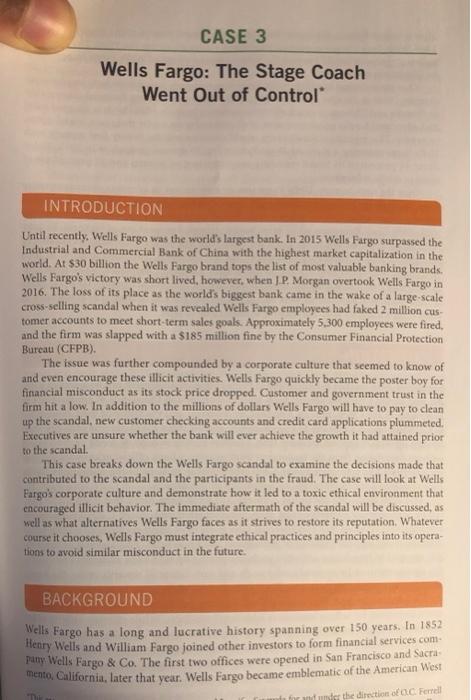
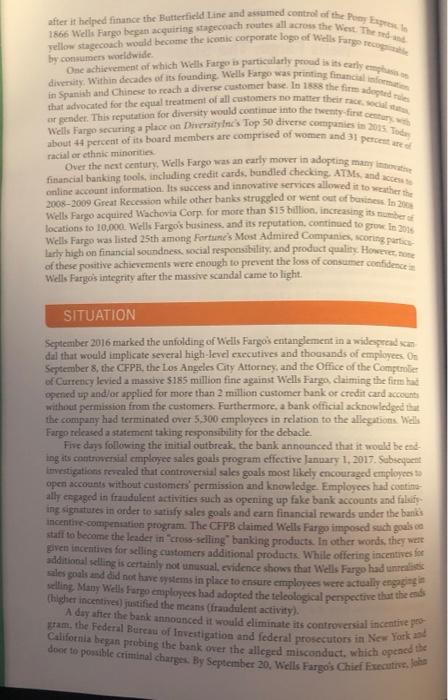
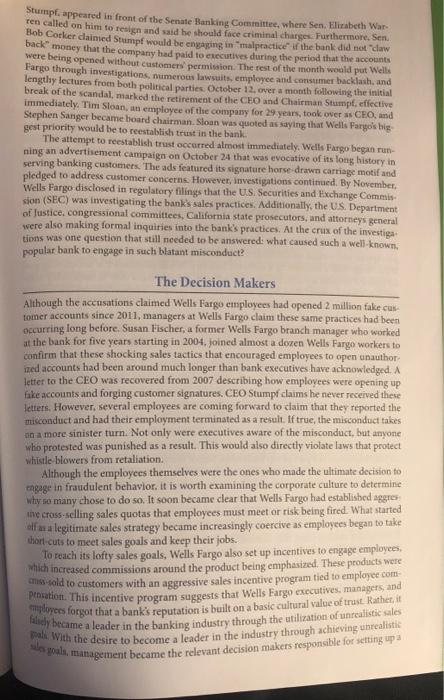
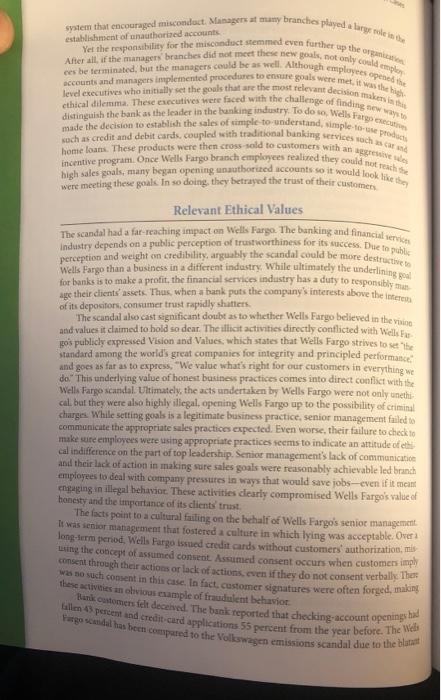
CASE 3 Wells Fargo: The Stage Coach Went Out of Control INTRODUCTION Until recently. Wells Fargo was the world's largest bank. In 2015 Wells Fargo surpassed the Industrial and Commercial Bank of China with the highest market capitalization in the world. At $30 billion the Wells Fargo brand tops the list of most valuable banking brands. Wells Fargo's victory was short lived, however, when I.P. Morgan overtook Wells Fargo in 2016. The loss of its place as the world's biggest bank came in the wake of a large-scale cross-selling scandal when it was revealed Wells Fargo employees had faked 2 million cus- tomer accounts to meet short-term sales goals. Approximately 5,300 employees were fired, and the firm was slapped with a $185 million fine by the Consumer Financial Protection Bureau (CFPB). The issue was further compounded by a corporate culture that seemed to know of and even encourage these illicit activities. Wells Fargo quickly became the poster boy for financial misconduct as its stock price dropped. Customer and government trust in the firm hit a low. In addition to the millions of dollars Wells Fargo will have to pay to clean up the scandal, new customer checking accounts and credit card applications plummeted. Executives are unsure whether the bank will ever achieve the growth it had attained prior to the scandal. This case breaks down the Wells Fargo scandal to examine the decisions made that contributed to the scandal and the participants in the fraud. The case will look at Wells Fargo's corporate culture and demonstrate how it led to a toxic ethical environment that encouraged illicit behavior. The immediate aftermath of the scandal will be discussed, as well as what alternatives Wells Fargo faces as it strives to restore its reputation. Whatever course it chooses, Wells Fargo must integrate ethical practices and principles into its opera- tions to avoid similar misconduct in the future. BACKGROUND Wells Fargo has a long and lucrative history spanning over 150 years. In 1852 Henry Wells and William Fargo joined other investors to form financial services com- pany Wells Fargo & Co. The first two offices were opened in San Francisco and Sacra mento, California, later that year. Wells Fargo became emblematic of the American West the direction of a Ferrell after it helped finance the Butterfield Line and assumed control of the Peoy Es 1866 Wells Fargo began acquiring stagecoach outles all across the West. The vellow stagecoach would become the con corporate logo of Wells Farge by consumers worldwide One achievement of which wells Fargos particularly proud statica diversity. Within decades of its founding. Wells Fargo was printing financials in Spanish and Chinese to reach a diverse customer base. In 1988 the first that advocated for the equal treatment of all customers no matter the ar gender. This reputation for diversity would continue into the twenty-first Wells Fargo securing a place on Dress Top 50 diverse companies in 2015 To about 14 percent of its board members are comprised of women and 31 percent racial or ethnic minorities Over the nest century Wells Fargo was an early move in adopting mam online account information. Its success and innovative services allowed it to the the actions 2008-2009 Great Recession while other hans struggled or went out of beninem. In 20 Wells Fargo acquired Wachovia Corp for more than $15 billion, increasing its number of locations to 10,000. Wells Fargos business and its reputation continued to grme in the Wells Fargo was listed 25th among Fortune's Most Admired Companies, scoring partice larly high on financial soundness, social responsability, and product quality. However, tone of these positive achievements were enough to prevent the loss of consumer confidence Wells Fargos integrity after the massive scandal came to light. SITUATION September 2016 marked the unfolding of Wells Fargos entanglement in a widespread an dal that would implicate several high-level executives and thousands of employees. On September 8, the CFPB, the Los Angeles City Attorney and the Office of the Compte of Currency levied a massive $185 million fine against Wells Fargo, claiming the first opened up and/or applied for more than 2 million customer bank or credit card accounts without permission from the customers. Furthermore, a bank official acknerledged the the company had terminated over 5.300 employees in relation to the allegations. Wells Fargo released a statement taking responsibility for the dehade Five days following the initial outbreak the bank announced that it would be en ing its controversial employee sales goals program effective January 1, 2017. Subsequent larvestigations revealed that controversial sales goals most likely encouraged employees to open accounts without customers' permission and knowledge. Employees had contina ally engaged in fraudulent activities such as opening up fake bank accounts and falsify ing signatures in order to satisfy sales goals and earn financial rewards under the banks incentive.compensation program. The CFPB claimed Wells Fargo imposed such goals ce stati to become the leader in cross-selling banking products. In other words, they west given incentives for selling customers additional products While offering incentives fine additional selling is certainly not unusual evidence shows that Wells Fargo had umelise sales goals and did not have systems in place to ensure employees were actually engaging welling Many Wells Fargo employees had adopted the teleological perspective that the end (higher incentives) justified the means (fraudulent activity). A day after the bank annoanced it would eliminate its controversial incentive gram, the Federal Bureau of Investigation and federal prosecutors in New York and California began probing the bank over the alleged misconduct, which opened the door to possible criminal charges. By September 20, Wells Fargo's Chief Executive Jobs Stumpf, appeared in front of the Senate Banking Committee, where Sen. Elizabeth War ren called on him to resign and said he should face criminal charges. Furthermore. Sen Bob Corker daimed Stumpf would be engaging in malpractice of the bank did not daw back money that the company had paid to executives during the period that the accounts were being opened without customers permission. The rest of the month would put Welle Fargo through investigations, numerous lawsuits, employee and consumer backlash, and lengthy lectures from both political parties. October 12, over a month following the initial break of the scandal, marked the retirement of the CEO and Chairman Stumpf, effective immediately. Tim Sloan, an employee of the company for 29 years, took over as CEO and Stephen Sanger became board chairman Sloan was quoted as saying that Wells Fargo's big gest priority would be to reestablish trust in the bank The attempt to reestablish trust occurred almost immediately. Wells Fargo began run- ning an advertisement campaign on October 24 that was evocative of its long history in serving banking customers. The ads featured its signature horse drawn carriage motif and pledged to address customer concerns. However, investigations continued. By November, Wells Fargo disclosed in regulatory filings that the US Securities and Exchange Commis sion (SEC) was investigating the bank's sales practices. Additionally, the US Department of Justice congressional committees, California state prosecutors, and attorneys general were also making formal inquiries into the bank's practices. At the crux of the investiga tions was one question that still needed to be answered: what caused such a well-known, popular bank to engage in such blatant misconduct? The Decision Makers Although the accusations claimed Wells Fargo employees had opened 2 million fake cu tomer accounts since 2011, managers at Wells Fargo claim these same practices had been occurring long before. Susan Fischer, a former Wells Fargo branch manager who worked at the bank for five years starting in 2004, joined almost a dozen Wells Fargo workers to confirm that these shocking sales tactics that encouraged employees to open unauthor ied accounts had been around much longer than bank executives have acknowledged. A letter to the CEO was recovered from 2007 describing how employees were opening up fake accounts and forging customer signatures. CEO Stumpf claims he never received these letters. However, several employees are coming forward to claim that they reported the misconduct and had their employment terminated as a result. If true, the misconduct takes on a more sinister turn. Not only were executives aware of the misconduct, but anyone who protested was punished as a result. This would also directly violate laws that protect whistleblowers from retaliation Although the employees themselves were the ones who made the ultimate decision to engage in fraudulent behavior, it is worth examining the corporate culture to determine why so many chose to do so. It soon became clear that Wells Fargo had establisbed aggres Live cross-selling sales quotas that employees must meet or risk being fired. What started elf as a legitimate sales strategy became increasingly coercive as employees began to take thoirt-cuts to meet sales goals and keep their jobs. To reach its lofty sales goals, Wells Fargo also set up incentives to engage employees, which increased commissions around the product being emphasized. These products were om told to customers with an aggressive sales incentive program tied to employee.com Pensation. This incentive program suggests that Wells Fargo executives, managers and loyees forgot that a bank's reputation is built on a basic cultural value of trust. Rather, it lady became a leader in the banking industry through the utilization of unrealistic ales la poals, management became the leader in decision taxes esponsible for setting up a establishment of unauthorized accounts system that encouraged misconduct Manager at many branches played a large in the Yet the responsibility for the misconduct stemmed even further up the After all of the man branches did not meet the new goals, not only cold accounts and managers implemented procedures to ensure goals were met, it was the ces be terminated, but the managers could be as well. Although employees open the cthical dilemma. These executives were faced with the challenge of findes level executives who initially set the goals that are the most relevant decision makes distinguish the bank as the leader in the banking industry. To do so, Wells Farge made the decision to establish the sales of simple to understand, simple products such as credit and debit cards, coupled with traditional banking service och som home loans. These products were then cross-sold to customers with an TV incentive program. Once Wells Fargo branch employees realized they could not each high sales goals, many began opening unauthorized accounts so it would look like the were meeting these goals. In so doing, they betrayed the trust of their customers Relevant Ethical Values The scandal had a far-reaching impact on Wells Fargo. The banking and financial ser perception and weight on credibility, arguably the scandal could be more destructive Wells Fargo than a business in a different industry. While ultimately the underlining on for banks is to make a profit, the financial services industry has a duty to responsibly hun age their clients' assets. Thus, when a bank puts the company's interests above the internet of its depositors, consumer trust rapidly shatters The scandal also cast significant doubt as to whether Wells Fargo believed in the visina and values it claimed to hold so dear. The illicit activities directly conflicted with Wells pos publicly expressed Vision and Values, which states that Wells Fargo strives to see the standard among the world's great companies for integrity and principled performance: and goes as far as to express, "We value what's right for our customers in everything we do. This underlying value of honest business practices comes into direct conflict with Wells Fargo scandal. Ultimately, the acts undertaken by Wells Fargo were not only unethi cal, but they were also highly illegal, opening Wells Fargo up to the possibility of criminal charge. While setting goals is a legitimate business practice, senior management failed to communicate the appropriate sales practices expected. Even worse, their failure to check to make sure employees were using appropriate practices seems to indicate an attitude of the cal indifference on the part of top leadership. Senior management's lack of communication and their lack of action in making sure sales goals were reasonably achievable led branch employees to deal with company pressures in ways that would save jobseven if it meant engaging in illegal behavior. These activities clearly compromised Wells Fargo's value of honesty and the importance of its clients' trust The facts point to a cultural failing on the behalf of Wells Fargo's senior management. It was senior management that fostered a culture in which lying was acceptable. Over long-term period. Wells Fargo issued credit cards without customers' authoritation, using the concept of assumed consent. Assumed consent occurs when customers imply consent through their actions or lack of actions, even if they do not consent verbally. The was so such coment in this case. In fact, customer signatures were often forged, making these activities an obvious example of fraudulent behavior Gallen percent and credit card applications 55 percent from the year before. The Web Bancustomers felt deceived. The bank reported that checking account openings had Yugo scandal has been compared to the Volkswagen emissions scandal due to the blat deception of the company and massive loss in consumer trust. Since the Great Recession. the financial services industry has been struggling to recoup lost trust. The Wells Fargo scandal will likely not only affect its own business but could impact the level of trust for the entire industry What Next? For years. Wells Fargo enjoyed a reputation for sound management. Itu reputation was so intact that it emerged from the 2008-2009 financial crisis with one of the best reputations of any of the major retail banks. Wells Fargo sidestepped many of the errors of other banka and prospered on meaningful customer relations with a focus on sales. Yet today the bank finds its reputation in ruins thanks to unrealistic sales quotas and a coercive corporate environment. Even worse, sources claim that top executives were aware of these practices years ago, but instead of taking action they allegedly retaliated against whistleblowers for speaking up. Once Wells Fargos illegal practices had been discovered internally, the com pany could have worked to amend these practices, re-emphasize its corporate values, and begin restoring trust with customers. Reporting the misconduct early might have actually enhanced Wells Fargo's reputation as it would have shown the bank had no tolerance for unethical behavior whenever it was discovered. Greater senior management involvement and alignment with the values and mission statement of the company would have allowed Wells Fargo to make necessary changes to avoid the 2016 scandal Instead, Wells Fargo embraced short-term gains such as increased revenues and incen- tives even when it resulted in illegal activity. By adopting such stringent ambitious goals and punishing employees who were unable meet them in a legitimate manner--Wells Fargo also destroyed relationships with its employees RESOLUTION With the above considered. It is no surprise that Wells Fargo is struggling to keep custom- ers. Despite taking credit for the scandal, having the CEO step down, and implementing marketing campaigns targeted at rebuilding consumer trust, Wells Fargos business prac- tices have been compromised in the eyes of consumers. In addition to government imes tigations, former Wells Fargo employees have filed lawsuits against the firm. Thus far, one whistle-blower has already won a lawsuit. Former CEO Stumpf was forced to pay back millions in compensation for allegedly turning a blind eye to the misconduct. The levd of misconduct is so great that regulators are even considering holding the board of dires tors accountable, something which is rarely done unless it can be proved that the board of directors neglected their duties and was aware (or should have been aware of the massive Ultimately, the stakeholders injured in this situation were the individuals who were victims of the creation of fake accounts, the stockholders and the employees convicted of fraud. Wells Fargo chose to adopt a short-term perspective and abandoned a deontological cepoach for the temporary gains that came with committing fraud. Denntology focuses ou the means used to achieve an end rather than the end itself. According to deontological Tural theory, the means of attaining a certain outcome are just as important morally as the ortcome itself. If Wells Fargo executives and managers had prioritized how employees were along their sales goals, then they would have detected the fraud sooner and taken steps Wells Fargo had a duty to its customers and employees to operate in an ethical man er but the company allowed lofty sales goals to get in the way of ethical business practices frod taking place. to correct it Part 5: Cases The company had a duty to its depositors to manage their accounts honestly rather than duty to its employees to create an environment where sales goals could be met without forward to say they were punished for speaking up, which likely created a strong culture employees taking matters into their own hands. Instead whistle blowers are now coming of distrust with employees and kept the misconduct hidden. While the company valued its position as a top retail bank in the United States, deontology states that Wells Fargo's duty to its stakeholders carried significantly more weight than meeting sales goals. In going forward, Wells Fargo must put its duty to its stakeholders above the com- pany's aim to make short-term gains. Taking a more long-term, ethical approach would benefit not only its stakeholders but the firm itself. Since the banking industry is built on trust, Wells Fargo has a duty to maintain that trust with depositors and employees even if it means sacrificing some profits in the short term. Developing a strong ethical culture that is intolerant of misconduct will not only allow Wells Fargo to avoid future scandals, it will allow the company to rebuild trust over time. Thoroughly embracing its ethical values will help Wells Fargo regain trust among regulators, consumers, and employees. Until Wells Fargo fully embraces its duties, the company will struggle to put the scandal behind it. Wells Fargo must adopt a renewed focus on its stakeholders to repair customers' shattered trust and rebuild its reputation. QUESTIONS FOR DISCUSSION 1. How did Wells Fargo's focus on short-term gains violate the duties they owed to con- sumers, regulators, and employees? 2. Describe how the Wells Fargo scandal demonstrates that organizational leaders must not only establish goals but ensure that those goals are being acted upon appropriately, 3. Why are ethical values useless unless they are continually reinforced within the company
Step by Step Solution
There are 3 Steps involved in it
1 Expert Approved Answer
Step: 1 Unlock

Question Has Been Solved by an Expert!
Get step-by-step solutions from verified subject matter experts
Step: 2 Unlock
Step: 3 Unlock