







Question: Read Case Study 1 Going to the Dogs. Answer Question 1: What is your position on this issue? Provide two or three reasons to support
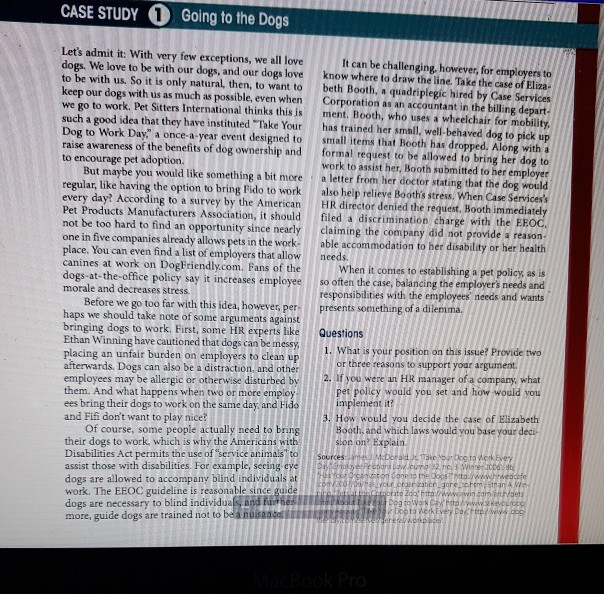
Read Case Study 1 Going to the Dogs. Answer Question 1: What is your position on this issue? Provide two or three reasons to support your argument in 150 words.
CASE STUDY O Going to the Dogs Let's admit it: With very few exceptions, we all love dogs. We love to be with our dogs, and our dogs love to be with us. So it is only natural, then, to want to keep our dogs with us as much as possible, even when we go to work. Pet Sitters International thinks this is such a good idea that they have instituted "Take Your Dog to Work Day," a once-a-year event designed to raise awareness of the benefits of dog ownership and to encourage pet adoption. But maybe you would like something a bit more regular, like having the option to bring Fido to work every day? According to a survey by the American Pet Products Manufacturers Association, it should not be too hard to find an opportunity since nearly one in five companies already allows pets in the work place. You can even find a list of employers that allow canines at work on DogFriendly.com, Fans of the dogs-at-the-office policy say it increases employee morale and decreases stress. Before we go too far with this idea, however, per haps we should take note of some arguments against bringing dogs to work. First, some HR experts like Ethan Winning have cautioned that dogs can be messy placing an unfair burden on employers to clean up afterwards. Dogs can also be a distraction, and other employees may be allergic or otherwise disturbed by them. And what happens when two or more employ ees bring their dogs to work on the same day, and Fido and Fifi don't want to play nice? Of course, some people actually need to bring their dogs to work, which is why the Americans with Disabilities Act permits the use of service animals to assist those with disabilities. For example, seeing eye D dogs are allowed to accompany blind individuals at work. The EEOC guideline is reasonable since guide dogs are necessary to blind individuals and further more, guide dogs are trained not to be a nusante It can be challenging, however, for employers to know where to draw the line. Take the case of Eliza beth Booth, a quadriplegic hired by Case Services Corporation as an accountant in the billing departe ment. Booth, who uses a wheelchair for mobility, has trained her small, well-behaved dog to pick up small items that Booth has dropped. Along with a formal request to be allowed to bring her dog to work to assist her, Booth submitted to her employer letter from her doctor stating that the dog would also help relieve Boothis stress. When Case Services's HR director denied the request. Hooth immediately filed a discrimination charge with the EROC. claiming the company did not provide a reason able accommodation to her disability or her health needs. When it comes to establishing a pet policy, as is so often the case, balancing the employer's needs and responsibilities with the employees' needs and wants presents something of a dilenima. Questions 1. What is your position on this issue? Provide two or three reasons to support your argument. 2. If you were an HR manager of a company, what pet policy would you set and how would you implement it? 3. How would you decide the case of Elizabeth Booth, and which laws would you base your deci sion on? Explain sources armes McDonald Take og ta verk Evey o nors wonen Winter c on Gone to the otwheels Wacroaree gore, come d .merate at www.win.com /gets Degro Work Day' www.ke TH D Verk Every Dachttp:/ww... PareceStep by Step Solution
There are 3 Steps involved in it
1 Expert Approved Answer
Step: 1 Unlock

Question Has Been Solved by an Expert!
Get step-by-step solutions from verified subject matter experts
Step: 2 Unlock
Step: 3 Unlock
 Study Help