



Question: Read Case study 12.1 Visitor Management in Bhutan, in your text. Think about the positive and negative social, environmental and economic impacts of tourism. Which
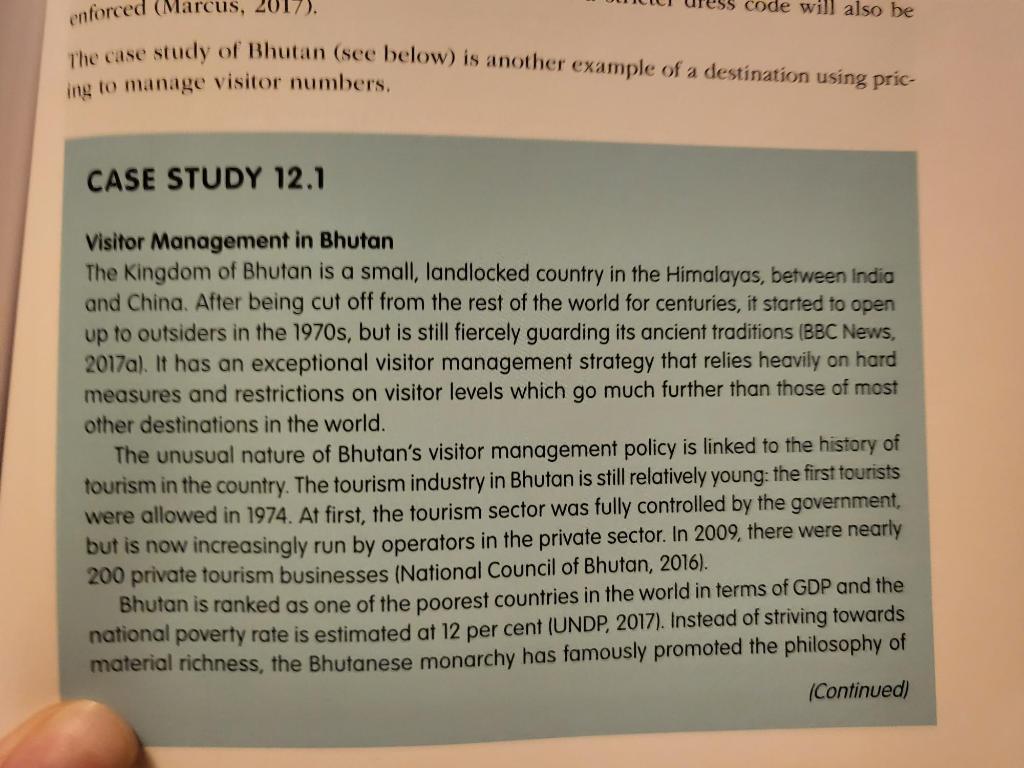
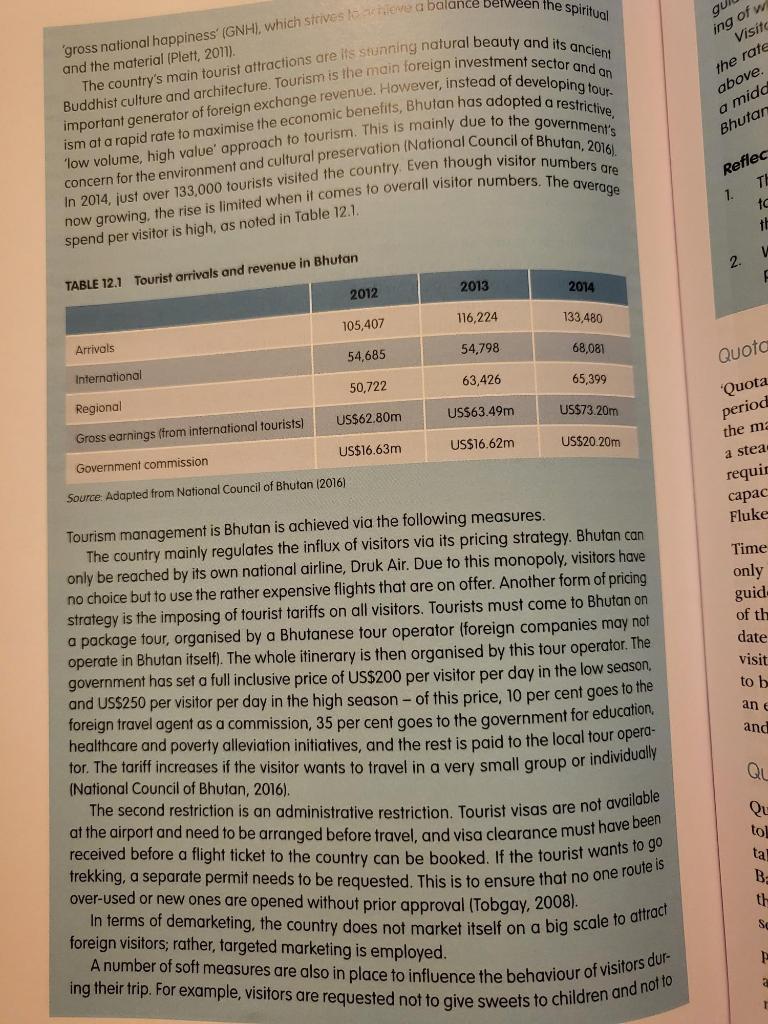
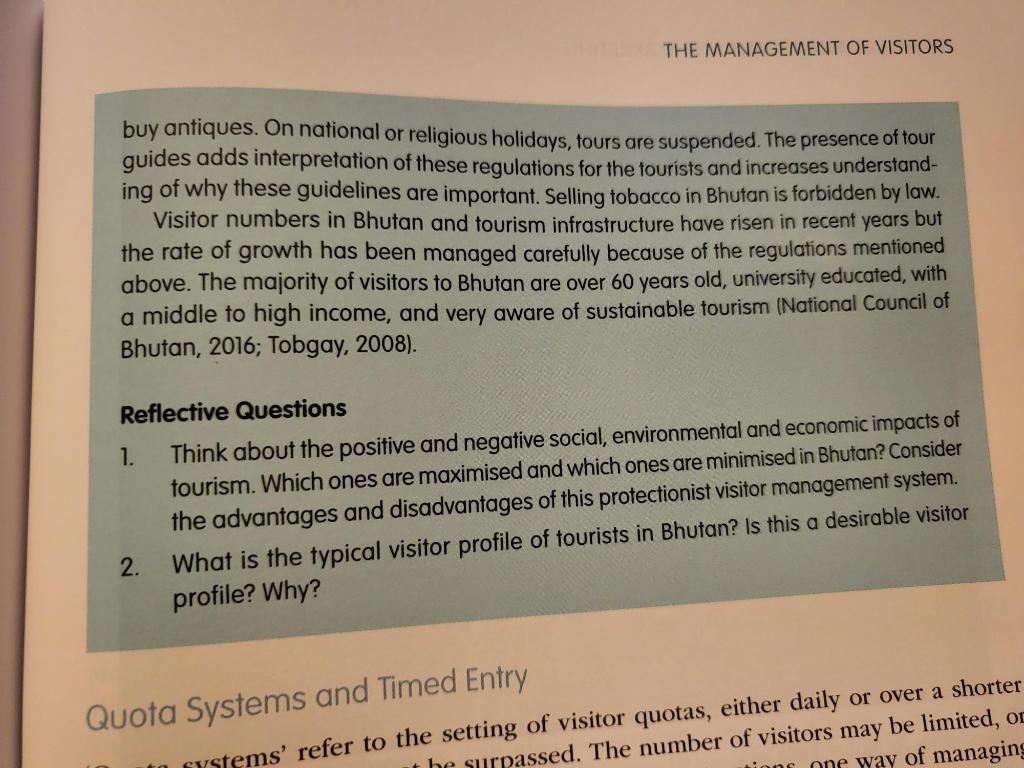
- Read Case study 12.1 Visitor Management in Bhutan, in your text.
- Think about the positive and negative social, environmental and economic impacts of tourism. Which ones are maximized, and which ones are minimized in Bhutan? Consider the advantages and disadvantages of the protectionist visitor management system.
- What is the typical visitor profile of tourists in Bhutan? Is this a desirable visitor profile? Why?
enforced (Marcus, 201 code will also be The case study of Bhutan (see below) is another example of a destination using pric- ing to manage visitor numbers. CASE STUDY 12.1 Visitor Management in Bhutan The Kingdom of Bhutan is a small, landlocked country in the Himalayas, between India and China. After being cut off from the rest of the world for centuries, it started to open up to outsiders in the 1970s, but is still fiercely guarding its ancient traditions (BBC News, 2017a). It has an exceptional visitor management strategy that relies heavily on hard measures and restrictions on visitor levels which go much further than those of most other destinations in the world. The unusual nature of Bhutan's visitor management policy is linked to the history of tourism in the country. The tourism industry in Bhutan is still relatively young: the first tourists were allowed in 1974. At first, the tourism sector was fully controlled by the government, but is now increasingly run by operators in the private sector. In 2009, there were nearly 200 private tourism businesses (National Council of Bhutan, 2016). Bhutan is ranked as one of the poorest countries in the world in terms of GDP and the national poverty rate is estimated at 12 per cent (UNDP, 2017). Instead of striving towards material richness, the Bhutanese monarchy has famously promoted the philosophy of (Continued) and the material (Plett, 2011). gross national happiness' (GNH), which strives to achieve a balance between the spiritual The country's main tourist attractions are its stunning natural beauty and its ancient Buddhist culture and architecture. Tourism is the main foreign investment sector and an important generator of foreign exchange revenue. However, instead of developing tour- ism at a rapid rate to maximise the economic benefits, Bhutan has adopted a restrictive, 'low volume, high value' approach to tourism. This is mainly due to the government's concern for the environment and cultural preservation (National Council of Bhutan, 2016), In 2014, just over 133,000 tourists visited the country. Even though visitor numbers are now growing, the rise is limited when it comes to overall visitor numbers. The average spend per visitor is high, as noted in Table 12.1. TABLE 12.1 Tourist arrivals and revenue in Bhutan 2012 2013 2014 105,407 116,224 133,480 Arrivals 54,685 54,798 68,081 International 50,722 63,426 65,399 Regional US$62.80m US$63.49m US$73.20m Gross earnings (from international tourists) US$16.63m US$16.62m US$20.20m Government commission Source: Adapted from National Council of Bhutan (2016) Tourism management is Bhutan is achieved via the following measures. The country mainly regulates the influx of visitors via its pricing strategy. Bhutan can only be reached by its own national airline, Druk Air. Due to this monopoly, visitors have no choice but to use the rather expensive flights that are on offer. Another form of pricing strategy is the imposing of tourist tariffs on all visitors. Tourists must come to Bhutan on a package tour, organised by a Bhutanese tour operator (foreign companies may not operate in Bhutan itself). The whole itinerary is then organised by this tour operator. The government has set a full inclusive price of US$200 per visitor per day in the low season, and US$250 per visitor per day in the high season of this price, 10 per cent goes to the foreign travel agent as a commission, 35 per cent goes to the government for education, healthcare and poverty alleviation initiatives, and the rest is paid to the local tour opera- tor. The tariff increases if the visitor wants to travel in a very small group or individually (National Council of Bhutan, 2016). The second restriction is an administrative restriction. Tourist visas are not available at the airport and need to be arranged before travel, and visa clearance must have been received before a flight ticket to the country can be booked. If the tourist wants to go trekking, a separate permit needs to be requested. This is to ensure that no one route is over-used or new ones are opened without prior approval (Tobgay, 2008). In terms of demarketing, the country does not market itself on a big scale to attract foreign visitors; rather, targeted marketing is employed. A number of soft measures are also in place to influence the behaviour of visitors dur- ing their trip. For example, visitors are requested not to give sweets to children and not to qui ing of w Visito the rate above. a midd Bhutan Reflec T 1. 2. to th W F Quota Quota period the ma a stea requir capac Fluke Time only guid. of th date visit to b an e and Qu Qu to ta . th Se a T THIT THE MANAGEMENT OF VISITORS buy antiques. On national or religious holidays, tours are suspended. The presence of tour guides adds interpretation of these regulations for the tourists and increases understand- ing of why these guidelines are important. Selling tobacco in Bhutan is forbidden by law. Visitor numbers in Bhutan and tourism infrastructure have risen in recent years but the rate of growth has been managed carefully because of the regulations mentioned above. The majority of visitors to Bhutan are over 60 years old, university educated, with a middle to high income, and very aware of sustainable tourism (National Council of Bhutan, 2016; Tobgay, 2008). Reflective Questions 1. Think about the positive and negative social, environmental and economic impacts of tourism. Which ones are maximised and which ones are minimised in Bhutan? Consider the advantages and disadvantages of this protectionist visitor management system. What is the typical visitor profile of tourists in Bhutan? Is this a desirable visitor profile? Why? 2. systems' refer to the setting of visitor quotas, either daily or over a shorter the surpassed. The number of visitors may be limited, or tions one way of managing Quota Systems and Timed Entry
Step by Step Solution
There are 3 Steps involved in it
1 Expert Approved Answer
Step: 1 Unlock

Question Has Been Solved by an Expert!
Get step-by-step solutions from verified subject matter experts
Step: 2 Unlock
Step: 3 Unlock