







Question: ***READ INSTRUCTIONS BELOW CAREFULLY PLEASE. C++ ONLY*** Trying to build a pig dice game but my code is breaking and I need help finishing. Here
***READ INSTRUCTIONS BELOW CAREFULLY PLEASE. C++ ONLY***
Trying to build a pig dice game but my code is breaking and I need help finishing. Here are the error codes:
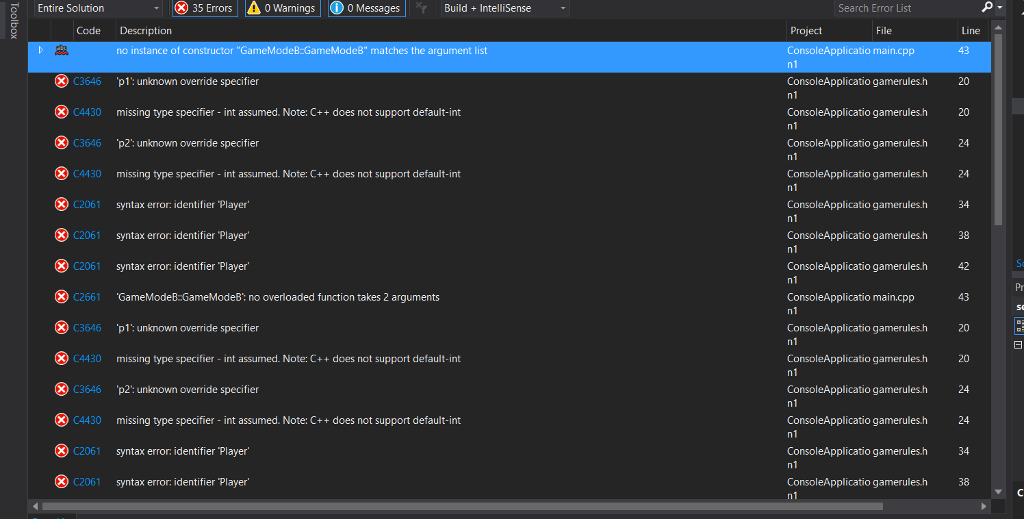
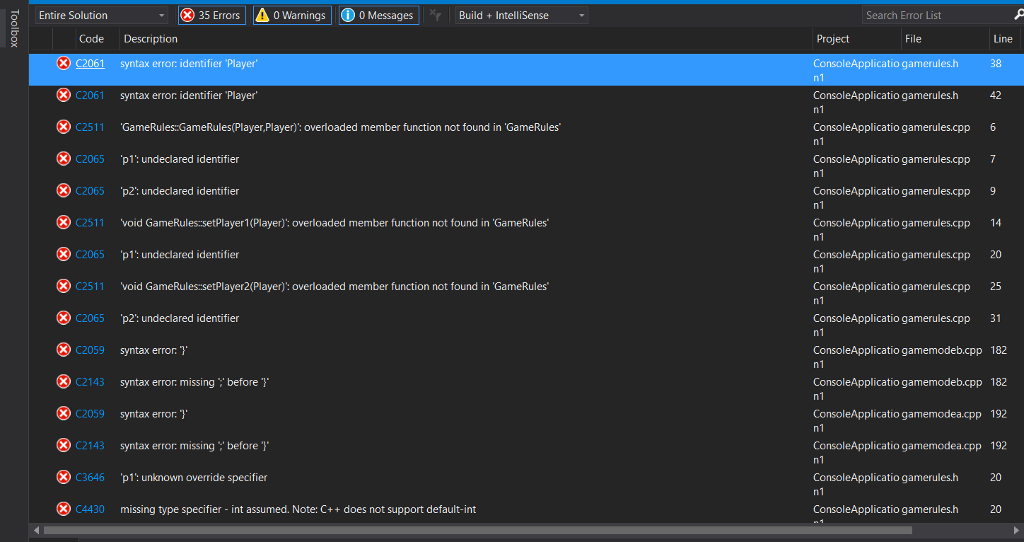
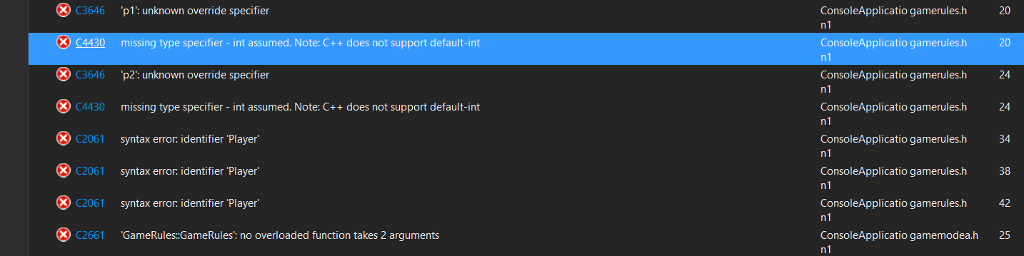
The game will first ask the user to pick between game A or game B. Then will proceed to have players 1 & 2 (HUMAN CONTROLLED, NO CP's) roll (for example, player one will have the option of rolling until they hit a 1 or snake eyes. If they choose to hold, it will go to player 2), while keeping track of the score.
*I also need all the "cout" statements in the classes to be placed into main instead of in the classes, but unsure of how to do it.
*For game A (one dice game), if player 1 or 2 rolls a 1, their score goes back to 0.
*For game B (two dice game), if player 1 or 2 rolls snake eyes (two 1's) OR rolls a 1, their score goes back to 0.
Here is my code:
GameRules.h:
#pragma once #include "Player.h" #include "Dice.h" #include using namespace std; class GameRules { //define protected variables protected: //define two players //define player 1 Player p1; //define player 2 Player p2; //define public variables public: //constructor of game rules //passing two player in parameter GameRules(Player a, Player b); //setter for player one void setPlayer1(Player a); //setter for player two void setPlayer2(Player b); //create virtual function play virtual void play() = 0; };GameRules.cpp:
#include "Player.h" //set both player to a and b GameRules::GameRules(Player a, Player b) { p1 = a; p2 = b; } void GameRules::setPlayer1(Player a) { //setting p1 to a //calling overloaded = operator here p1 = a; } void GameRules::setPlayer2(Player b) { //setting p2 to b //calling overloaded = operator here p2 = b; }GameModeA.h:
#include "GameRules.h" //define game mode a that extends game rules class GameModeA : public GameRules { //adding dice to the private member private: //adding dice d1 Dice d1; //define public methods to the class dice public: //adding gamemode a constructor //calling parent constructor as well by doing : gameRules(a,b) GameModeA(Player a, Player b) : GameRules(a, b) {} //define virtual function play definition here void play(); };GameModeA.cpp:
#include "GameRules.h" #include "GameModeA.h" #include "Player.h" #include "Dice.h" void GameModeA::play() { //set player one turn to true p1.Turn(true); int n; char playerChoice; //loop until it's player one turn while (p1.Turn()) { //print score of player one cout > playerChoice; //change choice to upper case playerChoice = (toupper(playerChoice)); //check if choice is H if (playerChoice == 'H') { //set player one turn to false p1.Turn(false); //set player two turn to true p2.Turn(true); //output player one name and score cout > playerChoice; playerChoice = (toupper(playerChoice)); if (playerChoice == 'H') { p2.Turn(false); p1.Turn(true); cout p2.Score()) { //print player one win cout GameModeB.h:
#pragma once #include "GameRules.h" // game mode b extends gameRules //this is second child class class GameModeB : public GameRules { private: //having two dice in game mode B Dice d1; Dice d2; public: //constructor player a and b : calling parent class constructor also //GameModeB() :GameRules(a, b) {} //declare gamemodeB play definition void play(); }; GameModeB.cpp:
#include "GameModeB.h" #include "GameModeA.h" #include "Player.h" #include "Dice.h" void GameModeB::play() { //set player one turn to true p1.Turn(true); int n, n1; char playerChoice; //while player one turn while (p1.Turn()) { //print score cout > playerChoice; //convert choice to upper case playerChoice = (toupper(playerChoice)); //if choice is H if (playerChoice == 'H') { //set player one turn to false p1.Turn(false); //set player two turn to true p2.Turn(true); cout > playerChoice; playerChoice = (toupper(playerChoice)); if (playerChoice == 'H') { p2.Turn(false); p1.Turn(true); cout p2.Score()) { cout Player.h:
#pragma once #include #include "GameRules.h" #include "Dice.h" //declare player class class Player { private: //define name to store player name std::string name; //turn will decide whose turn is it bool turn; //store score of player int score; public: //constructor of player using name field Player(std::string name); //default constructor of class player Player(); //copy constructor of player //it will set current player to the one what is passing in parameter Player(const Player &p); //overriding = operator to assign player value to calling object //passing player as const so that cannot change value of p Player& operator=(const Player &p); //setter for name void setName(std::string n); //setter for score void Score(int sc); //getter for store. const so that cannot change value of score int Score()const; //set turn void Turn(bool t); //get the turn. const so that cannot change turn bool Turn()const; //getter of the name std::string Name()const; }; Player.cpp:
#include "Player.h" Player::Player(std::string name) { //set class name to parameter name this->name = name; //set turn to false initially turn = false; //set score to 0 score = 0; } //default constructor of class player Player::Player() { //set name to x name = "X"; //set turn to false turn = false; //set score to 0 score = 0; } //copy constructor of player //it will set current player to the one what is passing in parameter Player::Player(const Player &p) { //set this class pointer to the address of player p *this = p; } //overriding = operator to assign player value to calling object //passing player as const so that cannot change value of p Player& Player::operator=(const Player &p) { //set name to p name name = p.name; //set turn to p turn turn = p.turn; //set score to p score score = p.score; //return calling object reference return *this; } //setter for name void Player::setName(std::string n) { //set name to n name = n; } //setter for score void Player::Score(int sc) { //set score to sc score = sc; } //getter for store. const so that cannot change value of score int Player::Score()const { //RETURN SCORE return score; } //set turn void Player::Turn(bool t) { //set turn to t turn = t; } //get the turn. const so that cannot change turn bool Player::Turn()const { //return turn return turn; } //getter of the name std::string Player::Name()const { return name; } Dice.h:
#pragma once #include #include "Player.h" #include "GameRules.h" //declare class dice class Dice { public: //declare function roll for class dice int roll(); }; Dice.cpp:
#include "Dice.h" #include "GameModeA.h" #include "GameModeB.h" int Dice::roll() { //declare integer to store random number int randInteger; //setting random time to stop execution srand(static_cast(time(0))); //store value to rand integer //range will be 1 to 6 randInteger = (int)(1 + rand() % (6 - 1 + 1)); return randInteger; } main.cpp:
#include #include #include "GameRules.h" #include "GameModeA.h" #include "GameModeB.h" #include "Player.h" #include "Dice.h" using namespace std; int main() { char gameChoice; cout > gameChoice; gameChoice = (toupper(gameChoice)); if (gameChoice == 'E') { cout > s1; p1.setName(s1); cout > s1; p2.setName(s1); if (gameChoice == 'A') { GameModeA g(p1, p2); g.play(); } else if (gameChoice == 'B') { GameModeB g(p1, p2); g.play(); } else { cout Entire Solution 8:5 Errors ? o warnings | 0 MessagesI xr Build +IntelliSense Search Error List Code Description File no instance of constructor argument icatio main.cpp C3646 p:unknown override specifier C4430 missing type specifier- int assumed. Note: C++ does not support default-int C 3646 .p2': unknown override specifier C4430 missing type specifier-int assumed. Note: C++ does not support default-int ConsoleApplicatio gamerulesh ConsoleApplicatio gamerules.h 20 ConsoleApplicatio gamerules.h 24 ConsoleApplicatio gamerules.h 24 ConsoleApplicatio gamerules.h ConsoleApplicatio gamerulesh ConsoleApplicatio gamerules.h ConsoleApplicatio main.cpp ConsoleApplicatio gamerulesh 20 ConsoleApplicatio gamerules.h 20 ConsoleApplicatio gamerulesh 24 ConsoleApplicatio gamerules.h 24 ConsoleApplicatio gamerules.h ConsoleApplicatio gamerules.h C2061 C2061 syntax error: identifier Player C2061 syntax error: identifier Player" C2661 GameModeB-GameModeB: no overloaded function takes 2 arguments C3646 p:unknown override specifier syntax error: identifier Player' 38 ? ( 4430 missing type specifier-int assumed. Note: C++ does not support default-int C3646 'p2:unknown override specifier C4430 missing type specifier - int assumed. Note: C++ does not support default-int C2061 syntax error: identifier Player C2061 syntax error: identifier-player. 34 38 Entire Solution 8:5 Errors ? o warnings | 0 MessagesI xr Build +IntelliSense Search Error List Code Description File no instance of constructor argument icatio main.cpp C3646 p:unknown override specifier C4430 missing type specifier- int assumed. Note: C++ does not support default-int C 3646 .p2': unknown override specifier C4430 missing type specifier-int assumed. Note: C++ does not support default-int ConsoleApplicatio gamerulesh ConsoleApplicatio gamerules.h 20 ConsoleApplicatio gamerules.h 24 ConsoleApplicatio gamerules.h 24 ConsoleApplicatio gamerules.h ConsoleApplicatio gamerulesh ConsoleApplicatio gamerules.h ConsoleApplicatio main.cpp ConsoleApplicatio gamerulesh 20 ConsoleApplicatio gamerules.h 20 ConsoleApplicatio gamerulesh 24 ConsoleApplicatio gamerules.h 24 ConsoleApplicatio gamerules.h ConsoleApplicatio gamerules.h C2061 C2061 syntax error: identifier Player C2061 syntax error: identifier Player" C2661 GameModeB-GameModeB: no overloaded function takes 2 arguments C3646 p:unknown override specifier syntax error: identifier Player' 38 ? ( 4430 missing type specifier-int assumed. Note: C++ does not support default-int C3646 'p2:unknown override specifier C4430 missing type specifier - int assumed. Note: C++ does not support default-int C2061 syntax error: identifier Player C2061 syntax error: identifier-player. 34 38
Step by Step Solution
There are 3 Steps involved in it

Get step-by-step solutions from verified subject matter experts
 Study Help