







Question: Read Introduction to Systems Thinking by Daniel H. Kim.Watch the YouTube video: Goal Seeking with Delay ArchetypeRun the Balancing Loop simulation: https://insightmaker.com/insight/98893/Clone-of-Balancing-Loop-with-Delay (Note: Some browser
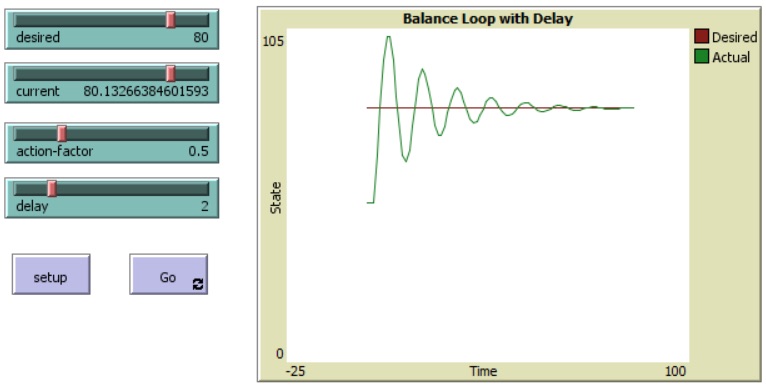
Read Introduction to Systems Thinking by Daniel H. Kim.Watch the YouTube video: Goal Seeking with Delay ArchetypeRun the Balancing Loop simulation: https://insightmaker.com/insight/98893/Clone-of-Balancing-Loop-with-Delay (Note: Some browser might have issues. I suggest that you use Google Chrome, if the simulation won't run). Once the model is open, click on the button "Step Forward" at the lower right corner.Reflect on what you observed. Does it make sense that corrective actions may make things worse when there is significant delay? How does the "action factor" impact the system behavior?After you finish "Step Forward", click on the "Exit Story" button at the lower left. Now you should see the "Simulation" button appear at the upper left. Change the parameter in the right pane. For example, change the "action-factor" to 0.8 and "time delay" to 2. Then click on "Simulation" at the upper left.Download and install NetLogo at: https://ccl.northwestern.eduetlogo/download.shtml (Note: You don't need to enter name, email, etc., just click Download).Download the NetLogo program: Balance Loop with DelayIf you have NetLogo installed successfully, you should be able to double click on the downloaded file name to launch NetLogo.There are 4 sliders that you use to change the parameters. Click on "setup" and the "Go" to run the program. Click on "Go" again to stop it.Optional: Click on the "Code" tap at the upper left to see the code. Click on "Interface" to get back to the program interface.balancing-loopYour challenge: Come up with a scenario in business where product/service quantity/quality shows a gap between the desired level and the actual level. Corrective measures will be taken to reach the desired target. However, there are implementation or delivery delays. Your scenario should be as close to a real world problem as possible.Example: Inventory Management. You have a desired safety stock level, say 80 units. But the current inventory is only 50 units. If you use an "action-factor" of 0.5 and a "delay" of 2 days. It will take you nearly 80 days to have the system stabilized at the 80 units level, as shown in the picture above.Modify the current the program interface: Right click on a slider, say, "desired", you will be able to select "Edit" and change the parameters to meet your need. For example, if you are desiring 50% market share, the range of "desired market" could be 0.0 to 1.0. Then, of course, your "current" market must be in the range of 0.0 and 1.0. (Perhaps for antitrust reasons, we don't want to have the market share to be too high)Run the simulation with various parameter settings in your chosen scenario and answer the following questions:What is the business scenario/problem?Under what conditions the system is stable (converging to the target)?Under what conditions the system is unstable (out of control)?Is the balancing loop with delay simulation realistic in your chosen scenario?Does the simulation help you to gain any insights about the business scenario?What have you learned from the reading of Introduction to Systems Thinking and the simulation?
Step by Step Solution
There are 3 Steps involved in it

Get step-by-step solutions from verified subject matter experts
 Study Help