Question: READ Knowing the different ways to solve a quadratic equation can help us determine key aspects of the graph of the quadratic. Sometimes, converting from
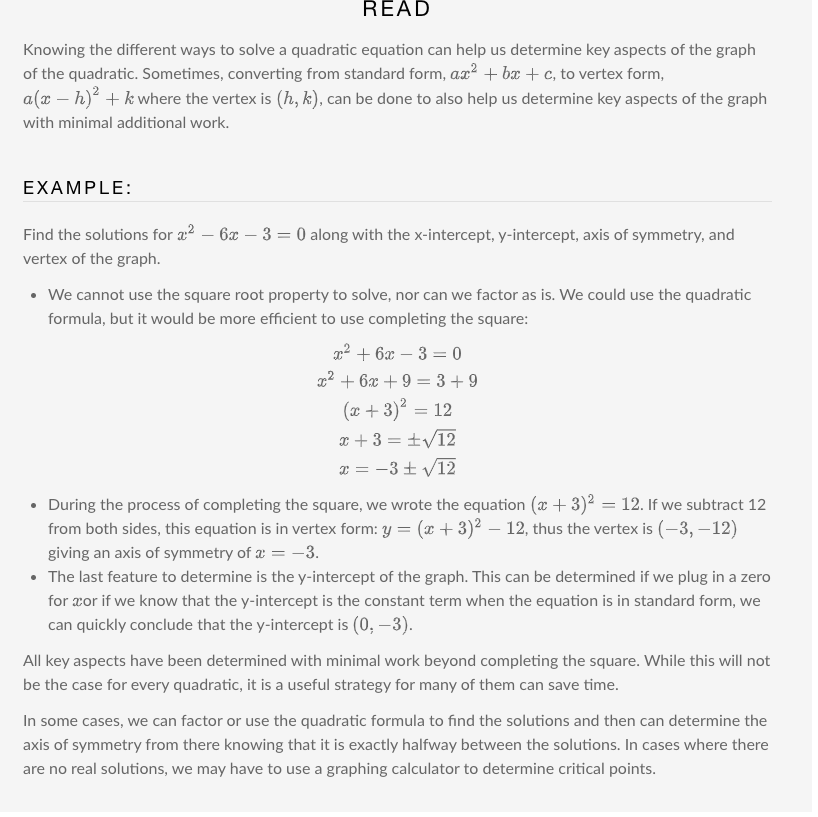
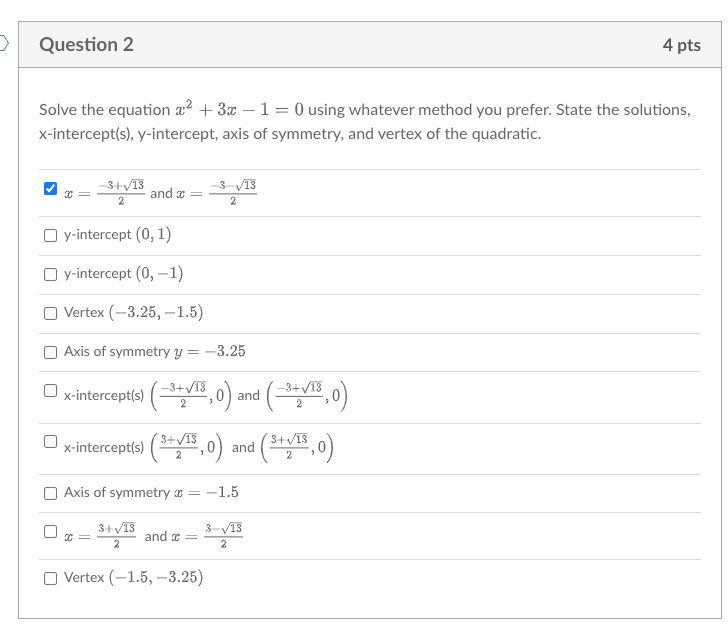
READ Knowing the different ways to solve a quadratic equation can help us determine key aspects of the graph of the quadratic. Sometimes, converting from standard form1 m2 + Em + c, to vertex form, d[:r. .31)? l k where the vertex is (h, is], can be done to also help us determine key aspects of the graph with minimal additional work. EXAMPLE: Find the solutions for 3:2 5m 3 : [I along with the xintercept, yintercept, axis of symmetry, and vertex of the graph. - We cannot use the square root property to solve, nor can we factor as is. We could use the quadratic formula, but it would be more efcient to use completing the square: m2+m3: xz+$+9=3+9 {m+3}2=12 m+3=im mzEix/ - During the process of completing the square, we wrote the equation [11: + 3)2 : 12. If we subtract 12 from both sides, this equation is in vertex form: 3: = (II: + 3F 12, thus the vertex is {3, 12} giving an axis of symmetry of :L' = 3. . The last feature to determine is the yintercept of the graph. This can be determined if we plug in a zero for mor if we know that the y-intercept is the constant term when the equation is in standard form, we can quickly conclude that the yintercept is [[1, 3}. All key aspects have been determined with minimal work beyond completing the square. While this will not be the case for every quadratic, it is a useful strategy for many of them can save time. In some cases, we can factor or use the quadratic formula to find the solutions and then can determine the axis of symmetry from there knowing that it is exactly halfway between the solutions. In cases where there are no real solutions, we may have to use a graphing calculator to determine critical points. Question 2 4 pts Solve the equation 2 + 3x - 1 = 0 using whatever method you prefer. State the solutions, x-intercept(s), y-intercept, axis of symmetry, and vertex of the quadratic. -3+V13 - and c = - -3-V13 2 2 O y-intercept (0, 1) O y-intercept (0, -1) O Vertex (-3.25, -1.5) O Axis of symmetry y = -3.25 x-intercept(s) (234,vis, 0) and (-3(913 , 0) x-intercept(s) ( 3+v13 2 ,0) and ( 3+w/15 , 0) O Axis of symmetry a = -1.5 Ox- 3+v13 3-V13 2 and o = 2 O Vertex (-1.5, -3.25)
Step by Step Solution
There are 3 Steps involved in it
1 Expert Approved Answer
Step: 1 Unlock
Question Has Been Solved by an Expert!
Get step-by-step solutions from verified subject matter experts
Step: 2 Unlock
Step: 3 Unlock
Students Have Also Explored These Related Mathematics Questions!









 Study Help