







Question: READ ONLY - This is an older file forma... Assignment 1- 7% of total grade The Long-Gun Registry in Canada Chapter 1 introduces the roles
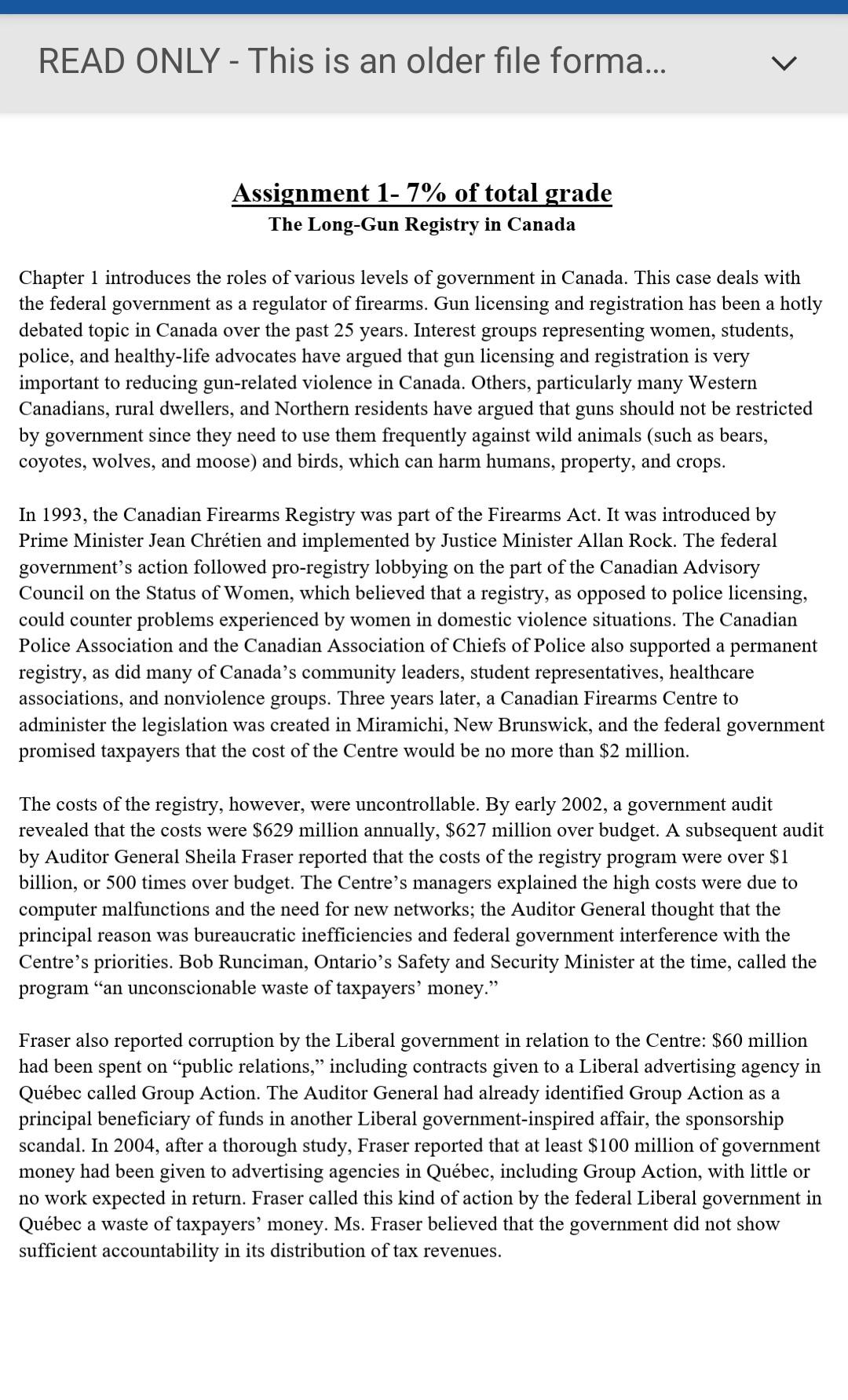
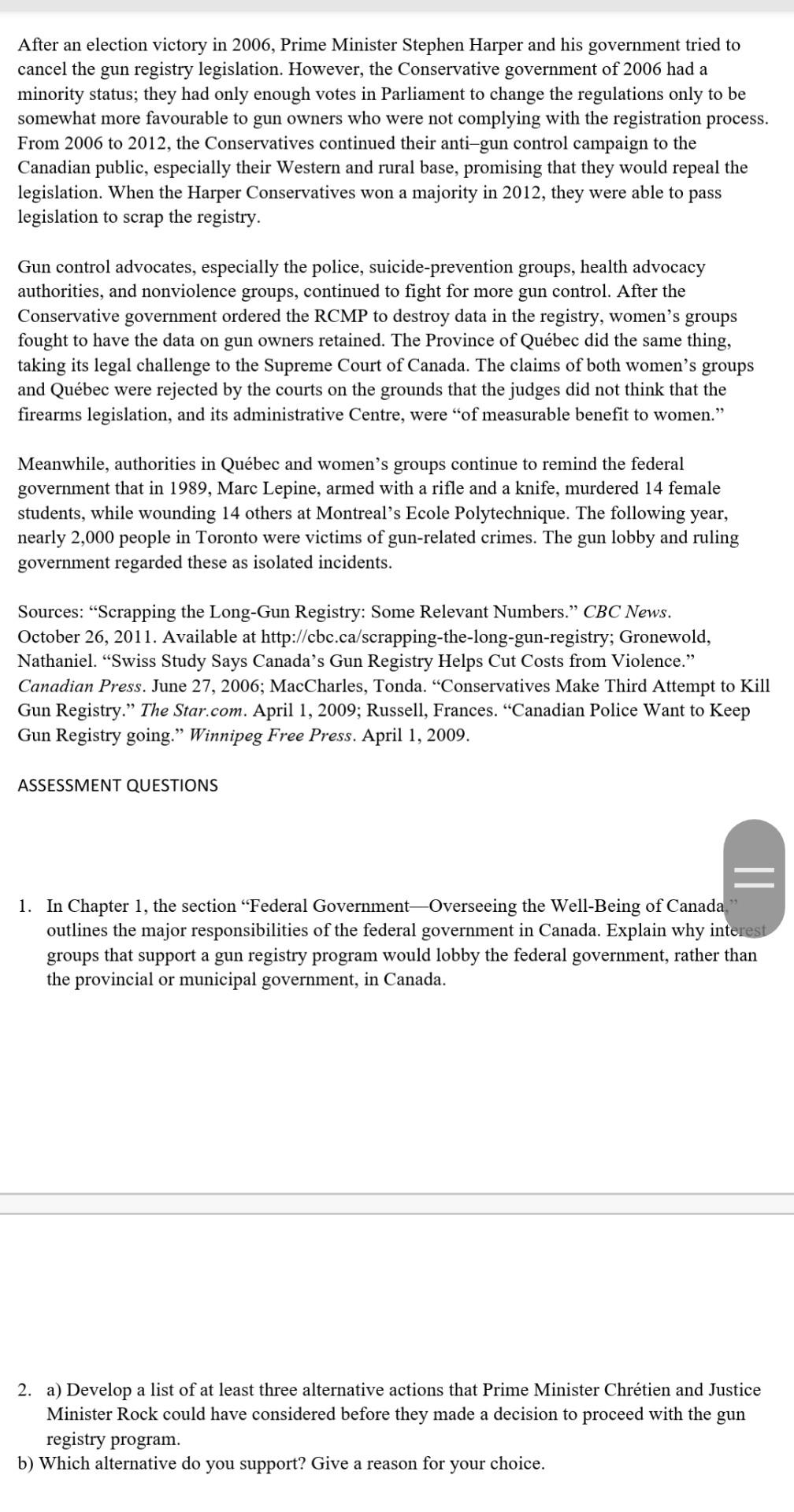
READ ONLY - This is an older file forma... Assignment 1- 7% of total grade The Long-Gun Registry in Canada Chapter 1 introduces the roles of various levels of government in Canada. This case deals with the federal government as a regulator of firearms. Gun licensing and registration has been a hotly debated topic in Canada over the past 25 years. Interest groups representing women, students, police, and healthy-life advocates have argued that gun licensing and registration is very important to reducing gun-related violence in Canada. Others, particularly many Western Canadians, rural dwellers, and Northern residents have argued that guns should not be restricted by government since they need to use them frequently against wild animals (such as bears, coyotes, wolves, and moose) and birds, which can harm humans, property, and crops. In 1993, the Canadian Firearms Registry was part of the Firearms Act. It was introduced by Prime Minister Jean Chrtien and implemented by Justice Minister Allan Rock. The federal government's action followed pro-registry lobbying on the part of the Canadian Advisory Council on the Status of Women, which believed that a registry, as opposed to police licensing, could counter problems experienced by women in domestic violence situations. The Canadian Police Association and the Canadian Association of Chiefs of Police also supported a permanent registry, as did many of Canada's community leaders, student representatives, healthcare associations, and nonviolence groups. Three years later, a Canadian Firearms Centre to administer the legislation was created in Miramichi, New Brunswick, and the federal government promised taxpayers that the cost of the Centre would be no more than $2 million. The costs of the registry, however, were uncontrollable. By early 2002, a government audit revealed that the costs were $629 million annually, $627 million over budget. A subsequent audit by Auditor General Sheila Fraser reported that the costs of the registry program were over $1 billion, or 500 times over budget. The Centre's managers explained the high costs were due to computer malfunctions and the need for new networks; the Auditor General thought that the principal reason was bureaucratic inefficiencies and federal government interference with the Centre's priorities. Bob Runciman, Ontario's Safety and Security Minister at the time, called the program an unconscionable waste of taxpayers' money." Fraser also reported corruption by the Liberal government in relation to the Centre: $60 million had been spent on "public relations, including contracts given to a Liberal advertising agency in Qubec called Group Action. The Auditor General had already identified Group Action as a principal beneficiary of funds in another Liberal government-inspired affair, the sponsorship scandal. In 2004, after a thorough study, Fraser reported that at least $100 million of government money had been given to advertising agencies in Qubec, including Group Action, with little or no work expected in return. Fraser called this kind of action by the federal Liberal government in Qubec a waste of taxpayers' money. Ms. Fraser believed that the government did not show sufficient accountability in its distribution of tax revenues. After an election victory in 2006, Prime Minister Stephen Harper and his government tried to cancel the gun registry legislation. However, the Conservative government of 2006 had a minority status; they had only enough votes in Parliament to change the regulations only to be somewhat more favourable to gun owners who were not complying with the registration process. From 2006 to 2012, the Conservatives continued their anti-gun control campaign to the Canadian public, especially their Western and rural base, promising that they would repeal the legislation. When the Harper Conservatives won a majority in 2012, they were able to pass legislation to scrap the registry. Gun control advocates, especially the police, suicide-prevention groups, health advocacy authorities, and nonviolence groups, continued to fight for more gun control. After the Conservative government ordered the RCMP to destroy data in the registry, women's groups fought to have the data on gun owners retained. The Province of Qubec did the same thing, taking its legal challenge to the Supreme Court of Canada. The claims of both women's groups and Qubec were rejected by the courts on the grounds that the judges did not think that the firearms legislation, and its administrative Centre, were "of measurable benefit to women." Meanwhile, authorities in Qubec and women's groups continue to remind the federal government that in 1989, Marc Lepine, armed with a rifle and a knife, murdered 14 female students, while wounding 14 others at Montreal's Ecole Polytechnique. The following year, nearly 2,000 people in Toronto were victims of gun-related crimes. The gun lobby and ruling government regarded these as isolated incidents. Sources: "Scrapping the Long-Gun Registry: Some Relevant Numbers. CBC News. October 26, 2011. Available at http://cbc.ca/scrapping-the-long-gun-registry; Gronewold, Nathaniel. Swiss Study Says Canada's Gun Registry Helps Cut Costs from Violence. Canadian Press. June 27, 2006; MacCharles, Tonda. Conservatives Make Third Attempt to Kill Gun Registry. The Star.com. April 1, 2009; Russell, Frances. Canadian Police Want to keep Gun Registry going. Winnipeg Free Press. April 1, 2009. ASSESSMENT QUESTIONS 1. In Chapter 1, the section Federal Government-Overseeing the Well-Being of Canada outlines the major responsibilities of the federal government in Canada. Explain why interest groups that support a gun registry program would lobby the federal government, rather than the provincial or municipal government, in Canada. 2. a) Develop a list of at least three alternative actions that Prime Minister Chrtien and Justice Minister Rock could have considered before they made a decision to proceed with the gun registry program. b) Which alternative do you support? Give a reason for your choice
Step by Step Solution
There are 3 Steps involved in it
1 Expert Approved Answer
Step: 1 Unlock

Question Has Been Solved by an Expert!
Get step-by-step solutions from verified subject matter experts
Step: 2 Unlock
Step: 3 Unlock
 Study Help