







Question: Read Opp v. Wheaton Van Lines. What could Wheaton Van Lines have done to obligate Mrs. Opp to the contract? Opp v. Wheaton Van Lines,
Read Opp v. Wheaton Van Lines.
What could Wheaton Van Lines have done to obligate Mrs. Opp to the contract?
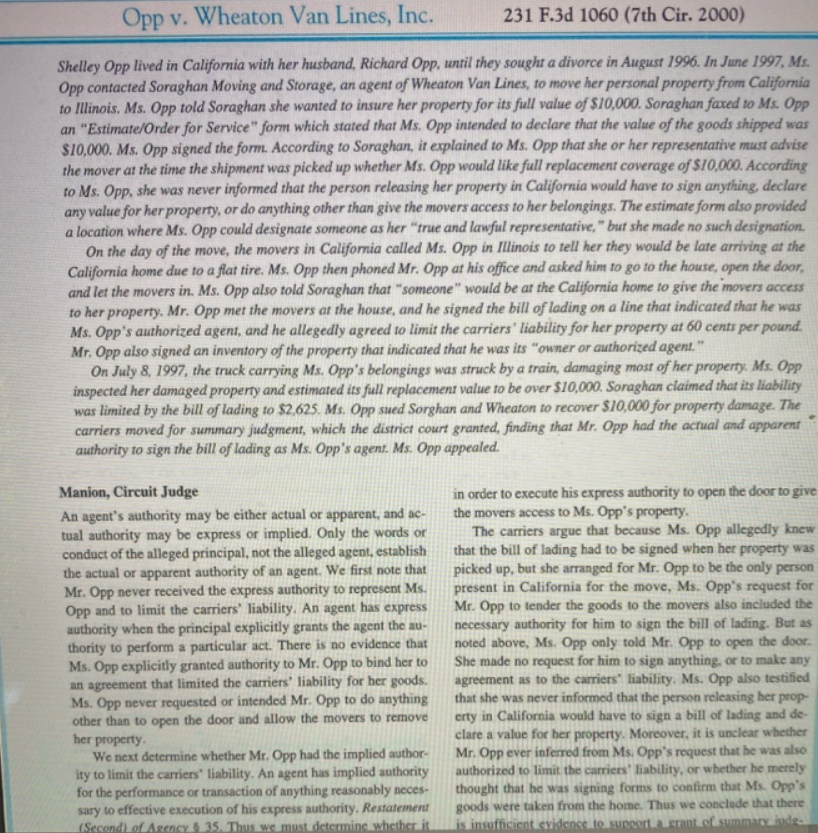
Opp v. Wheaton Van Lines, Inc. 231 F.3d 1060 (7th Cir. 2000) Shelley Opp lived in California with her husband, Richard Opp, until they sought a divorce in August 1996. In June 1997, Ms. Opp contacted Soraghan Moving and Storage, an agent of Wheaton Van Lines, to move her personal property from California to Illinois. Ms. Opp told Soraghan she wanted to insure her property for its full value of $10,000. Soraghan faxed to Ms. Opp an "Estimate/Order for Service" form which stated that Ms. Opp intended to declare that the value of the goods shipped was $10,000. Ms. Opp signed the form. According to Soraghan, it explained to Ms. Opp that she or her representative must advise the mover at the time the shipment was picked up whether Ms. Opp would like full replacement coverage of $10,000. According to Ms. Opp, she was never informed that the person releasing her property in California would have to sign anything, declare any value for her property, or do anything other than give the movers access to her belongings. The estimate form also provided a location where Ms. Opp could designate someone as her "true and lawful representative," but she made no such designation. On the day of the move, the movers in California called Ms. Opp in Illinois to tell her they would be late arriving at the California home due to a flat tire. Ms. Opp then phoned Mr. Opp at his office and asked him to go to the house, open the door, and let the movers in. Ms. Opp also told Soraghan that someone" would be at the California home to give the movers access to her property. Mr. Opp met the movers at the house, and he signed the bill of lading on a line that indicated that he was Ms. Opp's authorized agent, and he allegedly agreed to limit the carriers' liability for her property at 60 cents per pound. Mr. Opp also signed an inventory of the property that indicated that he was its owner or authorized agent." On July 8, 1997, the truck carrying Ms. Opp's belongings was struck by a train, damaging most of her property. Ms. Opp inspected her damaged property and estimated its full replacement value to be over $10,000. Soraghan claimed that its liability was limited by the bill of lading to $2,625. Ms. Opp sued Sorghan and Wheaton to recover $10,000 for property damage. The carriers moved for summary judgment, which the district court granted, finding that Mr. Opp had the actual and apparent authority to sign the bill of lading as Ms. Opp's agent. Ms. Opp appealed. Manion, Circuit Judge An agent's authority may be either actual or apparent, and ac- tual authority may be express or implied. Only the words or conduct of the alleged principal, not the alleged agent, establish the actual or apparent authority of an agent. We first note that Mr. Opp never received the express authority to represent Ms. Opp and to limit the carriers' liability. An agent has express authority when the principal explicitly grants the agent the au- thority to perform a particular act. There is no evidence that Ms. Opp explicitly granted authority to Mr. Opp to bind her to an agreement that limited the carriers' liability for her goods. Ms. Opp never requested or intended Mr. Opp to do anything other than to open the door and allow the movers to remove her property We next determine whether Mr. Opp had the implied author- ity to limit the carriers' liability. An agent has implied authority for the performance or transaction of anything reasonably neces. sary to effective execution of his express authority. Restatement (Second) of Arendy 535. Thus we must determine whether it in order to execute his express authority to open the door to give the movers access to Ms. Opp's property. The carriers argue that because Ms. Opp allegedly knew that the bill of lading had to be signed when her property was picked up, but she arranged for Mr. Opp to be the only person present in California for the move, Ms. Opp's request for Mr. Opp to tender the goods to the movers also included the necessary authority for him to sign the bill of lading. But as noted above, Ms. Opp only told Mr. Opp to open the door. She made no request for him to sign anything, or to make any agreement as to the carriers' liability. Ms. Opp also testified that she was never informed that the person releasing her prop- erty in California would have to sign a bill of lading and de clare a value for her property. Moreover, it is unclear whether Mr. Opp ever inferred from Ms. Opp's request that he was also authorized to limit the carriers' liability, or whether he merely thought that he was signing forms to confirm that Ms. Opp's goods were taken from the home. Thus we conclude that there is insufficient evidence to suncertant of summaryaludeStep by Step Solution
There are 3 Steps involved in it
1 Expert Approved Answer
Step: 1 Unlock

Question Has Been Solved by an Expert!
Get step-by-step solutions from verified subject matter experts
Step: 2 Unlock
Step: 3 Unlock
 Study Help