







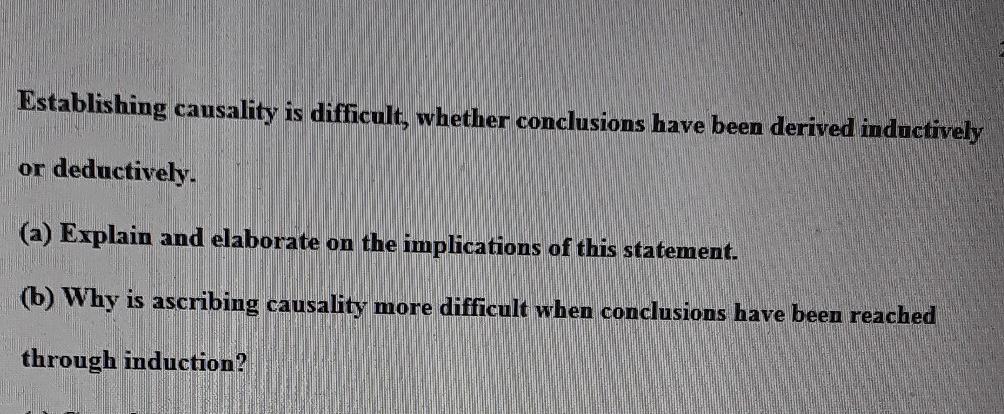
Question: Read part A, and elaborate on this statement? Read part B, and elaborate on this statement? Establishing causality is difficult, whether conclusions have been derived
Read part A, and elaborate on this statement? Read part B, and elaborate on this statement?
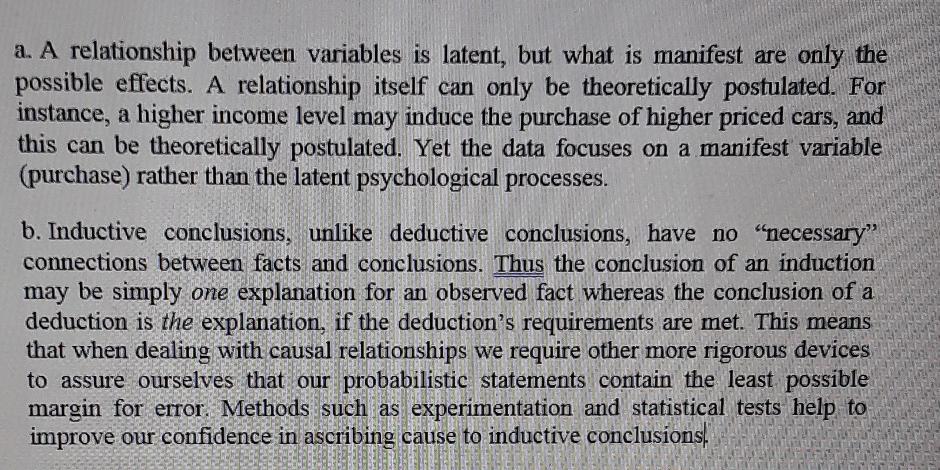
Establishing causality is difficult, whether conclusions have been derived inductively or deductively. (a) Explain and elaborate on the implications of this statement. (b) Why is ascribing causality more difficult when conclusions have been reached through induction? a. A relationship between variables is latent, but what is manifest are only the possible effects. A relationship itself can only be theoretically postulated. For instance, a higher income level may induce the purchase of higher priced cars, and this can be theoretically postulated. Yet the data focuses on a manifest variable (purchase) rather than the latent psychological processes. b. Inductive conclusions, unlike deductive conclusions, have no "necessary connections between facts and conclusions. Thus the conclusion of an induction may be simply one explanation for an observed fact whereas the conclusion of a deduction is the explanation, if the deduction's requirements are met. This means that when dealing with causal relationships we require other more rigorous devices to assure ourselves that our probabilistic statements contain the least possible margin for error. Methods such as experimentation and statistical tests help to improve our confidence in ascribing cause to inductive conclusions
Step by Step Solution
There are 3 Steps involved in it

Get step-by-step solutions from verified subject matter experts
 Study Help