







Question: read the article and answer the questions 1. Writing Assignment: A. After reading Brown v Board of Education and having listened to and reviewed the

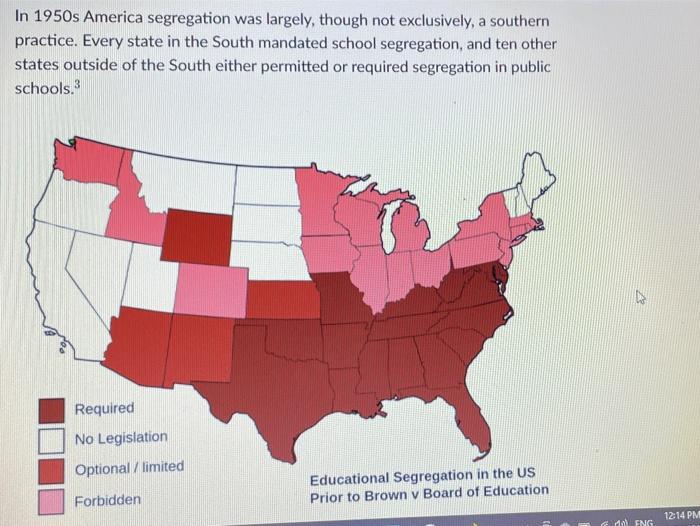
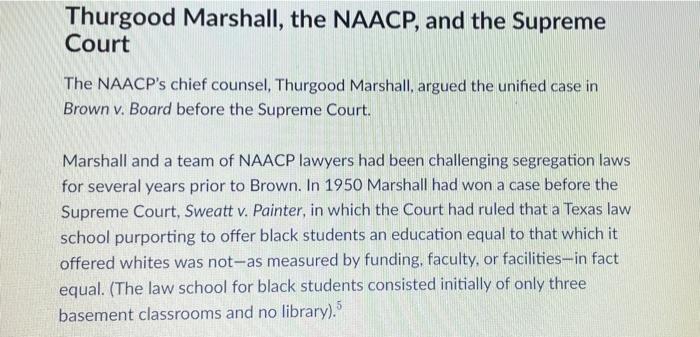
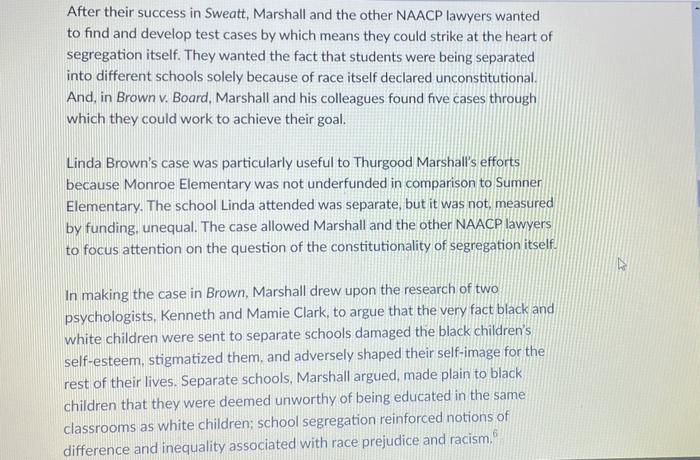
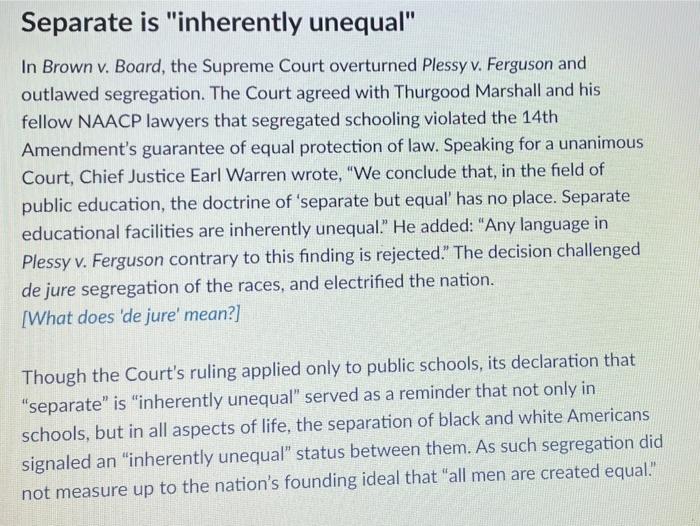
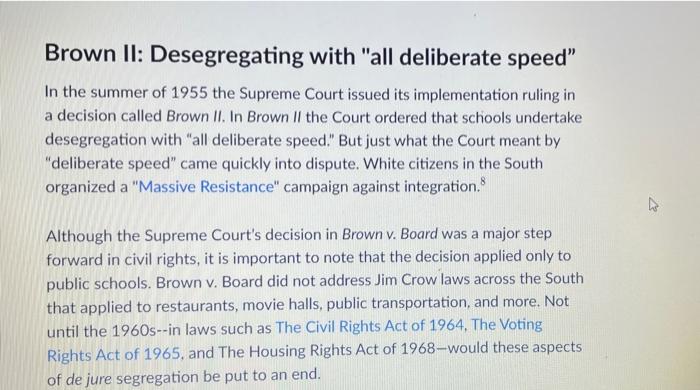
1. Writing Assignment: A. After reading Brown v Board of Education and having listened to and reviewed the links above, answer the following Questions: i. Who are the integral parties of the case? i. What was the main underlying issue of the case? iii . Where did the case originate and where did the case have an impact? iv. When did this case occur but more importantly when did this case achieve its greatest impact? v. Why was this case relevant at the time the Supreme Court issued its ruling? Why is this case important today? vi. If you were a child in 1954, how would this case have impacted you and your education? Requirements: Each question answered in part 7.A. above should be a minimum of 3 to 5 sentences with a maximum of 15 sentences for any question. As you can tell some questions will require less writing than others. While part of your answer may be like other students it is your method of writing that is expected to be different. A segregated society An 1896 Supreme Court decision, Plessyv. Ferguson, had declared "separate but equal" Jim Crow segregation legal. The Plessy ruling asserted that so long as purportedly "equal" accommodations were supplied for African Americans, the races could legally, be separated. In consequence,"colored" and "whites only" signs proliferated across the South at facilities such as water fountains restrooms, bus waiting areas, movie theaters, swimming pools, and public schools. Learn more about Jim Crowl Despite the claim that black schools were equal to white schools, schools for black children frequently lacked even basic necessities. In South Carolina, black children attended schools without running water, flush toilets, or electricity. In one county, $149 was spent per year on each white student, but only $43 on each black student. In Delaware, black students attended a poorly-equipped one-room schoolhouse, while a well-equipped white school existed nearby. In Virginia, a black high school at the center of the case was overcrowded and was without a cafeteria or gym; the same was not true at the local white school. In 1950s America segregation was largely, though not exclusively, a southern practice. Every state in the South mandated school segregation, and ten other states outside of the South either permitted or required segregation in public schools. Required No Legislation Optional / limited Educational Segregation in the US Prior to Brown v Board of Education Forbidden 12:14 PM ENG The Brown v. Board of Education case Linda Brown, a third grader, was required by law to attend a school for black children in her hometown of Topeka, Kansas. To do so, Linda walked six blocks, crossing dangerous railroad tracks, and then boarded a bus that took her to Monroe Elementary. Yet, only seven blocks from her house was Sumner Elementary, a school attended by white children, and which, save for segregation, Linda would otherwise have attended. Her father, Oliver Brown, encouraged by NAACP chief counsel Thurgood Marshall, brought suit against the Topeka school district. The case was named after a lawsuit filed in 1951 by NAACP lawyers against the Topeka, Kansas school district on behalf of Linda Brown and her family. By the time the Brown's case made it to the US Supreme Court in 1954 it had been combined with four other similar school segregation cases into a single unified case. Thurgood Marshall, the NAACP, and the Supreme Court The NAACP's chief counsel, Thurgood Marshall, argued the unified case in Brown v. Board before the Supreme Court. Marshall and a team of NAACP lawyers had been challenging segregation laws for several years prior to Brown. In 1950 Marshall had won a case before the Supreme Court, Sweatt v. Painter, in which the Court had ruled that a Texas law school purporting to offer black students an education equal to that which it offered whites was not-as measured by funding, faculty, or facilities-in fact equal. (The law school for black students consisted initially of only three basement classrooms and no library). After their success in Sweatt, Marshall and the other NAACP lawyers wanted to find and develop test cases by which means they could strike at the heart of segregation itself. They wanted the fact that students were being separated into different schools solely because of race itself declared unconstitutional. And, in Brown v. Board, Marshall and his colleagues found five cases through which they could work to achieve their goal. Linda Brown's case was particularly useful to Thurgood Marshall's efforts because Monroe Elementary was not underfunded in comparison to Sumner Elementary. The school Linda attended was separate, but it was not measured by funding, unequal. The case allowed Marshall and the other NAACP lawyers to focus attention on the question of the constitutionality of segregation itself. In making the case in Brown, Marshall drew upon the research of two psychologists, Kenneth and Mamie Clark, to argue that the very fact black and white children were sent to separate schools damaged the black children's self-esteem, stigmatized them, and adversely shaped their self-image for the rest of their lives. Separate schools, Marshall argued, made plain to black children that they were deemed unworthy of being educated in the same classrooms as white children; school segregation reinforced notions of difference and inequality associated with race prejudice and racism. Separate is "inherently unequal" In Brown v. Board, the Supreme Court overturned Plessyv. Ferguson and outlawed segregation. The Court agreed with Thurgood Marshall and his fellow NAACP lawyers that segregated schooling violated the 14th Amendment's guarantee of equal protection of law. Speaking for a unanimous Court, Chief Justice Earl Warren wrote, "We conclude that, in the field of public education, the doctrine of separate but equal' has no place. Separate educational facilities are inherently unequal." He added: "Any language in Plessy v. Ferguson contrary to this finding is rejected." The decision challenged de jure segregation of the races, and electrified the nation. [What does 'de jure' mean?] Though the Court's ruling applied only to public schools, its declaration that "separate" is "inherently unequal" served as a reminder that not only in schools, but in all aspects of life, the separation of black and white Americans signaled an "inherently unequal" status between them. As such segregation did not measure up to the nation's founding ideal that "all men are created equal." Brown II: Desegregating with "all deliberate speed" In the summer of 1955 the Supreme Court issued its implementation ruling in a decision called Brown II. In Brown II the Court ordered that schools undertake desegregation with "all deliberate speed." But just what the Court meant by "deliberate speed" came quickly into dispute. White citizens in the South organized a "Massive Resistance" campaign against integration. Although the Supreme Court's decision in Brown v. Board was a major step forward in civil rights, it is important to note that the decision applied only to public schools. Brown v. Board did not address Jim Crow laws across the South that applied to restaurants, movie halls, public transportation, and more. Not until the 1960s--in laws such as The Civil Rights Act of 1964. The Voting Rights Act of 1965, and The Housing Rights Act of 1968-would these aspects of de jure segregation be put to an end
Step by Step Solution
There are 3 Steps involved in it

Get step-by-step solutions from verified subject matter experts
 Study Help